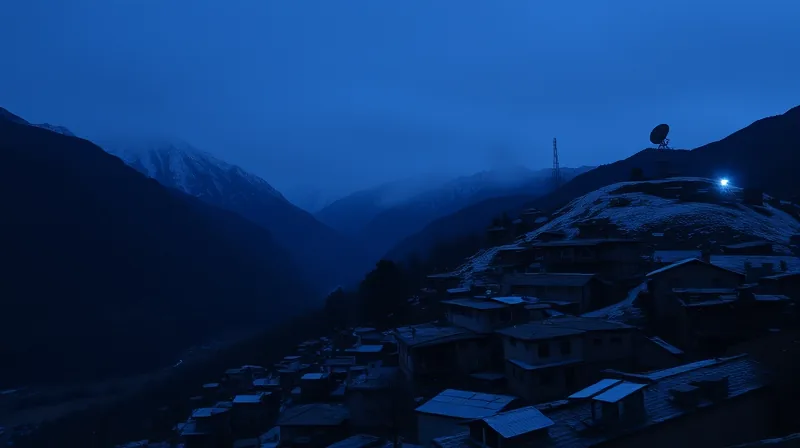
When satellites see danger but warnings fail
The Blind Spot in Our Instrumentation
In August 2026, a glacier collapsed along the Nepal-China border and the resulting flash flood killed people. Satellites had spotted the danger beforehand, yet the warning still failed to reach the communities in time. This single event exposes something uncomfortable: our ability to detect hazards has outrun our ability to act on what we detect. Safdar Bashir and Muhammad Adil of the University of Idaho in Moscow, Idaho, published a correspondence in Nature on 22 September 2026 arguing that this failure is not accidental but structural: the instruments worked, but the systems connecting them to people did not. [1].
The problem has two faces: national monitoring networks are sparse in high-mountain regions, and the hazard itself does not respect the border it crosses. A glacier lake can burst in one country and send water into another within hours. Each nation monitors its own territory. Neither owns the full picture. Bashir and Adil describe this as a “persistent weakness in climate adaptation” — not a one-time technical glitch but a recurring pattern that communities along the Nepal-China border face whenever risks emerge beyond political boundaries. [1]
What makes this case instructive is the sequence: satellites identified the danger, and that detection was real, but detection is not warning. A warning requires someone to receive the signal, interpret it, decide who needs to know, and deliver the message through channels that function when infrastructure is stressed. When monitoring is sparse and the risk crosses borders, each of those steps can stall. The collapse in August did not happen because no one saw it coming; it happened because seeing was never the same as telling.
The Gap Between Detection and Decision
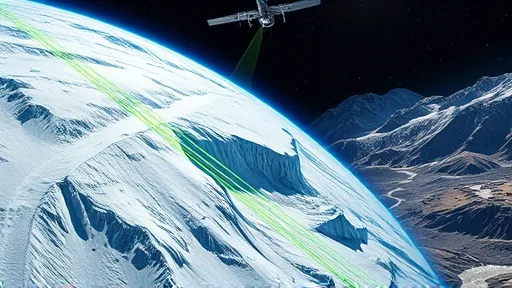
The timeline here is not measured in years of research. It is measured in the hours between a satellite pass and a flood wave. That window is shrinking as glaciers retreat and high-mountain lakes grow. Bashir and Adil point to a specific structural gap: when national monitoring is thin and the hazard itself is transnational, no single authority holds responsibility for the full chain from detection to evacuation. [1] This is not a failure of technology but a failure of arrangement.
The correspondence does not propose a new satellite constellation or a better sensor. It points to collective action as the missing piece. Disaster early-warning systems can succeed — that is not in question. The question is who assembles the pieces when the pieces belong to different governments. The August flood along the Nepal-China border is the most recent demonstration that this question remains unanswered. The satellites did their job. The systems that should have translated their data into human action did not.
The takeaway is not a call for more instruments but the recognition that a warning is a social chain, not a technical one. Each link — detection, interpretation, decision, delivery — must hold. When one link crosses a border and no one owns it, the chain breaks. The August collapse made that visible, and the correspondence makes it explicit.
What This Case Contributes to the Science of Warning
The value of this account lies in what it isolates: it separates detection from response and shows that the two can fail independently. That distinction matters for fundamental research on early-warning systems because it reframes the problem. The question is no longer only “Can we see the hazard?” but “Can we trace the path from seeing to saving?” Bashir and Adil do not offer a solution. They identify the structural condition under which solutions must operate: sparse monitoring, transnational risk, and no single owner of the full warning chain.
This is a contribution to how researchers frame the problem, not a promise of a fix. The August 2026 event along the Nepal-China border will be studied for what it reveals about the limits of current arrangements. The satellites worked; the warning did not. That gap — between what we can measure and what we can act on — is now the subject of formal scientific correspondence, and naming the weakness is the precondition for any collective response that might follow.

Sources
2. Nature — Quote source (original article)