Wildfire Spread Tracked by Listening to Low Frequency Hum
Eyes on a Fire Are Not Enough
In the past, wildfires tended to be spotted by people perched atop lookout stations. The watch was kept by eye alone, and smoke was the sign that mattered. Today, satellites and airborne platforms track most fires, and the view from above is far wider than any single gaze. Yet the newer technology shares the old weakness. Smoke and flames, the classic signals of a fire, can both be obscured. Clouds can block the view, and trees can hide what burns beneath them. “A lot of those things require direct line of sight,” says Cody Evers, an environmental scientist at Portland State University in Oregon who was not involved in the research. [1] To find a fire, you usually had to see it.
Now the watch can use its ears. Researchers report in the July 16 issue of the journal Geophysical Research Letters that a low-intensity grassland fire in Idaho hummed loudly enough to be monitored by sound alone. [2] Acoustic sensors deployed near the prescribed burn picked up the low-frequency rumble the fire gave off and followed where it was burning as it spread. Listening for fires is not entirely new; a prescribed forest fire has previously been detected with similar acoustic monitoring. But that fire burned hotter. The Idaho burn sat in a damp landscape and was therefore low-intensity. The successful tracking of a damp, weak burn matters precisely because the fire was not a fierce one. “That’s encouraging for the broader use” of the technique, says Jake Anderson, a geophysicist at Boise State University in Idaho.
Why would a fire make a sound at all? As it burns, a fire continuously releases plumes of hot gas and draws in cold air. The exchange is called puffing, and it sends pressure waves into the surrounding air. The waves arrive at frequencies between 1 and 20 hertz. Human hearing spans a higher band, roughly 20 to 20,000 hertz, so the fire’s voice sits below the threshold of the ear. A person can stand beside a burn and hear nothing of it while sensors kilometers away register the signal. That is the practical payoff: fast alerts without a clear view. “Infrasound can give you very fast alerts about how a fire is changing,” Anderson says. “And it can do so in poor-visibility conditions.”
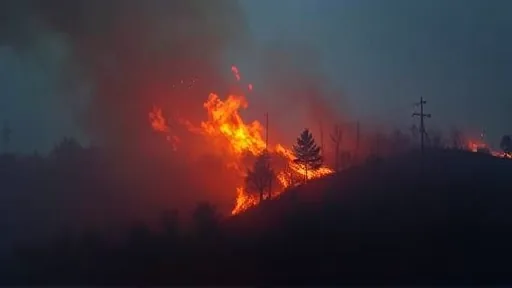
The test began in 2023, on a swath of southwestern Idaho scheduled for a prescribed fire — a burn that land managers set deliberately, under chosen conditions. Anderson and his colleagues placed more than 90 infrasound sensors across the area, designing and building the instruments themselves. Each sensor weighs less than a kilogram and is roughly the size of a paperback book. The sensors were spread across eight arrays, and a single array held anywhere from three to 44 sensors. The arrangement is about direction. Madeline Hunt, a geophysicist at Boise State University, puts it in everyday terms: “With two ears, you can get a better idea of the direction to something, more than if you were just listening with one ear.” With dozens of ears spread over the ground, a faint rumble reveals where it came from. The largest array sat nearly two kilometers from the fire and accurately tracked the fire’s spread over several hours. One doubt had to be cleared: a helicopter was igniting the burn, and the infrasound arrived from the same direction as that helicopter. The signal persisted, however, even after the helicopter left to refuel. That persistence is the proof that the fire itself was humming.
The Wind That Drowns the Signal
Every detection method has a weak point, and the weak point of infrasound may be weather. The warning comes from outside the research team. Cody Evers, the environmental scientist who noted the limits of line of sight, points to wind as the open problem. [1] A listening system that works on a quiet day may find its signal mixed with the wind’s own rumble on a stormy one.
The next step is a wildfire, and a wildfire is a far more difficult setting than a scheduled burn. A scheduled burn comes with a date and a map; a wildfire does not. Anderson notes that researchers may not be able to safely access the terrain where a wildfire burns. A fire that cannot be approached safely cannot easily be fitted with sensors. “In the long run,” Anderson says, “an ideal solution would be to have a technology that’s installable by firefighters themselves.”
The sensors are already small enough to carry; the challenge is turning them into a tool that works without a research team behind it. The 2023 experiment proved the sensors can do their work from a distance; a tool carried by crews would bring the ears closer still.
Sound Spreads Too Thin to Fight
Infrasound may do more than track a fire; a company is trying to make it fight one. No sprinklers need to open, so there is no water damage in a kitchen. Putting out a flame with a low rumble is a striking idea, and the demonstration suggests it works indoors. The outdoors is a different arena.
That is why the company’s success stays where it was shown. The Idaho result tells a different story about the same waves. Infrasound carried news of that fire across nearly two kilometers, and a sensor caught the signal and located the flames. But catching a signal is not the same as delivering a blow. Listening only requires the wave to arrive; extinguishing requires it to arrive with force. “I would be surprised if anytime soon we see a long-range, outdoor infrasound tool for extinguishing fires,” Anderson says. Sound that can be heard across two kilometers cannot necessarily act across them.