Underwater Perovskite Solar Cells Generate Power in Deep Sea
A Material That Should Not Survive Underwater
Solar cells made from perovskites instead of silicon have always involved trade-offs. They can be produced cheaply. They can take unusual forms, such as thin, flexible, transparent films. They can convert a substantially larger share of incoming sunlight into electricity than silicon can. The difficulty is that they tend to degrade quickly. Moisture is especially destructive to perovskites. That makes them a seemingly odd choice for a panel meant to sit underwater.
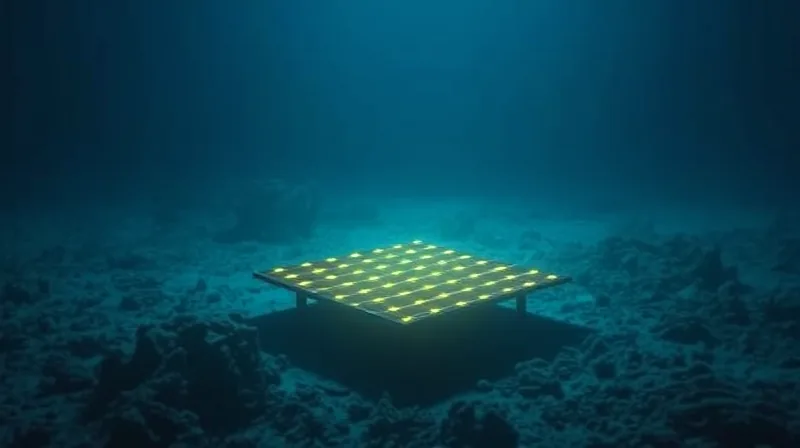
Simin Ma at Yunnan University led a team that pursued both questions at once. The result is an underwater perovskite solar cell that generated 324 milliwatt-hours of electricity at a depth of ten meters in seawater within two hours, mounted on an underwater robot. [1]
The materials side supplies durability. The optics side supplies the reason a perovskite can work where silicon cannot. Neither half alone would produce a functioning deep-sea panel.
Why Blue Light Reaches Deeper Than Silicon Can Follow
Water quickly blocks the wavelengths of light that silicon solar panels absorb. A carefully designed perovskite cell, by contrast, can still make electricity in the deep blue sea. This is possible because perovskites have a critical property: they can be tuned to work with different wavelengths of light. Tuning them requires only tweaking some of their chemistry during production. Getting a cell that absorbs the wavelengths present a few meters deep was therefore not the hard part.
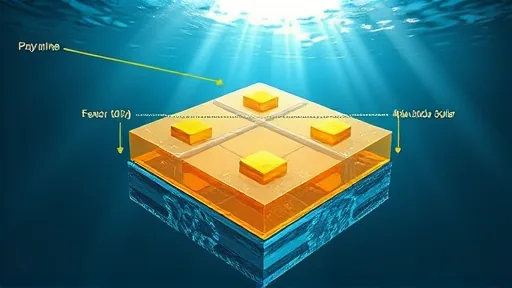
Using test data from a simulated sunlight system at different sea depths, the researchers developed a perovskite cell that can utilize blue to orange light. They then scaled it up. The result is a module in a size that would also be used in commercial projects. At ten meters down, that module produced its 324 milliwatt-hours over two hours. That amount of energy would be sufficient to charge a small lithium-ion battery or power an LED light.
The lower light levels and cooler temperatures at depth should also help the cell live longer. The team states that the module could supply energy at a depth of ten meters in saltwater for about 5.5 years. [1].
The Additive That Keeps the Crystal Alive

The real task was making the cells durable. The team found a particularly effective additive — polyhexamethylene guanidine hydrochloride — that helped in several ways. It built a water-repelling layer around the material. Part of the compound also gets involved with the perovskite crystal lattice, helping larger crystals form and preventing ions from moving around in the lattice structure. The additive limits some of the common ways that perovskites break down while also improving the solar cell’s electricity production.
The potential applications are diverse. Underwater robots performing maintenance on underwater infrastructure could be supplied with power. Communication buoys, underwater cameras, and sensors could also be operated this way. It would likewise be conceivable to provide ships with a kind of power outlet buoy, allowing them to minimize the use of climate-damaging generators. The researchers published their findings in the scientific journal Joule. [2]
In further tests, the researchers aim not only to increase the electricity yield but also to test the maximum depth at which solar systems can generate energy in the sea. China has long been driving large-scale offshore photovoltaic projects to avoid wasting expensive coastal land for energy generation. The province of Jiangsu on China’s east coast alone recently launched an offshore solar program with a capacity of more than 27 gigawatts. [2] Those projects are combined with energy storage systems. The Yunnan University work points to a next step: not only on the sea, but within it.
Sources
2. Joule