
One ant triggers colony-wide synchronized activity
For decades, biologists have watched ant colonies erupt in sudden, coordinated bursts of activity. A seemingly calm nest would explode into a frenzy of movement, with hundreds of workers swarming in unison. The trigger for these collective pulses remained a stubborn mystery. Individual ants appeared to act without any obvious external signal, and the colony-wide response seemed out of proportion to any single ant’s behavior.
The puzzle was that these eruptions were brief, intense, and involved a staggering number of individuals. A single stimulus would produce a wave of activity that rippled through the entire colony, yet no one could explain how such a small event could produce such a massive, synchronized response.
The breakthrough comes from new simulations led by researchers at the New Jersey Institute of Technology. [1] The team built a mathematical model demonstrating that a single ant can act as the catalyst for a wave of collective activity, launching brief bursts of coordinated movement that sweep through hundreds or even thousands of swarming workers.
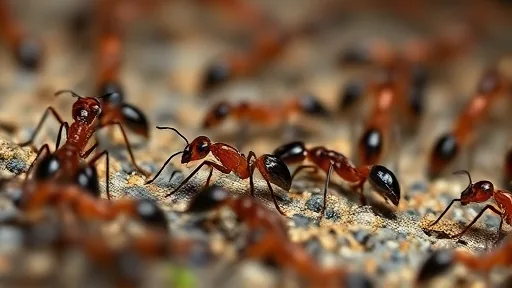
The model reveals a dynamic that resembles a cascade. One ant’s movement creates a local disturbance that draws in nearby workers. Those workers, in turn, trigger their neighbors, creating a chain reaction that amplifies the initial signal. The result is a colony-wide burst of activity that originates from a single “first mover.”
This finding resolves the long-standing question of how ant colonies achieve such rapid, large-scale coordination. The answer lies not in a central command or a complex communication system, but in the amplification of a single individual’s actions. The colony’s response is an emergent property of simple local interactions.
The simulations also highlight the transient nature of these events. The bursts are brief, suggesting that the system is finely balanced. It can be triggered by a single ant, but it also quickly returns to a resting state. This delicate equilibrium is what allows the colony to respond rapidly to opportunities or threats without remaining in a constant state of high alert.
The mathematical model offers a new lens for viewing collective behavior, suggesting that similar dynamics might operate in other social organisms. The principle of a single actor triggering a massive, synchronized response could be a general feature of complex systems, from bird flocks to fish schools.

The team’s next step is to test the model’s predictions against real-world observations of ant colonies, checking whether the dynamics simulated on a computer actually play out in the physical world.