
A small-business owner in Nairobi opens an app on a cheap phone, taps a button, and receives a chart. The chart tells him something about his customers. He trusts it. [1]. That trust is the whole product — and it is also the problem. What the software claims to know and what it can actually demonstrate are two different things, and the distance between them is where the story of Fastagger lives.
The Promise in the Pitch
Fastagger, founded by Mutembei Kariuki with Jude Mwenda and Stephanie Njerenga, builds AI models designed to run offline on low-power cellphones in Kenya. [1] Its flagship product, Auni, launched in 2024 and was integrated into the business app of M-Pesa, the country’s largest mobile money service. [1] About 6,000 businesses have signed up since. [1] The pitch is seductive in its simplicity: your transaction records, once trapped on paper or scattered across SMS receipts, become structured data, and that data becomes advice.
The advice sounds authoritative. It arrives as a chart, a recommendation, a nudge. But the machinery behind it is humbler than the interface suggests. Reading a sales statement involves optical character recognition to pull text from a PDF, followed by a small neural network that identifies how the document is structured. More detailed analysis and question-answering require an internet connection and a cloud query. The system is a pipeline of ordinary tools wearing the costume of intelligence.
What the Chart Actually Shows
Peter Chege, who owns a salon and barbershop in Nairobi, used to record every sale on paper. He describes the old method plainly: the information could not be translated into a graph. Auni changed that. It showed him his busiest days and hours. It flagged regular customers who had stopped coming, so he could send them a personalized message. It revealed that mornings were his slowest stretch, which let him schedule errands then or keep fewer barbers on the floor until business picked up around 1 p.m.
Every one of those outputs is real and useful. None of them is a prediction about the future. The app is not forecasting demand or modeling customer behavior in any deep sense; it is counting, sorting, and drawing. [1]. The deception is not that the numbers are wrong. It is that the presentation — a clean visualization, a confident recommendation — implies a level of understanding the underlying computation does not possess. A bar chart of past sales does not know why mornings are slow. It only knows that they are.
The Restaurant That Needed a List
At a fish restaurant in Nairobi, the founders observed a different version of the same gap. Identifying loyal customers for discounts meant reading SMS sales receipts one at a time, a task so tedious that retention marketing had effectively been abandoned. Auni now surfaces top customers automatically. The restaurant gets a list it can act on.
What the list does not supply is a theory of loyalty. It identifies frequent buyers, but frequency is a proxy, not a cause. A customer who comes weekly because the restaurant is near their office looks identical in the data to one who comes because they love the food. The system cannot tell the difference, and it does not say so. [1]. The owner receives a ranked list and reads intention into it. That reading is the owner’s contribution, not the model’s — but the interface never makes the distinction visible.
Watching Before Building
The founders did not arrive at this design by accident. Before developing Auni, they spent entire days watching small-business owners work and interact with customers. Kariuki’s observation about salon owners captures what they learned: they stand up the whole day cutting hair, so any tool has to fit into a life with no room for reflection. The user journey had to account for what happens in the background while someone is holding scissors.
That fieldwork shaped the product in a way that is genuinely admirable. It also shaped the product’s limits. A system built for people with no time to interrogate it must present its conclusions simply. Simplicity and transparency pull in opposite directions. The cleaner the chart, the less it reveals about its own construction. Fastagger solved the usability problem by hiding the machinery, and hiding the machinery is precisely what makes the output feel more knowing than it is.
The Data Problem Behind the Data

The company’s first challenge was not analysis but ingestion. Existing OCR models struggled with the PDFs produced by mobile money apps — unfamiliar formatting, stamps, errors, low quality. Fastagger adapted an open-source model and made key steps, like organizing extracted data into tables, run on-device because connections were unreliable. With more than 80 percent of Kenya’s adults using mobile money, the transaction record is the richest data source available.
That richness is narrower than it sounds. A mobile money statement records payments. It does not record why a customer chose a salon, whether they were satisfied, or what a competitor offered. The model builds its picture of a business from the thinnest possible slice of reality — the moment money changes hands — and then speaks about the business as a whole. The confidence of the output is inversely proportional to the completeness of the input, and nothing in the app signals that inversion. [1].
The Economist’s Warning
Daniel Björkegren, an economist at Columbia University who studies AI’s implications for developing economies, sees both the promise and the trap. He notes that sub-Saharan Africa’s prevalence of basic phones rather than smartphones and computers will produce different usage patterns. His formulation is memorable: \"The history of technology should suggest that this is not going to be people running Claude Code or Codex on their laptop.\” [1]. Most of the population will need different modalities entirely.
His concern goes further. Björkegren worries about a bifurcation — a clear division between small models designed for emerging economies and increasingly large, powerful models for wealthier regions. That worry applies directly to the deception problem. A two-tier AI landscape does not just mean different capabilities; it means different levels of scrutiny. Systems built for wealthy users face demanding benchmarks, public evaluation, and skeptical journalists. Systems built for basic phones in Nairobi face grateful users who have never had analytics before and no easy way to check whether the advice is sound.
The Security Guard Test
Fastagger’s second product sharpens the question. The company built a workforce management tool for Kenya’s security companies, which employ hundreds of thousands of people. Guards work in remote locations without reliable internet and carry low-end phones. The AI agent communicates via SMS to track routes, detect anomalies, and generate alerts for operations teams. [1].
Consider what an anomaly means here. The system detects a deviation and generates an alert for an operations team that may act on it. The guard has no view of the model and no obvious way to contest the inference. The gap between what the system reports (this guard behaved abnormally) and what it actually measured (this phone’s location data diverged from a pattern) has consequences that fall on a person who never sees the chart. [1].
The Offline Illusion
There is a technical detail that deserves more attention than it usually gets. Some of Auni’s functions run offline, without cloud queries. Others require a connection. The user experience, however, does not clearly mark the boundary. A chart generated on-device and a recommendation generated in the cloud arrive through the same interface, with the same visual authority. [1].
This is a subtle form of deception, and it is structural rather than intentional. The offline functions are simpler — text extraction, document classification, basic visualization. The online functions are more elaborate. But the phone screen flattens the difference. A user who has learned to trust the app’s charts has no reason to trust its recommendations less, even though the two rest on very different computational foundations. The seam is invisible, and invisible seams are where misplaced confidence grows.
A Wider Pattern
Fastagger is not alone. An app for rural schools without internet in Chile, a medical triage chatbot for rural patients in India, translation models for African languages that run on basic phones — these are all part of an emerging effort to build AI around the technological realities of developing economies rather than adapting products designed for wealthier markets. [1]. The impulse is right. The constraint-driven innovation is real.
But every one of these systems faces the same structural temptation. When users have never had access to analytics, any analytics feels like a gift. When the alternative is paper records, a bar chart looks like omniscience. The gratitude that greets these tools is genuine and deserved, and it is also the reason their limits go unexamined. A user who has never seen a graph is not positioned to ask what the graph left out.
What Transparency Would Require
The founders’ own framing reveals the tension. Kariuki’s questions at the outset were about speed: how to help Africa catch up fast, how to create training data fast enough, how to get it into people’s hands fast enough. [1]. Speed is the right goal for access. It is a poor goal for verification. A product built to move quickly into users’ hands has little incentive to slow down and explain itself.
Transparency, in the sense that matters here, would mean showing the user what the model saw and what it did not. It would mean marking the boundary between counting and predicting. It would mean telling a salon owner that the morning lull is an observation, not a forecast, and telling a security guard that a route deviation is a data point, not a verdict. None of that is technically difficult. All of it is commercially awkward, because explanation dilutes the authority that makes the product feel valuable.
The Bifurcation Made Visible
Björkegren’s warning about a split AI landscape acquires a sharper edge when viewed through this lens. [1]. The danger is not only that emerging economies get smaller models. It is that they get models whose limitations are less visible, deployed among users with fewer resources to detect them. Wealthier markets generate skeptical coverage, regulatory attention, and users who have seen enough software to distrust it. Markets served by basic phones generate gratitude and silence.
The Fastagger case shows how this happens without anyone deciding it should. The company’s fieldwork was conscientious. Its engineering choices were sensible. Its products work. And yet the aggregate effect is a set of tools that speak with more confidence than their inputs justify, to users who have the least capacity to push back. The deception is emergent, not malicious — which makes it harder to fix, because there is no villain to name and no obvious moment where a different choice should have been made.
The Image That Stays
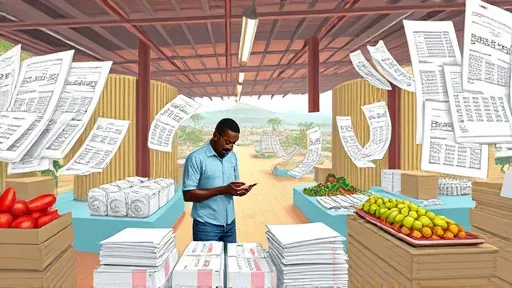
Picture the salon owner at midday. He has finished his morning errands, the shop is filling up, and his phone shows him a chart of the week’s customers. The chart is accurate. The recommendation beneath it is plausible. He acts on both. Somewhere in the pipeline, a small neural network classified a document, a cloud service ran a query, and a visualization library drew a line. None of those components knows anything about haircuts, loyalty, or the neighborhood. The owner supplies all of that meaning himself, and then credits the app for it.
That is the shape of the problem, and it will not be solved by better models. It will be solved, if at all, by interfaces honest enough to show their seams — by tools that say what they counted and stop there. Until then, the most sophisticated thing about AI for small businesses may be the user’s own inference, quietly doing the work the software merely appears to have done.