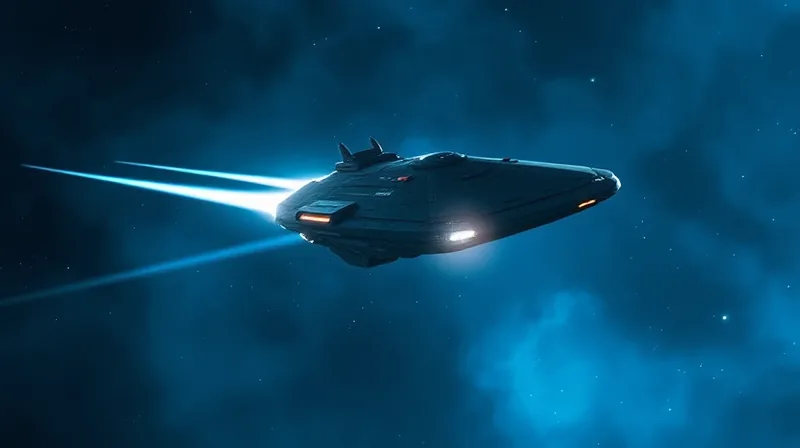
Two Images and One Ship: The Picard Maneuver and the Limit of Measurement
A television trick that survived the arithmetic
In the first season of Star Trek: The Next Generation, an episode called “The Battle” introduced a tactical idea that seemed far too clever to be real. A Ferengi commander forces Captain Jean-Luc Picard to relive an old engagement: outgunned and with shields down, Picard orders his ship to jump to warp speed, stop abruptly and fire. Because the vessel was travelling faster than light, the enemy would see two images of it - one where it entered warp, one where it stopped - and would fire at the wrong one.
For decades the trick sat in the same drawer as the rest of television physics: clever, and impossible. Then a physicist did the arithmetic. According to reporting on the work, the two-image effect is what an observer would genuinely see from a faster-than-light craft - the physics of that was already established - and the researcher’s contribution was to show that the maneuver, as written for television, misses a detail that would make it more effective in reality.
Why an object can appear twice
The double image is not a camera artifact or a storytelling shortcut. It is what follows when an object moves faster than the light it emits: light released at different points along its path arrives at the observer in an order that no longer matches the order in which it was emitted. The observer sees an object where it was and an object where it is, and cannot tell from the picture alone which one is the ship and which one is the echo.
That is also why the maneuver is interesting to physicists rather than only to screenwriters. It is a clean thought experiment about information arriving out of order.
The limit is measurement, not theory
Here the arithmetic stops being the hard part. Confirming the full subtlety in a real system would require observing an object travelling faster than light, and that remains out of reach. There is a measurable analogue - particles moving through a medium in which light travels more slowly can exceed the local speed of light, which is how detectors the size of a building register neutrinos - but the vacuum case cannot be tested directly.
So the honest summary of the whole episode is not “science fiction was right”. It is narrower, and more useful: the theory is settled enough to be calculated with, and the measurement is beyond our instruments. The constraint is not the mathematics. It is the measurement.
Why we are telling you this today
We mention it because it happens to describe the standard we hold ourselves to, and because this is the first story we are publishing from our own instruments.
freegardner is a magazine with four desks - Science, Synapse, EconPol and Markets - running on its own domain rather than inside somebody else’s platform. Our market coverage is built on a long-running simulation of our own instead of borrowed opinion. Our science coverage names its sources, as this piece does at the end. The rule we try to keep everywhere is the one this small Star Trek story illustrates so neatly: patterns, not promises.
The first post we sent out carried this story, and it pointed here, to our own ground. That is a technical detail. It is also the whole idea.
Grown, not harvested
A harvest is taken. A garden is kept. If you find an error in this piece, tell us - a correction is not an embarrassment, it is the instrument reading moving.
Sources
1. Physicist does the math on Star Trek’s Picard maneuver (reporting via Ars Technica / MSN)