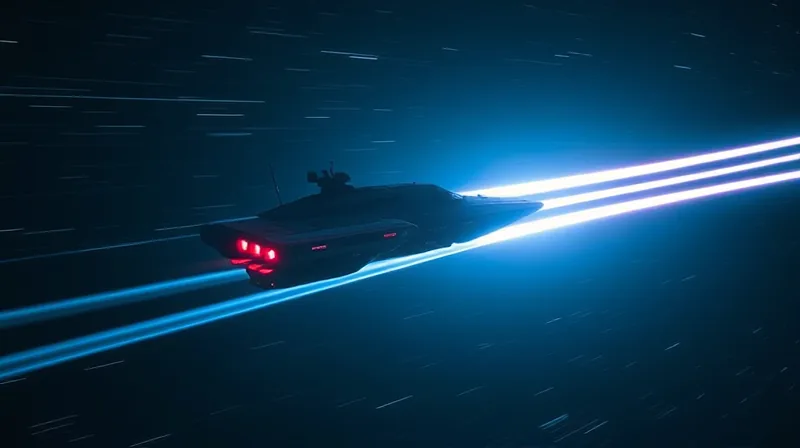
Picard Maneuver Physics Upgrade Reveals Real Effect
The Simplest Answer Misses Something
In the first season of Star Trek: The Next Generation, an episode called “The Battle” introduced a tactical trick that seemed too clever for its own good. A Ferengi leader forces Captain Jean-Luc Picard to relive a battle from years earlier, when Picard commanded a ship called the Stargazer. Under fire, with shields down, Picard made a gamble. He ordered his ship to charge the enemy at warp speed — faster than light — then stop abruptly and fire. Because the Stargazer was moving faster than light, the enemy would see two images of it: one where it first reached warp speed, and one where it stopped. If the enemy fired at the wrong image, they would miss. Later in the episode, Commander Riker notes that the trick had been immortalized in Starfleet textbooks as the “Picard maneuver.”
The simplest reading of that scene is that it is pure science fiction — a clever bit of writing with no basis in real physics. That reading turns out to be wrong. Níckolas de Aguiar Alves, a physicist at the Federal University of ABC in Brazil, first watched Next Generation as a master’s student. [1] When he reached “The Battle,” the plot reminded him of his relativity coursework. Something about the story bothered him at the time, but he forgot about it until years later, when he was working through a more practical problem involving particles in a medium with a slower speed of light. Not trusting that he had done the math right, he started trying to work out the situation visually.
What he found was not a plot hole but a subtlety the episode never addresses: the two-image effect is not the whole story. A detail in the timing and geometry of the maneuver makes the trick more effective in real life than the fictional version suggests.
A Faster-Than-Light Object Leaves Two Images
The core physics is simpler than it sounds. While warp speed is pure science fiction, physicists sometimes need to consider what happens when an object goes faster than light. And such an object really does leave two images. That is not a Star Trek invention. It is a real feature of how light and fast-moving objects behave in relativity. The show got that part right, even if it arrived there by accident.
The maneuver, in other words, would work even better than Picard’s own textbooks claimed.
The same mathematics that governs particles moving through a medium with a slower speed of light — the problem de Aguiar Alves was working on when he returned to the episode — governs what a faster-than-light object would look like to an observer.
The Real Limit Is Measurement, Not Theory
The physics of faster-than-light objects leaving two images was already established. What de Aguiar Alves added was the recognition that the Picard maneuver, as written, misses a detail that would make it more effective.
The constraint now is not theory but measurement. Confirming the full subtlety in a real system would require observing an object moving faster than light, which remains out of reach. Particles in a medium with a slower speed of light can be studied, but the faster-than-light case cannot be directly tested.