
An Error That Became the Universe’s Missing Weight
The gravity of unseen dark matter is the leading explanation for why galaxies rotate so fast. [1] The same unseen mass explains why galaxies orbit inside clusters so fast, why gravitational lenses so strongly deflect light, and how visible matter ended up distributed the way it is. [1].
Visible matter alone cannot account for the speeds astronomers observe. What began as a mismatch between prediction and measurement became the central clue of modern cosmology.
The leading explanation is gravity from matter we cannot see. That unseen mass is the reason galaxies rotate so fast, the reason galaxies orbit inside clusters so fast, and the reason gravitational lenses bend light so strongly. It also explains how visible matter ended up distributed the way it is. Dark matter is not a patch bolted onto the model — it is the scaffolding the whole model stands on.
A frame from a detailed computer simulation makes the invisible visible. Complex filaments of dark matter, rendered in black, are strewn across the universe like spider webs. The familiar baryonic matter — the ordinary protons and neutrons that make up stars, planets and people — appears only as relatively rare clumps, colored orange. The dark filaments dominate the frame; the orange clumps of ordinary matter are relatively rare.
The Data That Will Not Fit the Model
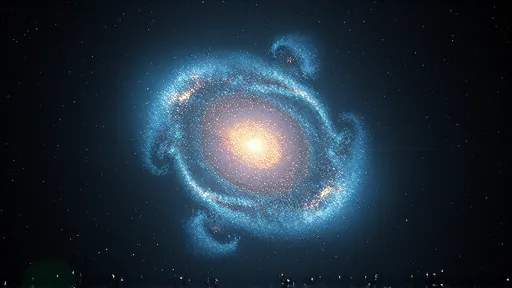
These simulations are good statistical matches to astronomical observations. [1] A model that merely looks pretty is decoration; a model that reproduces what telescopes actually record is evidence. The dark matter map earns its place because the numbers line up.
But the map forces an uncomfortable question. Dark matter is strange. It exists in an unknown form. And yet it is no longer thought to be the strangest source of gravity in the universe. That honor has moved.
The stranger force is dark energy — a more uniform source of repulsive gravity that seems to now dominate the expansion of the entire universe. [1] Where dark matter pulls, dark energy pushes. One invisible thing helps explain why galaxies hold together. Another invisible thing explains why the cosmos flies apart. The haunted map has a second ghost.
Neither can be seen. Together they decide whether a structure stays whole or drifts away. The model that began as a fix for spinning galaxies now has to account for the expansion of everything.
The Planetarium Already Building the Next Map
The image itself comes from “Dark Universe,” a space show at the American Museum of Natural History’s Hayden Planetarium. [1] The frame is drawn from a detailed computer simulation, not from a photograph. [1] That distinction matters: the map is a reconstruction, an inference painted onto the sky.
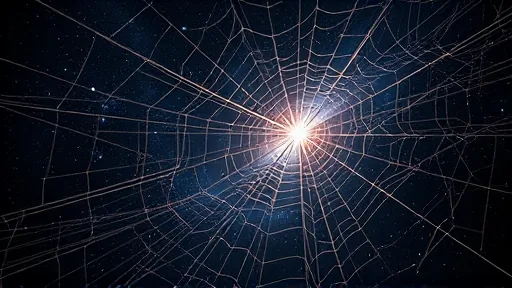
The next stage is already underway in the same place: turning statistical matches into something a visitor can walk through under a dome.
The question the map leaves open is the one the simulation cannot answer. What is dark matter made of? The web is drawn. The filaments are measured. The substance remains unnamed. That is where the work stands — a universe mapped by its shadows, with the source of the shadow still unknown.