
When the Glue Goes Missing
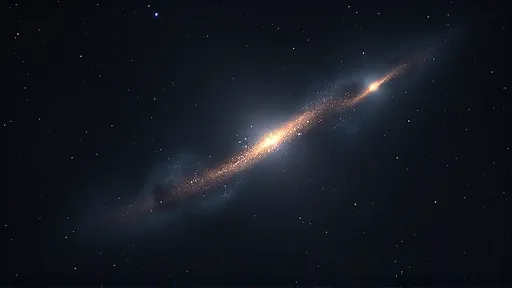
The discovery of three galaxies nearly devoid of dark matter forces a choice: abandon the standard model of cosmology or accept that dark matter is a physical substance that can be separated from ordinary matter. The three objects — DF2, DF4, and DF9 — sit roughly 65 million light-years from Earth. [1] They are not the luminous whirlpools most people picture when they hear the word galaxy. They are pale, diffuse smudges, lit by a sparse scattering of stars. Michael Keim, an astrophysicist at Yale University, describes their appearance as ghostly. [2] That word carries weight, because the standard picture of galaxy formation says such objects should not exist at all.
Dark matter is the invisible scaffolding of the cosmos. It draws ordinary matter toward it, allows stars to ignite, and keeps the outer limbs of rotating galaxies from flying apart. Shyam Balaji, a theoretical physicist at King’s College London, states the consensus plainly: almost all galaxies are dominated by dark matter. [2] The Milky Way is no exception. Neither are the great clusters, the cosmic webs, or the dwarf satellites that orbit larger systems. The rule is close to universal.
The measurements behind the exception are not guesses. Astronomers tracked the motions of stars inside each galaxy and used those motions as a proxy for total mass. A galaxy’s stars move under the pull of everything present, visible or not. When the numbers came in, all three galaxies carried far too little mass for their dark matter content to be significant. A pittance of ordinary matter alone must have forged their small stellar populations.
The timeline of discovery matters. DF2 was spotted in 2018, DF4 in 2019, and DF9 in 2026. All three sit along a line, as neighbors in the same patch of sky, and that alignment is what first drew astrophysicists toward a shared origin story.
A Collision That Separated the Inseparable
The proposed explanation is a cosmic collision of unusual violence. Two ordinary galaxies met head-on. Their gas and dust — the ordinary matter — swirled together and clumped. Their dark matter passed straight through and kept going, because dark matter is known to feel only gravity and meets almost no friction or drag.
Aaron Romanowsky, an astronomer at San José State University, offers an analogy that captures the mechanics. [2] Two knights joust. The knights and their lances collide and may be thrown to the ground in a heap. Their horses keep running at full speed. The knights are ordinary matter. The horses are dark matter. The heap is the new galaxy. The horses are already gone.
The result of that pileup was three new galaxies, each bereft of dark matter, each left to struggle to form a new batch of stars. The struggle is the observable signature. Without dark matter to draw gas together, star formation becomes inefficient.
The distribution of mass there is messy in a way that only makes sense if dark matter and ordinary matter were torn apart during the collision. The intracluster gas and the dark matter have separated. The Bullet Cluster is the same physics writ large; DF2, DF4, and DF9 are the same physics writ small. The difference is one of clarity. The separation is easier to read in the triplet than in the larger, messier cluster.
Not everyone accepts the collision story. Kinwah Wu, a theoretical astrophysicist at University College London, points out that the triplet shows none of the fluid, wispy features a galactic collision should leave behind. His alternative: the three galaxies passed through a large group of massive galaxies, and that outsize rabble stripped them of their dark matter during their voyage. The mechanism differs. The outcome — dark matter removed, ordinary matter left behind — does not.
The Gravity Test and the Waves That Passed Through
Some scientists have suggested that dark matter may not exist at all, and that a tweak to gravity might explain what we see instead. That alternative is called MOND, or modified Newtonian dynamics, proposed in 1983 by the physicist Mordehai Milgrom. MOND asks a simple question: what if there is only visible matter, but its gravity works differently than we thought? The proposal implies that when objects experience a very weak gravitational pull — say, two stars separated by extreme distances — the gravitational force does not dwindle as much as scientists expect. That tweak could explain why spinning galaxies hold together without an extra source of gravity from dark matter. Daniel Whiteson, a particle physicist at the University of California, Irvine, puts the idea plainly: MOND says, what if there is only visible matter, but its gravity works differently than we thought?
The triplet undermines that logic. If you segregate ordinary matter from dark matter, as the collision story does, you would expect the dark-matter-lacking galaxies to struggle to form stars. That is what DF2, DF4, and DF9 show. Under MOND, there is no dark matter to segregate in the first place. The galaxies should behave like any other ordinary-matter system, and their star formation should not be stunted in this particular way. Keim puts the conclusion directly: what this is showing is that dark matter is not just a modification of gravity. The absence of dark matter, Balaji notes, is in a way some evidence of dark matter. The irony is not lost on him.
MOND had already taken a significant blow in 2015, when the Laser Interferometer Gravitational-Wave Observatory, or LIGO, detected gravitational waves for the first time. These ripples in the fabric of the universe were found to move at the speed of light in all directions over huge distances. That behavior implies that gravity works in a consistent, unmodified way throughout the cosmos. A theory that changes gravity’s behavior at low accelerations has no room for such consistency. Chamkaur Ghag, a physicist at University College London, notes that MOND could never really explain everything. The 2015 detection narrowed the space it could occupy.
So what is dark matter? The question remains open. Ever since the astronomer Fritz Zwicky formally proposed the substance in the 1930s, and the astronomer Vera Rubin built upon that work in the 1970s, cosmologists and astrophysicists have put forward their best candidates. Could it be a stealthy type of neutrino? Might it be so-called weakly interacting massive particles, or WIMPs? Some have suggested primordial black holes as small as individual atoms and as old as the universe itself. Whiteson states the position honestly: we do not know which dark matter candidate is the right one. Whatever it is, it has yet to be detected directly.
What the triplet does establish is a boundary condition, and the numbers behind it are stark. In 2018, Keck Observatory measurements showed DF2 holds at most 400 times less dark matter than expected, making it the first dark-matter-deficient galaxy ever found. DF2 is roughly the size of the Milky Way but has 200 times fewer stars. DF9 packs the mass of about 100 million suns, consistent with ordinary matter alone; packed with dark matter, it would be 100 times more massive. Dark matter makes up 27% of the universe and 85% of all matter. [1] It interacts with gravity. It warps space itself, bending light around objects in a process called gravitational lensing. Ordinary matter alone would struggle to clump tightly enough to form stars, and stars on the edges of rapidly spinning galaxies would escape into space. Ghag asks whether there is a way of evolving galaxies without dark matter in the first place. Our understanding, he says, says no. The three ghost galaxies are the exception that tests the rule. Stacy McGaugh, a longtime proponent of modified gravity at Case Western Reserve University, remains unconvinced that the collision is the only way such galaxies could form. Most experts, though, cannot see how DF2, DF4, and DF9 could exist without dark matter being a physical thing. For now, the triplet is the clearest natural laboratory for watching what happens when the invisible glue is taken away.
Sources
Mentioned organisations (context, not sources)
- Yale University — Organisation (homepage)
- King’s College London — Organisation (homepage)
- San José State University — Organisation (homepage)
- University of California, Irvine — Organisation (homepage)
- Laser Interferometer Gravitational-Wave Observatory — Organisation (homepage)
- University College London — Organisation (homepage)