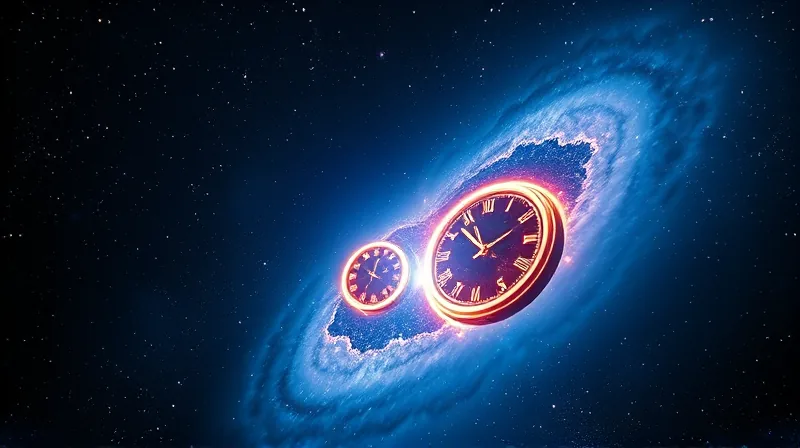
New method finds slower local universe expansion
A New Method Shifts the View of Nearby Expansion
For decades, astronomers have measured the expansion rate of the universe using two primary methods that stubbornly refuse to agree. One method looks at the cosmic microwave background — the faint glow left over from the Big Bang — and then uses the standard model of cosmology, called Lambda cold dark matter, to wind that ancient light forward to the present day. The other method measures the motion of nearby objects, particularly Type Ia supernovas, to determine how fast space is stretching right now in our cosmic neighborhood. The difference between these two numbers has become known as the Hubble tension, and it has persisted even as both measurement techniques have grown more precise.
Two recent studies have introduced a third approach that makes old data appear in a completely different light. Instead of relying on supernova explosions or the cosmic fossil of the universe’s first light, researchers analyzed the motion of two nearby galaxy groups — the Centaurus A group and the M81 group. These galaxies are simultaneously pulled together by their mutual gravity and dragged apart by the expansion of space itself. The lead researcher on the Centaurus A group study is not named in the available source material, but the work was conducted at the Space Telescope Science Institute.
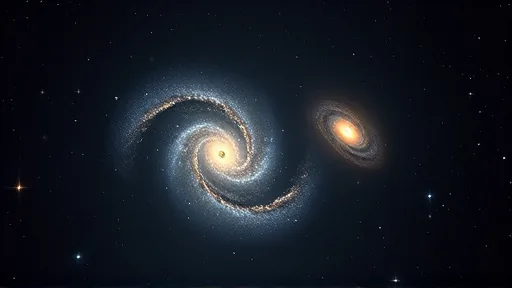
This new method examines how dozens of small galaxies move within their respective groups under the competing forces of gravity and cosmic flow. The Centaurus A group, one of the nearest galaxy clusters to us after the Milky Way’s local group, was found to have a surprising structure. The giant elliptical galaxy Centaurus A does not dominate the group as astronomers had assumed. Instead, it forms a binary system with the group’s M83 galaxy, meaning the two largest galaxies together govern the motions of the smaller members.
The M81 group was already known to have binary galaxies at its heart — M81 and M82. But the new research revealed an unexpected tilt in the group’s structure. This alignment suggests the two galaxy groups share a similar cosmic environment.
A Parallel Group Independently Confirms the Slower Rate
The two teams of scientists working on these galaxy groups discovered a crucial similarity that allowed them to calculate the local expansion rate with confidence. This means that the motions of all the smaller galaxies within each grouping can be understood as a simple interplay between the gravitational pull of the bright central galaxies and the cosmic flow caused by the expanding universe.
Because the two galaxy groups share similar environments and internal structures, the researchers could use their motions to derive a local value for the Hubble constant. This slower rate brings the local measurement closer in line with the value derived from the cosmic microwave background and the Lambda cold dark matter model.
The implications of this finding extend beyond the Hubble tension itself. If the local universe is indeed expanding more slowly, then less dark matter is needed to explain cosmic observations and the dynamics of galaxies. This could reshape our understanding of how dark matter is distributed throughout the cosmos and how galaxies form and evolve within their local environments.
Verifying the Slower Expansion Rate
The method of analyzing galaxy group motions needs to be applied to additional galaxy groups beyond the Centaurus A group and the M81 group to confirm that the slower expansion rate is not a local anomaly. Only by examining more groups can astronomers determine whether this new approach consistently produces values closer to the cosmic microwave background measurement.
Future observations with next-generation telescopes will provide higher-resolution data that can refine the mass estimates for the central galaxies and improve the accuracy of the derived Hubble constant. These observations will also help determine whether the tilt observed in the M81 group is a common feature of galaxy groups or a peculiarity of this particular system.
If the local universe is indeed expanding more slowly, then the discrepancy between local and cosmic microwave background measurements might be explained by a local void or overdensity of matter that affects the expansion rate in our immediate neighborhood. Mapping the distribution of galaxy groups and their motions on larger scales will reveal whether such a local effect exists.
Adam Riess, a professor of astronomy and physics at the Johns Hopkins University and a senior member of the science staff at the Space Telescope Science Institute, has been one of the loudest voices raising concern about the Hubble tension. Riess shared the 2011 Nobel Prize in physics for his part in the discovery that the universe’s expansion is accelerating. His work on Type Ia supernovas helped establish one of the two primary methods for measuring the Hubble constant, and he has watched the tension between the two methods grow as both have become more precise. The new method using galaxy group motions offers a potential path forward.