
Solar Eclipse Science Still Thrives on Earth
Spacecraft Cannot Replace What the Moon Provides
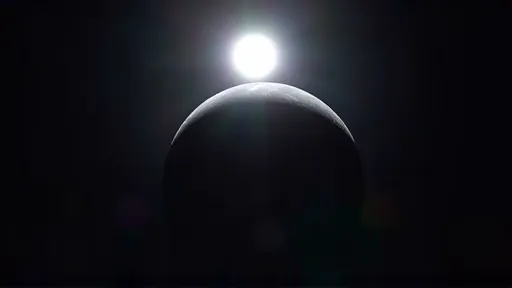
An observation from space with consequences on Earth: On 12 August 2026, the moon will slide directly between Earth and the sun, casting a narrow shadow across eastern Greenland, western Iceland, and northern Spain. This will be Western Europe’s first total solar eclipse since 1999. For a few precious minutes, the sun’s normally invisible outer atmosphere — the corona — will burst into view.
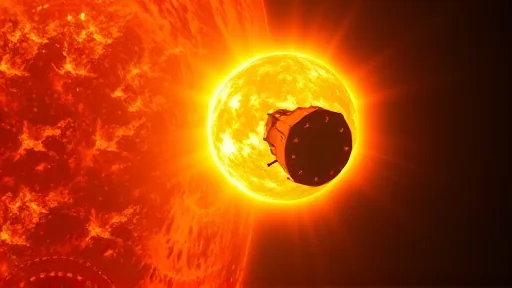
Spacecraft have not made such ground-based observations obsolete NASA’s Parker Solar Probe has flown through the corona itself. The European Space Agency’s Solar Orbiter studies the sun from close orbit. NASA’s Solar and Heliospheric Observatory watches the sun continuously from space. ESA’s Proba-3 mission can even create artificial eclipses in orbit, blocking the sun’s disk with a precisely positioned spacecraft.
Yet none of these missions can replace what total solar eclipses offer. Ryan French, a solar physicist at the Laboratory for Atmospheric and Space Physics in Boulder, Colorado, puts it simply: “Research groups that have novel ideas can go to an eclipse and take observations without having to bid for tens of millions of pounds’ worth of grants from NASA or the European Space Agency — the barrier to entry is much lower.” [1]
Eclipses remain the cheapest and most accessible laboratory for studying both the sun and Earth A university team can launch balloons for a few thousand dollars. A high school can build a coronagraph in a garage. No spacecraft launch required.
Balloons and Aircraft Open New Windows
The Nationwide Eclipse Ballooning
Project will send teams from several US universities to Spain and Iceland for the 2026 eclipse. Their goal: study how the atmosphere responds when the sun suddenly vanishes.
Balloons released in Spain will climb to altitudes between 27 and 37 kilometers. Each balloon carries a payload: 360-degree cameras, ozone instruments, and radio experiments. These instruments will measure what happens in the planetary boundary layer — the lowest region of the atmosphere, where warm air rising from the ground shapes weather and climate. When the sun’s heating stops, that layer changes in ways scientists still do not fully understand.
Icelandic teams will launch balloons carrying radiosondes. These devices monitor pressure, temperature, humidity, and other atmospheric parameters. The data will show exactly how the eclipse alters the atmosphere’s lowest layer, minute by minute.
NASA will fly its WB-57 high-altitude aircraft for the 2026 eclipse. The WB-57 can climb above most of Earth’s atmosphere, avoiding two problems at once. First, cloud cover cannot obscure the view from 18 kilometers up. Second, atmospheric interference drops dramatically at that altitude. “At high altitude, you can observe infrared light that you can’t observe from the ground,” says French. [2] Infrared light carries information about the corona that visible light cannot reveal.
The aircraft will measure polarized coronal light. Polarization — the direction in which light waves vibrate — tells scientists about the magnetic fields that shape the corona. Magnetic fields drive solar flares and coronal mass ejections, the most dangerous eruptions from the sun.
Citizen Scientists Measure What Probes Cannot
During the 2024 total solar eclipse, an experiment called Citizen CATE used telescopes spread along the path of totality. Funded by the US National Science Foundation and NASA, the project stitched together images from dozens of observers to create a 60-minute timelapse of the corona. No single observer could capture that — totality at any one location lasts only a few minutes.
The same experiment will repeat for the 2026 eclipse. But the ultimate goal is the August 2027 eclipse, when totality will last much longer. The new moon will be closer to Earth, making its shadow larger. The path of totality will cross near the equator, where Earth bulges outward toward the moon. The North African Telescope Eclipse experiment will then produce an even longer timelapse of the corona.
Spectroscopy reveals what photographs cannot. “Most of the scientific instruments at an eclipse are not just taking photographs, but collecting measurements of spectra,” says French. Spectroscopy splits light into its component wavelengths, like a rainbow. Each wavelength carries a signature: the speed, temperature, and density of plasma in the corona. “When you observe specific spectra, this can give you information on the speed of plasma moving in the sun, and can tell you about the temperature and the density of plasma sloshing around the sun,” he says.
A separate group asks a deceptively simple question: what is the radius of the sun? The sun has no solid surface. Its visible edge — the photosphere — is a region where gas becomes opaque. That edge shifts depending on how you define it. Yet tiny differences in the assumed radius can shift the predicted edge of the path of totality by kilometers.
The Besselian Elements Team, a group of researchers scattered across the world, records flash spectra at the path’s edge. These spectra appear for only a second as the moon covers the last sliver of the sun’s disk. By measuring exactly when those spectra appear, the team refines eclipse maps and calculates the sun’s actual radius.
Can aurora be detected during totality? Liz MacDonald, founder of the citizen science project Aurorasaurus, will use all-sky cameras in Iceland to search for faint auroral glow Iceland lies beneath the auroral oval — the region surrounding the geomagnetic North Pole where aurora regularly appear. During normal darkness, the aurora is visible. But during an eclipse, the sky darkens abruptly and completely. If aurora exist during totality, these cameras might catch them. Even a non-detection would help constrain whether eclipse darkness can reveal aurora at all.
The August 2026 eclipse will last only a few minutes at any given location. Clouds could ruin years of planning. The path of totality is narrow and geographically specific. Yet for those few minutes, the moon opens a rare observing window onto the sun’s inner corona.
Sources
1. Laboratory for Atmospheric and Space Physics
2. NASA
3. US National Science Foundation
4. Citizen CATE
6. Aurorasaurus