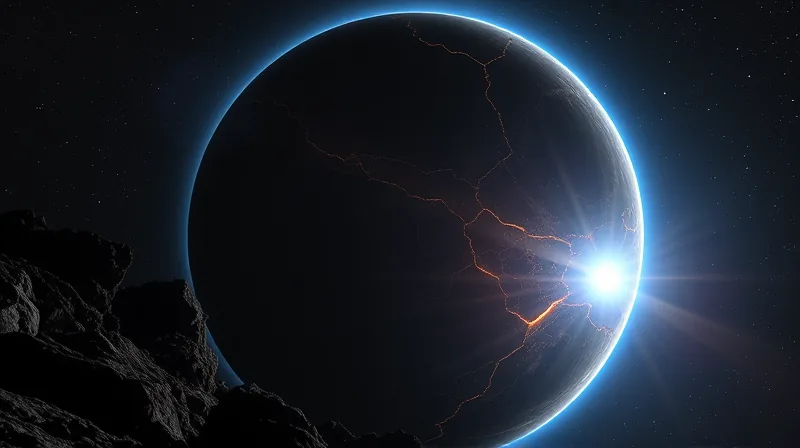
Massive Rocky Planet Defies Planetary Formation Theories
For decades, astronomers have mapped the skies with indirect measurements. They calculated what distant worlds must be like by observing their shadows and their tugs on distant stars. Now, for the first time, a combination of space telescopes and ground-based instruments has directly observed something that was previously only theoretical: a massive rocky planet that defies every rule of planetary formation.
The Transiting Exoplanet Survey Satellite, known as TESS, caught this world as it blocked a fraction of its host star’s light. This transit method, combined with follow-up observations from the WIYN 3.5-meter Telescope at Kitt Peak National Observatory and the James Webb Space Telescope, allowed researchers to measure the planet’s physical properties with unprecedented precision
What emerged from those observations is a celestial heavyweight named GJ 523b. The numbers are staggering. This planet carries roughly 23 times the mass of Earth, yet it remains predominantly rocky rather than becoming a gas giant. Its density clocks in at about 7.8 grams per cubic centimeter, which is comparable to pure rock and significantly denser than any gas giant in our solar system.
The system itself is practically a newborn by cosmic standards. At roughly 170 million years old, GJ 523b orbits its star every 17.75 days, completing a full year in less time than it takes most people to notice the changing seasons. The planet spans about 2.5 times Earth’s radius, making it roughly 60 percent the size of Neptune.
A Graduate Student Spots the Impossible
Max Kroft, a graduate student working alongside Assistant Professor Thomas Beatty at the University of Wisconsin-Madison’s Wisconsin Center for Origins Research, led the team that analyzed the data. The findings left them stunned. “This isn’t what we expected at all,” Kroft said in a statement. “Dense planets like this aren’t uncommon, but they’re usually small rocky planets similar to Earth or Mercury.”
The surprise stems from how planets are supposed to grow. According to traditional planet-building models, when a growing protoplanet’s rocky core reaches about 20 times the mass of Earth, something dramatic happens. Its gravitational pull transforms into what researchers describe as a giant vacuum cleaner, rapidly gobbling up surrounding hydrogen and helium gas.
This process should swell the planet into a gas giant like Jupiter or Saturn. The physics seemed straightforward: cross that threshold, and the planet inevitably becomes a gaseous behemoth.
Yet GJ 523b has crossed that threshold and somehow stayed almost entirely rocky. It holds onto only a surprisingly thin atmosphere, defying the gravitational logic that should have turned it into something entirely different. The planet sits at the exact boundary where theory says it should have transformed, and it simply refused.
A Blueprint Decades in the Making
The informal term “mega-Earth” has existed in astronomical circles for years. It describes exceptionally rare worlds that are extraordinarily massive yet remain predominantly rocky instead of becoming gas giants. But until now, the term had more theoretical weight than observational proof.
GJ 523b changes that. It represents the concrete blueprint that scientists have been waiting decades to find, a genuine mega-Earth that demonstrates this category of planet actually exists in nature. The discovery validates a class of worlds that was previously only hypothesized.
The implications reach far beyond this single system. If a planet can retain its rocky composition past the 20-Earth-mass threshold, then the models describing how planetary systems form require significant revision. The relationship between core mass, atmospheric retention, and planetary evolution clearly operates differently than astronomers assumed. Independent teams at the Harvard-Smithsonian Center for Astrophysics and the Max Planck Institute for Astronomy are pursuing similar mega-Earth candidates with their own transit surveys, suggesting this discovery is not an isolated anomaly but the leading edge of a broader reexamination of how rocky worlds form.
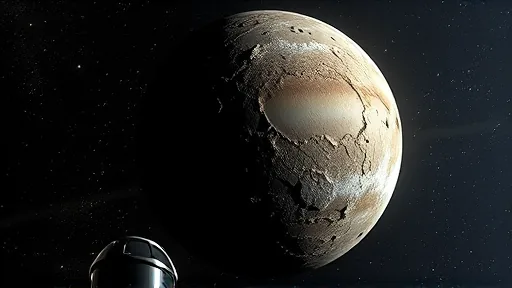
What makes this discovery particularly significant is its timing. The James Webb Space Telescope’s involvement means researchers could examine this world with a level of detail that was impossible just a few years ago. The combination of transit photometry, ground-based confirmation, and infrared spectroscopy has opened a window into planetary formation that simply did not exist before.
For anyone who tracks the field of exoplanet research, GJ 523b represents a fundamental challenge. It is not merely another entry in the growing catalog of thousands of confirmed exoplanets. It is the kind of discovery that forces scientists to question whether the rules they have written for planetary formation apply to the universe at large, or only to the narrow slice of it we thought we understood. As more telescopes come online and survey wider patches of sky, the question is no longer whether such worlds exist, but how many of them are waiting to be found.
Sources
1. Transiting Exoplanet Survey Satellite
2. Kitt Peak National Observatory