Proba-3 mission predicts solar eclipse corona two weeks early
For most of human history, the solar corona — that ghostly white halo surrounding the Sun — was visible only during total solar eclipses. These natural events occur roughly once or twice a year somewhere on Earth, and totality lasts at most a few minutes. Within that brief window, scientists could catch glimpses of the corona, but the observations were always fragmented, always rushed, always incomplete. The corona is not merely a beautiful sight; it is the birthplace of space weather, where the solar wind accelerates before streaming outward into the Solar System, and where coronal mass ejections originate. These eruptions can disrupt satellite networks, communication infrastructure, power grids, and other technologies that modern society depends on. Understanding the corona is not an academic luxury — it is a practical necessity for protecting the technological systems that underpin daily life.
The fundamental problem was one of timing. A natural eclipse gives scientists a few precious minutes of observation, perhaps twice a year, in locations that are often remote and difficult to reach. The corona, however, is a dynamic and complex structure that changes continuously. Trying to understand it through such brief, sporadic glimpses is like trying to understand a river by looking at it for two minutes once every six months. Scientists needed a way to observe the corona for extended periods, not just during the rare moments when the Moon happened to align perfectly with the Sun and Earth. The solution required a fundamental rethinking of how to study the Sun’s atmosphere.
The answer came from an instrument called a coronagraph, a telescope that uses a disc to block the Sun’s bright disc, creating an artificial eclipse. This technique allowed scientists to observe the corona without waiting for natural eclipses. However, most coronagraphs could reliably image the outer part of the corona but struggled with the region closest to the Sun’s surface. This gap in observations meant that scientists were missing crucial data about the very region where space weather processes begin. The challenge was to find a way to observe the inner corona, the area that holds the key to understanding how solar wind accelerates and how coronal mass ejections form.
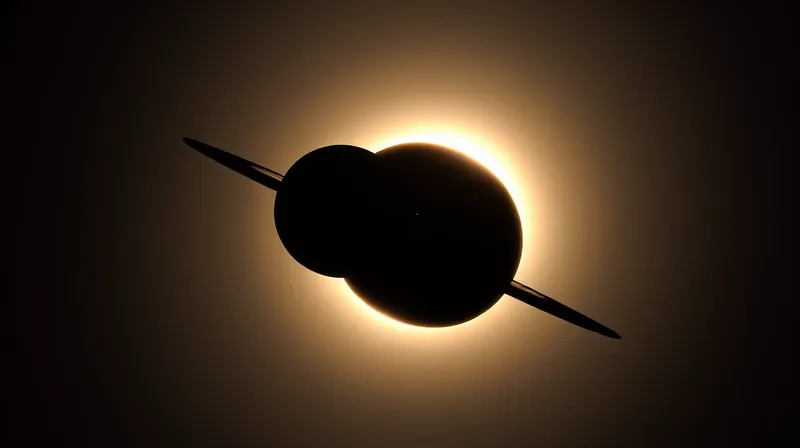
The European Space Agency developed a more ambitious solution: Proba-3, a mission consisting of two satellites flying 150 meters apart, operating autonomously as a single spacecraft. One satellite, the Occulter, blocks the Sun for the other satellite, the Coronagraph, which uses its scientific instrument, ASPIICS, to capture images of the solar corona. Unlike natural eclipses that last minutes, Proba-3 can create artificial eclipses that last for hours at a time. This extended observation window represents a fundamental shift in how scientists can study the corona, moving from brief snapshots to sustained observation.
Predicting the Corona Before the Sky Darkens
The value of Proba-3’s artificial eclipses became clear in the days before a natural total solar eclipse expected on 12 August 2026, visible from parts of Greenland, Iceland, Spain, and Portugal. Andrei Zhukov, principal investigator for the ASPIICS instrument at the Royal Observatory of Belgium, noted that the mission had completed its 62nd artificial eclipse during its nominal operations phase. [2] What made this particular artificial eclipse remarkable was its timing: it was captured approximately two weeks before the upcoming natural eclipse. The Sun takes two weeks to rotate halfway around its axis, which means that the artificial eclipse image could be mirrored horizontally to create a prediction of what the corona would look like during the natural eclipse as seen from Earth.
The logic behind this prediction is simple. The Sun’s large-scale coronal structure typically does not change dramatically over two weeks, so an image taken two weeks before the eclipse, mirrored to account for the Sun’s rotation, should provide a reliable forecast of what observers will see during totality. This approach transforms Proba-3 from a purely observational tool into a predictive one, capable of forecasting the corona’s appearance before the natural event occurs. This allows scientists to prepare their instruments and observation strategies in advance.
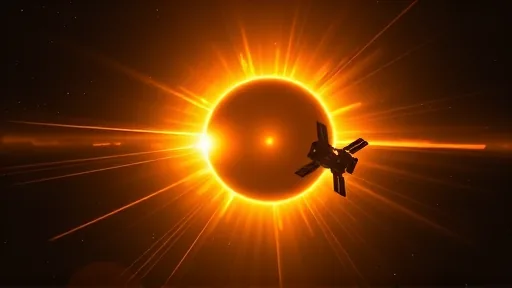
While Proba-3’s approach to mimicking solar eclipses is unique, other solar missions are treating the upcoming natural eclipse with equal seriousness. The ESA-led Solar Orbiter mission is running a special observation campaign in the days before 12 August, using its remote-sensing instruments to gather data from a different vantage point. [3] Most solar observations are made from near Earth, which provides only a limited view of a vast three-dimensional system. Solar Orbiter, however, follows a different path around the Sun than other solar observatories, and today it faces the side of the Sun that will soon rotate into Earth’s view. This positioning gives ground-based observers the opportunity to decide which targets to focus on during the eclipse.
The magnetic maps, or magnetograms, of the Sun’s visible surface recorded by Solar Orbiter’s Polarimetric and Helioseismic Imager, known as PHI, are particularly useful. From the spacecraft’s unique vantage point, these data provide modelers with a more complete picture of the Sun’s magnetic field. PHI has detected a newly emerging active region on the Sun, which is likely to affect what the corona will look like during the 12 August eclipse. This active region would not have been visible without Solar Orbiter’s position, highlighting the importance of multi-perspective observation. The magnetic field lines visible in simulations have been compared to hairs in a fuzz ball, and observing the Sun from multiple viewpoints allows scientists to determine their orientation in three dimensions.
Testing Models Against a Real Eclipse
A total solar eclipse provides a rare opportunity to test whether computer simulations accurately capture the Sun’s magnetic environment. Jorge Amaya, ESA Space Weather Modelling Coordinator, explained that a total solar eclipse allows scientists to verify that their models are correct by comparing forecasts with actual observations. [6] This verification process is essential for improving space weather predictions, which help protect the technological infrastructure that modern society relies on. The eclipse serves as a natural experiment, a moment when the corona becomes visible and models can be checked against reality.
ESA’s Solar Orbiter team is providing its unique data to Predictive Science Inc. to predict what the Sun’s corona will look like during the upcoming total solar eclipse. [4] In parallel, KU Leuven is supporting ESA’s Space Weather Office with predictions of what will be visible during the 12 August eclipse. [5] These parallel efforts represent a coordinated approach to eclipse prediction, combining data from multiple sources to create the most accurate forecasts possible. The predictions are available online, allowing both scientists and the public to see what the corona is expected to look like during the eclipse.
Solar Orbiter’s current location provides a preview of what ESA’s space weather forecasting mission Vigil will see when it launches in 2031. [7] Vigil will follow Earth to provide continuous, near real-time observations of the Sun’s side, offering a persistent view that complements the intermittent observations from other missions. Miho Janvier, ESA project scientist for the Proba-3 and Solar Orbiter missions, noted that these two missions together provide an unprecedented view of the Sun, from its surface to its extended atmosphere. [1] The upcoming total solar eclipse offers a chance to see how this knowledge comes together, comparing observations with modeling to deepen understanding of the Sun’s behavior.
For those unable to witness the full eclipse in person, ESA will broadcast the event live on 12 August from 19:30 to 20:45 CEST. Safety remains paramount: looking directly at the Sun without proper protection can cause serious eye damage, and regular sunglasses are not safe for observing a solar eclipse. Certified eclipse glasses meeting appropriate safety standards must be worn at all times during the partial phases. Only during totality — when the Moon completely covers the Sun — is it safe to briefly look without protection, and as soon as the Sun begins to reappear, eclipse glasses must be worn again. The ability to observe the corona during totality, whether in person or through ESA’s broadcast, represents the culmination of years of work by missions like Proba-3 and Solar Orbiter, bringing together artificial eclipses, computer models, and natural celestial mechanics to unlock the secrets of the Sun’s atmosphere.
Sources
2. Royal Observatory of Belgium
5. KU Leuven
7. Vigil