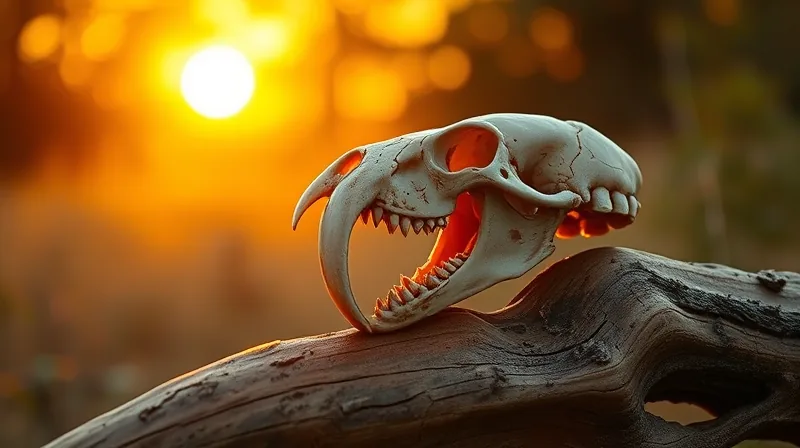
Sabre-Toothed Cats Could Crunch Through Bone
A Predator’s Canines Were Not as Fragile as Scientists Believed
For decades, scientists thought the sabre-toothed cat’s enormous canines were too delicate for bone. The long, curved teeth, reaching over 25 centimeters in length, were seen as a trade-off: excellent for piercing soft flesh but likely to snap if they hit hard bone beneath. This view shaped everything from museum exhibits to scientific papers. It seemed logical that such specialized weapons would be used only for precision strikes, not for crunching through skeletons.
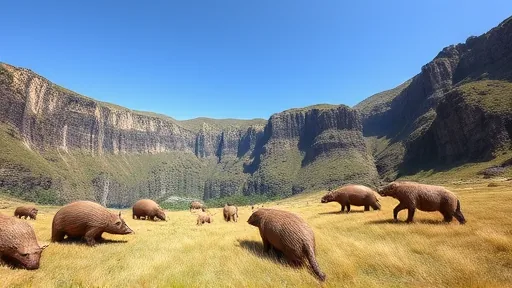
The bones from Salto de Piedra, a site about 350 kilometers south of Buenos Aires in Argentina, tell a different story. [3] Researchers have uncovered skeletons of giant armadillos, giant land sloths, mastodons, and sabre-toothed cats like Smilodon populator at this location. It is one of the only robustly dated Pleistocene localities in Argentina, meaning scientists can track animal populations there over time with unusual accuracy. The sabre-toothed cats frequented the area between 22,200 and 13,300 years ago.
Yolanda Fernández-Jalvo at the Museum of Natural Sciences in Madrid, Spain, led a new analysis of these bones Her team looked for two kinds of tooth marks: punctures and grooves. They measured the length, width, and depth of each marking using digital calipers. Then they compared these measurements with known Smilodon teeth.
The results surprised everyone. The markings on several megafauna bones matched the cat teeth perfectly. The hard cortical bone, which makes up 80 percent of bones, was broken. Federico Agnolín at the Argentine Museum of Natural Sciences, who was not involved with the research, said he always found the old interpretation difficult to accept. It seemed unlikely, he noted, that such a large predator would evolve enormous canines only to avoid using them. .
The Bite Force
Debate and the Real Weaponry of Smilodon
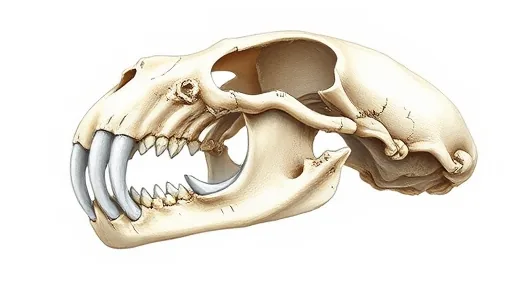
A landmark 2007 study published in PNAS found that Smilodon fatalis could generate only about a third the bite force of a similarly sized lion. [1] By some estimates, its bite was not far off a large house cat’s when adjusted for size difference. This finding created a paradox: how could an animal with such weak jaws break bone with its teeth?
The resolution to this puzzle lies in the cat’s forelimbs. Skull and limb studies consistently show that Smilodon had unusually robust, heavily muscled arms, closer in build to a bear’s than a modern big cat’s. Biologists think Smilodon used this upper-body strength to physically wrestle down prey many times its own size, such as ground sloths, ancient bison, and young mammoths. The animal would pin its prey so it could not move.
Only once the prey was immobilized did the jaws come into play. The leading interpretation had been that Smilodon delivered a single precise bite to the throat or belly, severing something vital in a target already helpless. This strategy explained the paradox: the 7-inch canines were precision instruments, and a weak, narrow jaw gape with modest bite force was safer because it reduced torque and the risk of snapping a canine on a thrashing, half-ton animal.
The new bone-mark evidence changes this picture. Agnolín stated that the new evidence reinforces the idea that Smilodon was capable of penetrating cortical bone with its canines, leaving distinctive marks without causing apparent damage to the teeth. This strongly suggests, he added, that the sabres were mechanically much more robust than traditionally believed. The canines were not just for precision — they could handle bone. .
Convergent Evolution and the
Limits of the Fossil Record. The sabre-tooth body plan appears across unrelated lineages. This is a case of convergent evolution: different branches of the tree of life independently arrived at the same solution to a similar problem. Smilodon was not even a close relative of today’s cats. An entirely different branch of mammals, the marsupial predator Thylacosmilus in South America, evolved almost the same elongated-canine, weak-bite architecture on its own.
A 2013 study published in PLOS ONE put both animals through the same biomechanical modeling. The pattern held for Thylacosmilus too: millions of years apart and continents away, two unrelated lineages had converged on the same odd solution. A 2022 study in Royal Society Open Science ran 1,074 biting simulations on 17 different cat-like carnivoran taxa at three different biting angles: 30 degrees, 60 degrees, and 90 degrees. The results showed a continuous spectrum of hunting methods rather than a simple bipolar split between sabre-toothed and non-sabre-toothed forms. .
Much of what scientists know about Smilodon comes from one extraordinary source: the La Brea Tar Pits in Los Angeles. More than 2,000 individual Smilodon have been pulled from sticky asphalt seeps there, among millions of fossils preserved over tens of thousands of years. That density of fossils is what let researchers move past guesswork. Comparing dozens of skulls and limb bones turned the big prehistoric cat into a testable biomechanical model. .
Smilodon ranged across the Americas through the Pleistocene and vanished around 10,000 years ago, part of the broader wave of megafauna extinctions that also claimed mammoths and giant sloths. A 2018 study published in Nature Communications modeled Smilodon’s population history alongside other Ice Age giants. Its decline tracked more closely with human hunting pressure, while some of its contemporaries’ declines lined up better with climate shifts at the end of the last Ice Age. The exact cause remains debated, but the fossil record shows a predator more complex than the simple image of a fragile-toothed hunter. .
Sources
1. DOI: 10.1186/s12862-026-02551-7
2. Museum of Natural Sciences in Madrid