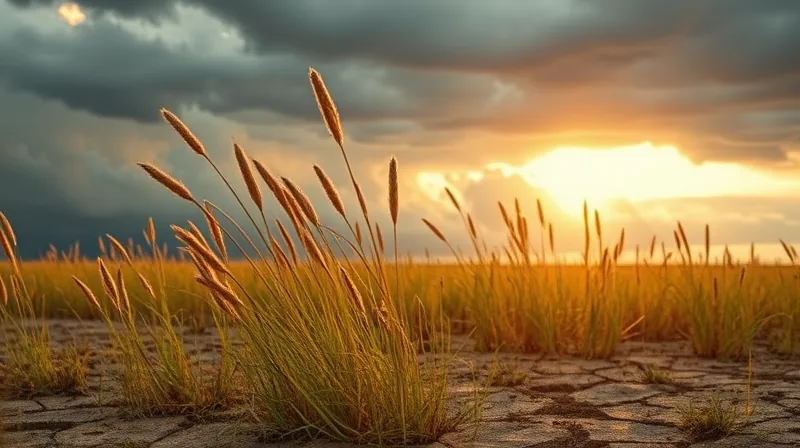
C4 grasses thrive with rising CO2 during drought
For decades, the scientific community operated on a simple assumption: certain grasses, known as C4 plants, were largely indifferent to rising carbon dioxide levels. These plants, which include maize, sugarcane, and the dominant savannah grasses of Africa and South America, possess a sophisticated carbon-concentrating mechanism. This biological innovation allows them to photosynthesize efficiently even when atmospheric CO2 is scarce. The logical conclusion seemed obvious. If these plants already have all the carbon they need, then pumping more CO2 into the air should not change their growth patterns at all. This belief shaped climate models, agricultural forecasts, and our understanding of how the planet’s great grasslands might respond to a warming world.
That assumption now lies broken. A comprehensive new analysis, published in the journal Nature, has turned this long-held belief on its head. [3] The research examined data from 70 separate experiments and 32 years of field observations. The results are unambiguous. When water becomes scarce, rising CO2 levels significantly boost the growth of C4 grasses. This finding challenges the foundational assumption that had guided ecological modeling for generations. It reveals an overlooked driver of change across the world’s savannahs, ecosystems that cover roughly one-fifth of the Earth’s land surface and support millions of people, livestock, and wildlife.
The mechanism at play is both elegant and practical. C4 grasses close the tiny pores on their leaves, called stomata, when water is limited. This conservation strategy prevents moisture loss but also restricts the intake of CO2. Higher atmospheric CO2 concentrations mean that even with partially closed stomata, the plant can still acquire sufficient carbon for photosynthesis. The result is that the plant can continue growing through dry periods that would normally halt its development. It is a simple matter of supply and demand. When the supply of carbon in the air rises, the plant’s need to open its pores diminishes, allowing it to retain precious water while still feeding itself.
From Laboratory Plots to Living Landscapes
The research team, led by K. J. Simpson, combined the controlled conditions of experimental plots with the messy reality of long-term field data. The 70 experiments provided the mechanistic understanding, showing exactly how individual grass species respond to elevated CO2 under drought conditions. The 32 years of field observations then confirmed that these responses actually occur in natural settings, where rainfall patterns fluctuate wildly and multiple species compete for the same resources. This dual approach gives the findings unusual weight.
The implications extend far beyond academic curiosity. Climate models used to project future vegetation patterns, carbon storage, and even wildfire risk have consistently treated C4 grasses as a constant factor, unresponsive to atmospheric change. These models must now be revised. The research points to a cascade of consequences. If savannah grasses grow more vigorously during dry seasons, they will accumulate more biomass. More biomass means more fuel for fires, which are a natural and frequent feature of savannah ecosystems. It also means changes in grazing patterns for the vast herds of herbivores that depend on these grasslands. The entire food web of the savannah, from termites to lions, may be subtly reshaped by this newfound growth response.
The work also connects to broader questions about tropical forest resilience. Studies by Hubau and others have shown that even dense forests, long considered stable carbon sinks, are showing signs of stress. [5] If the grasslands that surround these forests are simultaneously becoming more productive, the balance of carbon between ecosystems could shift in ways that scientists are only beginning to understand.
Open Questions in the Soil and the Sky
The recognition that C4 grasses respond to CO2 fertilization under drought conditions raises more questions than it answers. If these grasses grow more vigorously, what happens to the soil? Increased plant growth demands more nutrients, particularly nitrogen and phosphorus. Savanna soils are notoriously poor in these elements. The growth response documented by Simpson’s team may therefore be self-limiting, constrained by nutrient availability rather than by carbon or water. This question remains open, a tantalizing avenue for future research.
The temporal dimension of this response also demands scrutiny. The 32 years of field data show a clear trend, but grasslands are dynamic systems that shift over decades and centuries. Woody plants, many of which use the C3 photosynthetic pathway, are already encroaching on savannahs around the world. If C4 grasses gain a competitive advantage during dry periods, this encroachment might slow. Alternatively, the increased grass biomass might create conditions, such as more frequent fires, that actively suppress woody plant establishment. The long-term trajectory of these ecosystems hangs in the balance.
Perhaps most pressing is the question of how this new understanding affects projections of the Earth’s future carbon budget. The world’s grasslands store vast amounts of carbon in their soils, far more than in their above-ground vegetation. If increased CO2 leads to more root growth and more organic matter being returned to the soil, these ecosystems could become more significant carbon sinks than previously estimated. Earlier work by Chen, Riley, Prentice, and Keenan suggested that the land surface may be absorbing more carbon than current models indicate. [6] This new study provides a potential mechanism for that discrepancy. The ground beneath our feet may be changing in ways that scientists are only just beginning to map.
Sources
1. DOI: 10.1038/d41586-026-02480-x
3. Nature
4. Lawrence
5. Hubau
6. Riley
7. Prentice