Junaid Hafeez Blasphemy Appeal After Thirteen Years
The Phone That Became an Evidence Bag
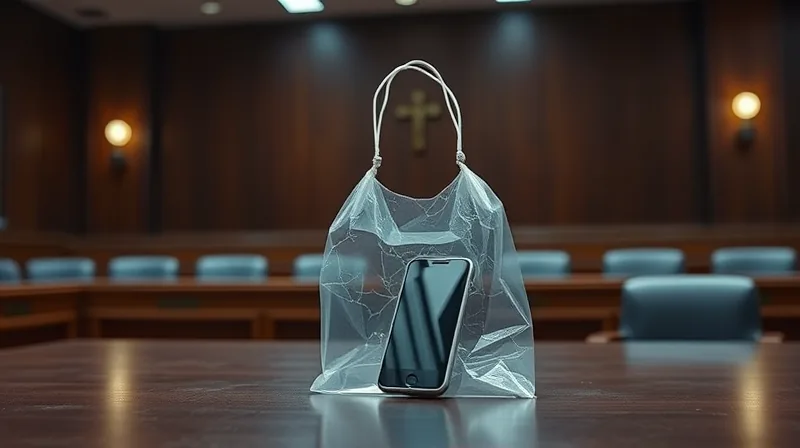
A phone sits somewhere in a court building in Punjab — in a drawer, in an evidence bag, in whatever container Pakistani courts keep for electronic exhibits. Most phones hold nothing that could end a life. A photo of a meal, a message typed and then deleted, an argument with a stranger that ends when the screen goes dark. This one is different. The case against Junaid Hafeez rests in large part on material attributed to a Facebook account. The account was a fake profile, according to the accusation. It posted inside a closed group called “So-Called Liberals of Pakistan.” The post is alleged to have insulted the Prophet Muhammad. The allegation has cost Hafeez thirteen years of freedom so far. Before his arrest he was a Fulbright scholar. He had studied in the United States. He returned to Pakistan and took a job teaching English literature at Bahauddin Zakariya University in the city of Multan. He was arrested on March 13, 2013. A trial court sentenced him to death in 2019. He has been in prison ever since. Whether he stays there, or is executed, or walks out, now depends on a court that is not the one that convicted him. That is what an appeal is: a second look at the same facts by different judges. In this case, the second look has barely started. It began, formally, last week, when the Lahore High Court took up the case.
In Pakistan, a death sentence imposed by a trial court does not become final without scrutiny by a high court. That single procedural rule is the hinge on which everything now turns. Hafeez challenged the verdict in 2020. The appeal then sat undecided for years. A high court in Lahore began hearing it last week. A two-member bench took up the matter last week. The judges issued notices to the prosecution and to the complainant. They asked both sides for arguments on the electronic evidence the case relies on. That evidence includes the Facebook material attributed to Hafeez. The next hearing is due on October 10. How long the court will take to decide after that remains unclear. Nothing in the calendar is fixed beyond the next date. What is fixed is narrower and more consequential: until the high court rules, the death sentence cannot become final. If the Lahore High Court overturns the conviction, Hafeez can still be released. That outcome will depend on how the judges assess the evidence and the arguments made during the appeal. The appeal is therefore not a formality, and not a review of paperwork. It is the place where the sentence either holds or falls.
For the family, the case is measured in a currency that never appears in the file. Hafeez-un-Naseer, the scholar’s father, met his son in prison last Thursday. They spoke through a glass window, by phone. “I want to see my son free and back home,” he said. [1] “We are fighting a very difficult battle.” His summary of the cost was shorter: “This case has taken everything from us.” It describes what a pending case does to the people waiting on it. Saif-ul-Malook, the lawyer representing Hafeez, describes a different kind of waiting inside the prison. The academic has read thousands of books during his years behind bars. “He is an intellectual,” Malook said. “His health is fine, but he is frustrated inside the jail.” The lawyer’s expectation is stated as hope rather than forecast: “I am hopeful that under this bench, he will be released.” [1] Hope is the only currency the defense currently holds. It is not a legal instrument. It is what remains after thirteen years of a case without an answer.
The Cost of Fear
Hafeez had begun working at Bahauddin Zakariya University as a graduate student in 2011. Human rights groups say that shortly after he began working there as a graduate student in 2011, he found himself targeted by an Islamist student group who took issue with what they considered his “liberal” teaching. The accusation followed: that he had used a fake Facebook profile to insult the Prophet Muhammad inside a closed group. His father has said he was set up by Islamists on campus. The motive the father describes is institutional rather than religious: they wanted one of their own in an open position at the university. The state’s account is contained in the charge, and the charge carries the maximum penalty available under Pakistan’s blasphemy laws. Between those two versions of events lies everything the appeal court has to sort through. The date of the arrest is the one fact both sides share: March 13, 2013. Everything after it is procedure, and the procedure has been extraordinary at every step.

The trial itself did not proceed in an ordinary courtroom. Proceedings began in 2014 and were later moved to Multan Central Jail because of security concerns. They were repeatedly delayed. Those delays were not incidental interruptions of a normal schedule; they stretched the case across years. From the start of the trial in 2014 to the death sentence in 2019, five years passed. From the arrest in 2013 to that sentence, six. The court that convicted him sat in Multan. Its verdict was challenged in 2020. The appeal has yet to be decided. Six years have now elapsed since the challenge was filed — longer than the trial that produced the sentence. The Lahore High Court’s hearing of the appeal is the first substantial engagement by a higher bench with the substance of the case. Whether it produces a ruling in weeks or months is not something the file can predict. What the file does show is a case that has moved at the speed of the pressure around it, not the speed of its own evidence.
Security has been the dominant fact of this case from the beginning, and the people who work on it have paid for that fact. At least seven judges were transferred during the trial. Hafeez’s first lawyer, Rashid Rehman, was shot dead in his Multan office in May 2014. He had reportedly received threats in connection with the case. No other detail in the record weighs as heavily as that one. A lawyer takes a case and is killed in his own office. The next lawyer takes it and continues. The transfers and the killing are not presented as evidence about whether the accusation is true. They are evidence about the conditions under which the accusation gets adjudicated. Those conditions shaped the pace of the trial and the willingness of courts to hear it. A docket can be delayed by weather, by illness, by backlog. It can also be delayed by fear, and fear leaves a different kind of trace. Here, the trace is a dead lawyer, a transferred bench, and years of quiet.
Human Rights Watch says Hafeez has been kept in solitary confinement since June 2014. [1]. That date matters for a simple reason: it places his isolation almost entirely inside the period of pre-verdict and post-verdict detention. He was sentenced in 2019. The isolation predates the sentence by five years. In a February press statement, the rights group called for his release and for the conviction to be overturned. That statement is an advocacy position, not a judicial ruling. It still fixes a factual claim that can be checked: the duration and conditions of his confinement. His lawyer describes the same man from the other side of the glass and the phone line. Thousands of books, fine health, frustration. Solitary confinement and thousands of books are not a contradiction. They are what a life looks like when the only resource available in abundance is time.
Why the Court Has Not Yet Decided
The question the case leaves open is not whether the accusation is true. It is why a case this old still has no answer. Raza Rumi, a Pakistani policy analyst, describes the pressure judges face when they handle blasphemy cases. “Acquittals or even procedural decisions can trigger threats and public backlash, contributing to delays and caution in handling such cases,” he says. [1] A procedural ruling, in other words, is not a neutral act. It can be read as a verdict. Rumi names a second mechanism: “Human rights groups have documented threats against judges, lawyers, and prosecutors in blasphemy cases. Concerns over their safety can affect both the pace of proceedings and judicial independence.” Pace and independence are usually discussed as separate problems. Here they are joined at the root. A judge who fears for his safety takes longer. A judge who takes longer has already been moved by something other than the evidence. Neither statement is a claim about any individual judge’s motives. Both are claims about the environment in which the decision has to be made. That environment is the reason a case can be open for thirteen years without being unresolved in any legal sense. It is fully resolved. It just has not been decided.
Saif-ul-Malook, the defense lawyer, is direct about what he expects from the bench. “Lahore High Court judges have generally been reluctant to hear blasphemy appeals,” he says. He names the judge who matters in this round: “This time, Justice Sadiq Mahmud Khurram is on the bench. Let’s see how he approaches the case.” Then he states his own experience of the process: “In my experience, there is prejudice against the accused at every stage.” That is a lawyer’s assessment, offered as experience rather than proof. It is also consistent with the procedural history. Seven judges transferred. One defense lawyer killed. Years of delay before a first hearing. The Lahore High Court session produced notices to the prosecution and the complainant and a request for arguments on the electronic evidence. Those are procedural steps, not signals of an outcome. In a case where procedural decisions can trigger threats, however, procedural steps are the news. The bench asked for the evidence to be argued. That is where the phone, and the profile attributed to it, re-enters the room.
The other side of the case is not silent. Hafiz Ehtisham Ahmed, an Islamabad-based Islamic activist, argues that the court should uphold the conviction. Abolishing the blasphemy laws, in his view, could “encourage disrespect for religion.” He also frames the case as a test of the system rather than of one man. “There is international pressure on Pakistan to change these laws,” he says. “If Hafeez is acquitted, it would raise serious questions about the justice system.” That position is a real argument with a real constituency. It treats an acquittal not as a finding about one defendant but as a statement about the law itself. The counter-position is that the law is already the problem. Pakistan’s blasphemy statutes have been widely condemned internationally for their arbitrary application and the potential for abuse of power. Both sides are describing the same mechanism from opposite ends. One says the law must stand because what it protects is sacred. The other says the law must be feared because what it permits is arbitrary. The appeal court is being asked to rule inside that argument, not above it.
Human Rights Watch does not hedge. In its February statement, the group called for Hafeez’s release and for his conviction to be overturned, noting the solitary confinement that began in June 2014. His lawyer’s closing assessment is familial rather than legal. “If his appeal is rejected, Junaid’s mother will not survive it,” he says. “His father can barely walk. The whole family has been destroyed.” He then adds a projection about what a release would mean: “If released, I believe Junaid will become an internationally recognized intellectual, lecturing at leading universities.” And a request: “We hope that Hafeez’s remaining life will not be wasted in the prison on the death row and that his case will be finally concluded and he will be acquitted.” The father’s account is smaller and harder to argue with. “I still remember the pain we have endured over all these years since my son was falsely accused,” he says. “Thirteen years have taken so much from our family, but we have never stopped hoping that one day Junaid will walk free.” And then: “We wish that one night we could go to sleep and wake up to find our son free and back home.” The next hearing is October 10. A phone, or the account attributed to it, is still what the judges have to weigh. The delay in this case is not an absence of activity; it is the visible product of the conditions under which the case has been adjudicated.