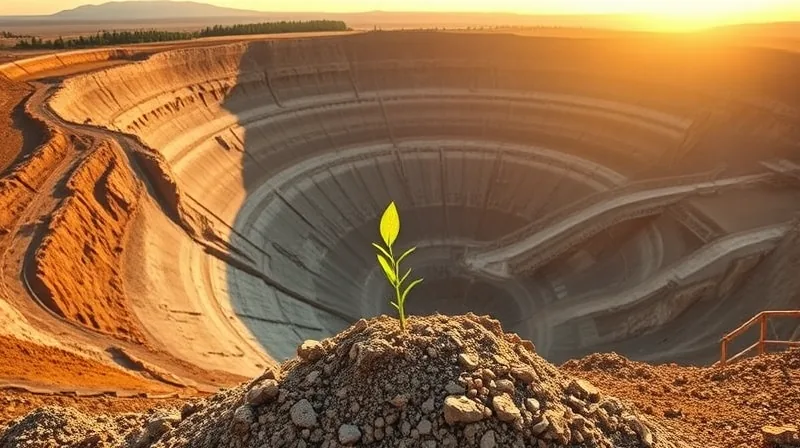
Phosphorus Reserves Facing Depletion While Waste Holds Solution
For decades, the assumption was simple: phosphorus, the essential nutrient that drives plant growth, would always be there when needed. Farmers spread it on fields, food producers relied on it silently, and no one questioned the supply chain. That assumption now fails against its own data. The United States, long a net exporter of phosphate rock, faces a stark projection: its domestic reserves could be exhausted within 40 years. The mineral that underpins global agriculture is running out, and the clock is measured in decades, not centuries.
The contradiction cuts deeper than a single country’s reserves. Europe, Latin America, and Southeast Asia already depend on imports from just two dominant suppliers—China and Morocco—to meet their agricultural needs. The system that feeds billions of people rests on a geopolitical bottleneck. A disruption in either exporting nation would ripple through global food markets with little warning and fewer alternatives. The established belief that phosphorus scarcity is a distant problem collapses against the reality that major regions are already import-dependent today.
The urgency is not abstract. Without phosphorus, crops cannot grow—and without a reliable supply of the mineral, the world’s food supply is at risk. This is not a hypothetical scenario for future generations; it is a present vulnerability with a finite horizon. The same logic that once applied to oil security now applies to a nutrient that has no synthetic substitute. Phosphorus cannot be manufactured in a laboratory at scale; it must be mined, and the mines are running dry.
Where the Waste Goes, the Reserves Remain
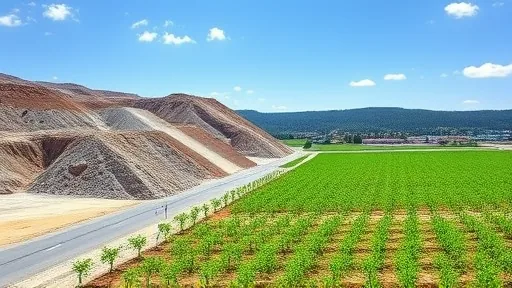
The most striking irony in this crisis is where the solution already sits. While the United States faces depletion of its mined phosphorus within four decades, the country simultaneously discards vast quantities of the same nutrient in its waste streams. Municipal sewage, agricultural runoff, and food processing byproducts all contain phosphorus that is currently treated as a disposal problem rather than a resource. The mineral that is scarce in the ground is abundant in what we throw away.
This is not a minor footnote. The waste streams represent a potential reserve that could extend the domestic supply timeline significantly—if the recovery infrastructure existed. The technology to extract phosphorus from wastewater and organic waste is not science fiction; it is an engineering challenge with proven prototypes. What is missing is the economic incentive and policy framework to scale these systems from pilot projects to municipal infrastructure. The contradiction is stark: a country running out of a critical mineral is simultaneously flushing that same mineral down the drain.
The comparison to the past is instructive. Before the industrial era, societies returned human and animal waste to the soil as a matter of course. The nutrient cycle was closed: what was taken from the land went back to the land. The modern linear model—mine, apply, harvest, discard—broke that cycle. The shift to synthetic fertilizers and centralized sanitation severed the connection between waste and soil. Now, as the mines deplete, the logic of the past reasserts itself with new urgency: the phosphorus we already have must be recovered, not buried or discharged.
The Search for a Closed Loop
The question of who will build the recovery systems is already being answered by researchers who study the problem at its source. The scientific community has documented the scale of the opportunity in peer-reviewed assessments, including work published in the journal Resources in 2018. These analyses map the flow of phosphorus through the economy, tracing where it enters, where it accumulates, and where it is lost. The data shows that recovery is not merely possible but technically demonstrated across multiple waste streams.
The next stage is institutional. Research groups are working on the transition from laboratory demonstration to full-scale implementation, focusing on the economic and logistical barriers that have kept phosphorus recovery from becoming standard practice. The work involves not just chemists and engineers, but economists and policymakers who must design the incentives that make recovery profitable. The path forward is not a single breakthrough but a series of coordinated shifts across infrastructure, regulation, and market design.
The direction of travel is set: the reserves are in the waste, and the work of extracting them has begun Researchers are not asking whether recovery should happen, but how to make it happen at the scale required. The window is narrow—40 years for domestic reserves—but the alternative to acting within that window is not a comfortable one. The phosphorus that feeds the world is finite, and the only new supply left is the supply we have already used and thrown away.