
Agricultural Liming Stored Carbon Not Released
Two Lenses, One Surprising Result
For decades, the story of agricultural liming seemed settled. Farmers spread crushed limestone and other carbonate minerals on acidic soils to raise pH and boost yields. Standard greenhouse gas accounting treated that lime as a source of carbon dioxide, because carbonate minerals release CO2 when they dissolve. The Mississippi River Basin, which drains roughly 40 percent of the contiguous United States, became a test case for that assumption.
A second line of evidence tells the opposite story. Century-scale records of river alkalinity fluxes — the dissolved mineral content that rivers carry to the sea — show that the basin has actually stored carbon, not released it. Two approaches, then, explain the same farming practice from different directions. One counts what leaves the soil. The other counts what reaches the river and, eventually, the ocean.
The reconciliation lies in the counterfactual. Current accounting frameworks implicitly apply an incomplete one, attributing CO2 emissions to lime addition rather than to the anthropogenic acidity inputs that drive CO2 release. Agricultural liming neutralizes that acidity. Judged against the correct baseline — the acidity humans added, not an untouched soil — liming comes out ahead.
The Accounting Error That Flipped a Sink Into a Source
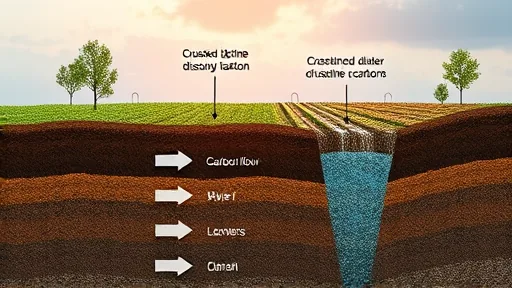
Here is the number that matters. Records of river alkalinity fluxes suggest that approximately 90 percent of the ideal CO2 removal potential of agricultural lime added since 1900 — roughly 0.44 GtCO2 — has been realized at the catchment scale. [1] That is not a model projection. It is a measurement drawn from a century of water chemistry.
The catch is timing. The carbon removal arrives with a decadal-scale time lag, owing to soil cation exchange and solute transport. When lime meets acidic soil, the chemistry does not finish in a season. Positively charged mineral ions trade places with hydrogen ions on soil particles, and the dissolved products then migrate slowly through groundwater toward streams. Reactive transport modelling of soil cation throughput traces this sequence: net CO2 removal emerges only after an initial emissions pulse tied to the neutralization of soil acidity pools.
The ledger, in other words, has two columns, and they settle on different clocks. The short-term column shows emissions. The long-term column shows storage. Which column matters depends entirely on the timescale in question.
The finding, published in Nature, carries a direct practical implication. [1] Optimized soil pH management can reduce agricultural greenhouse gas emissions while simultaneously improving crop yields and soil health. [1] The same lime that makes a field more productive also, over decades, draws carbon out of circulation.
What Else Could Rewrite Its Books
If the
Mississippi result holds, the question becomes which other fields have been keeping the wrong ledger. The reactive transport framework applies wherever carbonate minerals meet anthropogenic acidity — and anthropogenic acidity is not a uniquely American product. Industrial regions across Europe and Asia have loaded soils with the same sulfur and nitrogen compounds for a century or more. Each of those landscapes is a candidate for the same recalculation.

The deeper lesson concerns counterfactuals in carbon accounting generally. Any practice that neutralizes a human-caused disturbance looks like a polluter when measured against a pristine baseline, and like a remedy when measured against the disturbed one. Getting the baseline right is not a technical footnote. It decides whether a farmer’s lime truck is entered as an emissions source or a carbon sink.
What remains open is the question of scale. The Mississippi River Basin study covers a century and approximately 0.44 GtCO2 of realized removal potential. Nor is it settled how quickly optimized pH management could be deployed across working farmland, or how carbon markets would price a benefit that takes decades to arrive. Those are the measurements the next round of research will have to supply, and they will determine whether the Mississippi result becomes a template or an outlier.
Sources
1. DOI: 10.1038/s41586-026-11040-2