Mosquitoes Expanding Faster Than Surveillance Maps Can Track
When the Instruments Themselves Fall Behind
The UK Health Security
Agency issued a warning earlier this month: travellers heading abroad for the summer holidays should protect themselves against mosquito-borne diseases. That advisory is not a seasonal ritual. It is a signal that the geography of risk has shifted faster than the systems built to track it.
A surveillance map measures only what clinics report. When mosquitoes move into regions where no clinic is watching, the map stays blank — not because the danger is absent, but because the instruments point elsewhere. The record-breaking numbers now being logged are, in part, a measurement artifact finally catching up with a reality that was already present.
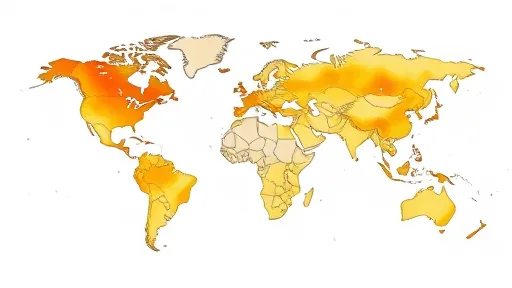
Four charts published in Nature lay out how mosquitoes are conquering the world. [4] Climate change and other human influences are allowing the insects to expand their range. The charts do not show a single dramatic jump. They show a steady, cumulative widening — the kind of change that stays invisible until it is plotted across years.
Which Other Fields Are Already Reading the Same Signal
The question is not whether public health will eventually absorb this. It is which adjacent fields are already working the same problem from a different angle, and whether their findings can be connected.
One bridge comes from mathematical biology. A team led by C. J. Carlson and colleagues, writing in Biology Letters, examined how the conditions that favour mosquito expansion intersect with the conditions that favour the pathogens the insects carry. [1] The work does not treat mosquito and virus as separate variables. It treats them as a coupled system whose joint range can be mapped.
A second bridge comes from climate and health geography. C. Barcellos, V. Matos, R. M. Lana and R. Lowe, publishing in Scientific Reports, analysed how environmental suitability for mosquito vectors translates into actual transmission risk across a landscape. Their contribution is not a new trap or a new repellent. It is a method for connecting environmental data to human case data at a resolution fine enough to reveal local variation that national averages hide.
A third bridge comes from entomology itself. G. Z. Laporta and colleagues, in the journal Insects, examined how vector species respond to changing thermal and hydrological conditions. The finding that matters here is not a single threshold. It is that different mosquito species cross their own thresholds at different points — so a warming trend does not move one uniform front. It moves several fronts at once, each with its own speed.
The Group Already Working on the Next Stage
At the level of molecular mechanism, R. Pabst and colleagues, publishing in Nature Communications, investigated how environmental temperature shapes the interaction between mosquito and pathogen at the cellular level. This is the step below the map. It asks why a warmer environment does not merely move mosquitoes into new territory but can also alter how efficiently they transmit what they carry.
The World Health Organization’s Global Health Observatory maintains the surveillance architecture that these findings feed into. [5] The UK Health Security Agency’s travel advisory is one downstream output of that architecture. [3] Neither body is waiting for a single breakthrough. Both are integrating incremental findings — from Carlson’s coupled-systems model, from Barcellos and colleagues’ landscape method, from Laporta’s species-specific thresholds, from Pabst’s cellular work — into the operational picture that produces a warning like the one issued this month.
H. Kang and colleagues, writing in BMJ Global Health, provide the connective tissue. Their work examines how these disparate lines of evidence — environmental, entomological, molecular, epidemiological — can be assembled into a coherent assessment of risk. The record-breaking season now underway is not a surprise to anyone working on this.
Sources
1. DOI: 10.1038/d41586-025-03966-w
2. The World Health Organization
4. Nature