
US China Tariff Cuts Face Holiday Deadline
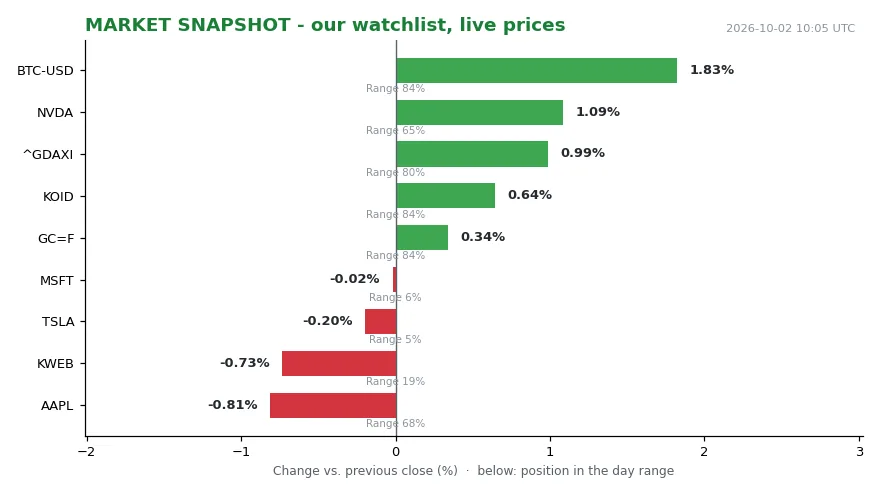
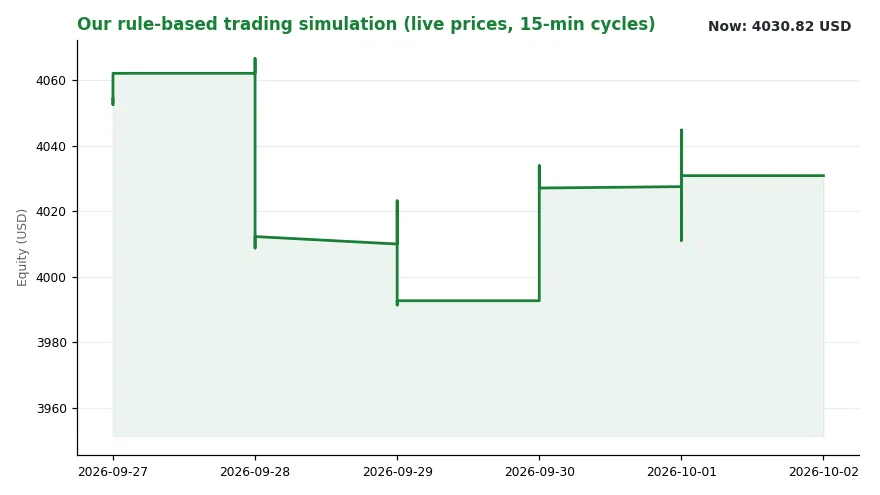
KWEB trades at 24.33, down 0.73 percent, at 19 percent of range (where today’s price sits between the period’s lowest and highest price). Gold prints 4,211.80, up 0.23 percent, holding 77 percent of range. Bitcoin runs 86,374.27, up 1.80 percent, near its high at 83 percent. Three numbers, one read. Desk read: Risk appetite lives in crypto and bullion. Desk read: It is absent from the China internet basket. Our rule-based simulation holds 2,020.64 dollars in cash and 4,030.82 dollars in equity, flat versus yesterday. The latest decision was WATCH KWEB. The busiest signal channel (the category of news the desk’s model flags as driving the tape) on October 1 was “central banks,” three events. The regime reading (the desk’s label for the current overall market state): falling trend, level 3.63. Desk read: The tape shows no China bid. Desk read: That gap is the story.
On Monday, Washington and Beijing announced plans to cut tariffs (taxes a government charges on goods crossing its border) on 30 billion dollars of goods each way [1]. The clock that matters is the holiday season. The U.S. list leans toward toys, sports equipment and Christmas decorations [1]. China’s list is far longer and runs heavily toward American farm products [1]. Miss the window and the biggest consumer quarter of the year closes without them.
Three readings of the deal are forming, and each one rests on a different part of the text.
The seasonal optimists
The first camp sees a genuine seasonal gift. Jacob Cooke, CEO at WPIC, framed the mechanism. “If we see the tariff cuts actually implemented before the holiday season, it could provide a welcome boost to U.S. consumption and to retailers,” he said [1]. The channel is straightforward. A tariff is a border tax. Lower the tax and the landed cost (the total price of a good once it has arrived at the buyer, import tax and shipping included) falls. Some lands in margin (the profit left after subtracting costs from the sale price), some in price. The U.S. list reads like a holiday inventory checklist: toys, sports equipment, Christmas decorations. Few of these goods are strategic. Almost all are fourth-quarter purchases.
The fine print
The second camp points at the fine print. The announcement left two questions open: when lower tariffs would take effect, and by how much the duties would fall [1]. Those unknowns decide whether a cut reaches a container ship before November. The starting level matters as much as the cut. The U.S. and China last year slapped import tariffs effectively of over 40 percent and more than 30 percent, respectively, on each other [1]. A trim from that level is real, but it is still a trim. Washington has chased a record goods trade deficit (the gap by which a country’s imports exceed its exports) with Beijing. That deficit was more than 202 billion dollars last year [1]. Thirty billion dollars each way does not close a gap of that size. What both sides did commit to is procedural. After a one-year truce last fall, they limited further tariff increases [1]. Last week, negotiators agreed to extend that truce to January [1]. January is the backstop.
The institution builders
The third camp treats the deal as a framework, not a fix. Monday’s announcement followed a summit between President Donald Trump and President Xi Jinping in Washington, D.C. [1]. The meetings ran three days and ended September 25 [1]. The two sides said the U.S.-China “Board of Trade” would consist of officials from both governments [1]. It would meet at least once a quarter, top officials “whenever necessary” [1]. That is an institution, not a headline, and institutions outlast news cycles. A quarterly body sets the pace of everything downstream. And the same meetings opened a second track. The two governments agreed to a bilateral dialogue on artificial intelligence [1]. The next round is planned for November [1]. The two countries intend a communication channel for AI-related incidents [1]. The White House calls it the US-China “Super Intelligence” Dialogue [1]. China’s Foreign Ministry keeps calling it an artificial intelligence dialogue [1]. Beijing said the two sides should increase communication as the technology develops [1]. The tariff file and the AI file now move together.
The mechanism
The mechanism runs through cost, price, then margin. An importer pays the tax on an imported good at the port. Duty is a cost line. The seller absorbs it or passes it on. For thin-margin, high-volume goods, a few points decide profit or loss. Cooke made that point about China’s import list. “Every percentage point counts for price competitiveness and preserving margin,” he said [1]. The asymmetry between the two lists is the part that travels furthest into prices. The American list is consumer and holiday. The Chinese list is farm gate (the price of a farm product at the point it leaves the farm). Farm gate prices move with weather and harvests, not with holiday shopping calendars. One side is buying party supplies, the other is buying dinner, and the two do not respond to the same calendar.
Who wins, who loses, who decides
On the U.S. side, the winners are retailers who import holiday goods and the shoppers who buy them. On the Chinese side, exporters in competitive categories. Categories to watch include hair care and packaged pet food. There, Chinese brands are highly competitive against U.S. offerings [1]. The losers are domestic producers who compete on price against the newly cheaper imports. The decision sits with the Board of Trade and the two governments behind it. The cadence is quarterly, with top officials meeting “whenever necessary” [1]. Until the effective date and the size of the cut are published, the holiday window stays open on paper only.