Mega Escarpment May Explain Earths Missing Billion Years
The Case of the Absent Billion Years
A river scoured a channel. A desert left no trace. Wind blew sand away before it could harden into stone.
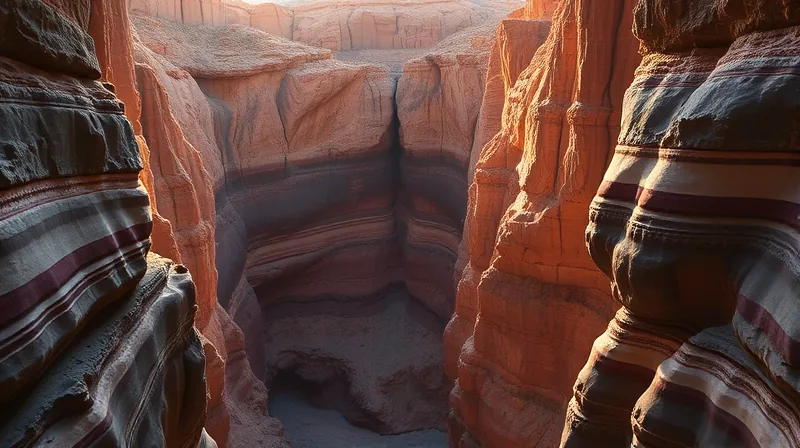
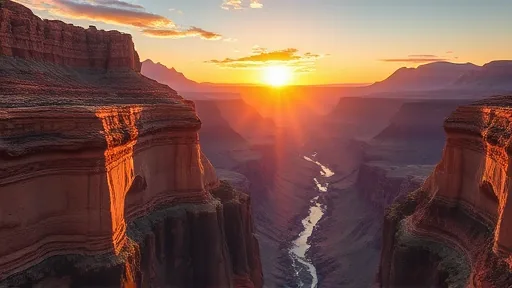
But the Grand Canyon does not offer a simple absence. Its walls preserve a nearly continuous archive of Earth’s history stretching back roughly two billion years. Layer upon layer, sandstone atop limestone atop shale, each one a page in a book that has been sitting open for eons. Then, between about 520 million and 1.8 billion years ago, the pages stop. [2] Not torn out one by one. Not faded. Simply gone — as if an entire wing of a museum had been emptied overnight, display cases and all, and no one left a note.
That missing interval is one of the coldest cases in geology. It has a name, the Great Unconformity, and it appears not just in Arizona but on every continent where ancient rocks meet younger ones. The gap is not a local curiosity. It is a planetary signature, and for more than a century geologists have argued about what could remove a billion years of rock from the face of the Earth.
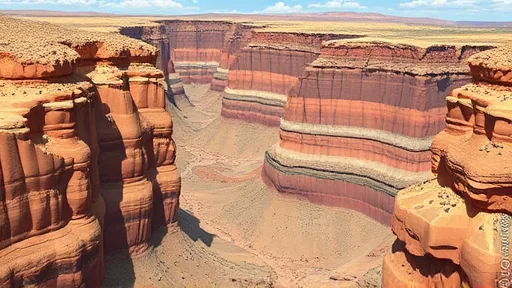
A new study proposes an answer that is almost absurd in its scale: a cliff. [2] Not a canyon wall, not a sea bluff, but a single escarpment that may have stretched across much of the ancient supercontinent Laurentia, the precursor to North America, from what would become Alaska all the way to Arizona. The mechanism is erosion by retreat, a cliff face migrating backward across a landscape, eating into the crust and carrying the debris away to some distant basin. Thomas Gernon, an earth scientist at the University of Southampton in England, and colleagues report August 17 in the journal Geology that this mega-escarpment, combined with a global glaciation acting as an accomplice, could account for the vanished strata. [2] What makes the proposal striking is not the violence it implies but the patience. The arithmetic is unremarkable. The consequence is a billion-year hole in the record.
The Rocks That Refuse to Fit
The data that do not fit the simple model are the basement rocks themselves. These are the oldest, lowermost units exposed in the canyon, crystalline igneous and metamorphic bodies that formed deep in the crust and had no business being at the surface. For them to be exposed today, something had to lift them or strip away everything above them. The new study points to erosion along the ancient escarpment as the agent that brought them up, not a tectonic elevator but a slow, relentless shaving of the overlying cover.
The Great Unconformity is not a single line on a single wall. It is a global surface, found where ancient cratons meet younger sedimentary sequences. In some places the missing time is shorter; in others it is longer. The variability is part of the puzzle. A single river cannot explain a gap that appears on separate continents. A single glacier cannot either, unless the glaciation was itself global — and the study invokes exactly that, a worldwide ice age whose sea-level drop would have exposed continental margins to erosion on an unprecedented scale.
That is not a small omission. It is a span longer than the time since complex life first appeared, and it covers the assembly and breakup of supercontinents, the first stirrings of multicellular organisms, and the chemistry of an oxygen-poor ocean. The rocks that should have recorded the assembly and breakup of supercontinents, the first stirrings of multicellular organisms, the chemistry of an oxygen-poor ocean — all of it is absent from the canyon’s walls. The escarpment hypothesis does not merely explain a local gap. It offers a mechanism for a planetary one.
The glaciation as accomplice is not a decorative detail. Ice lowers sea level. Lowered sea level exposes rock. Exposed rock erodes. The chain is simple, and each link is testable. What the study adds is the geometry: a cliff, not a gentle slope, is the most efficient erosional engine a continent can have.
The missing wing of the museum did not just remove exhibits. It rearranged the floor plan for everything that came after.
The Next
Test of a Cold Case
The next step is replication: testing whether the escarpment’s inferred path matches the distribution of the Great Unconformity across other continents, and whether the timing of the global glaciation aligns with the erosion the model requires. Gernon puts the open question plainly: it remains unclear whether the erosion that erased the rocks occurred before, during or after the Snowball Earth glaciations. If the cliff retreated where the gap is deepest, and if the ice advanced when the gap was cut, the case strengthens. If not, the hypothesis joins the long list of explanations that looked elegant on one wall and failed on another.
The same team has already shown the mechanism at work elsewhere. In a separate study published in Science, Gernon and a team explained how an escarpment created by tectonic activity was responsible for the formation of the East Antarctic Ice Sheet starting some 34 million years ago. The exposed rocky peaks of the escarpment, Gernon says, would have acted as glacier factories.
The Grand Canyon remains the best natural laboratory for this problem because it exposes the unconformity so cleanly. But the canyon is not the only witness. Gernon’s team points to modern-day examples where similar erosive processes are at work, including a similar escarpment in Antarctica as well as one in South Africa. The study’s contribution is to give the community a specific, falsifiable prediction: look for the cliff’s signature in the rock that remains, not just in the rock that is gone.
For now, the mystery of the missing billion years has a new suspect and a new map. The simplest explanation — that nothing was deposited — has been the wrong one for decades, because the basement rocks are there, and they should not be. Something removed what was above them. The argument is that a cliff did it, with ice as its partner, and that the evidence is written in the shape of the surface that remains. Alan Collins, a geologist at Adelaide University in Australia who was not involved in the new study, finds the case convincing: linking the disappearance of the rocks to verified events in Earth’s history such as the breakup of Rodinia bolsters it. Whether the case holds will be decided not by one canyon but by many, and not by one study but by the slow accumulation of independent lines of evidence.