A Signature That Cancels a Signature
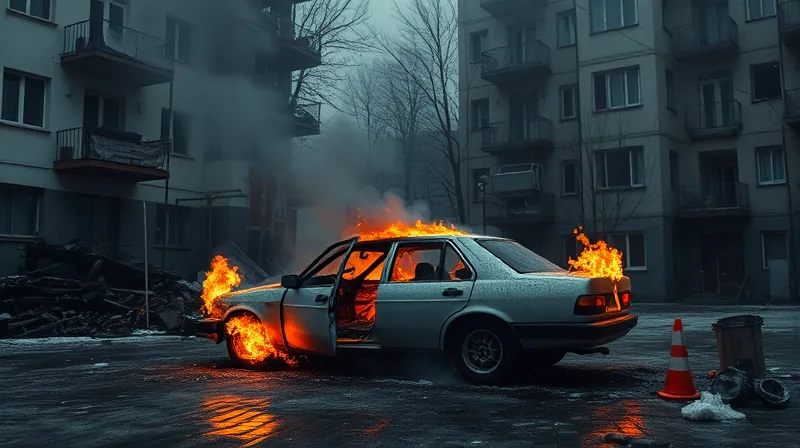
In Kyiv this week a mobile blast shelter stood at street level, installed for the minutes between the air raid alert and the impact. In Zaporizhzhia, a policeman took an elderly woman by the arm and walked her out of a residential building whose front had been torn away by a Russian airstrike; a car in the courtyard was still burning. Neither of them was making policy. Both were absorbing it. The policy itself landed on a Friday in October 2026, in Washington, and it came as a document rather than a missile: an executive order, which is a presidential instruction that sets aside the effect of a law Congress has already passed and the president has already signed. Its subject was Russia. Its consequences will be counted in Kyiv, and in the countries the law was written to reach, long before they are counted anywhere in the United States.
The law has a full name: the Lindsey O. Graham Sanctioning Russia and Iran Act of 2026, named for the late senator from South Carolina who championed it. It arrived at the White House with a margin that has become rare: the Senate passed it 86-11, and the House passed it with bipartisan support. Trump signed it in September 2026. It was due to take effect two days after the October 16, 2026 order stopped it. What the text contained matters more than the vote count, because the vote is politics and the text is mechanism. It authorized a tariff of up to 100 percent on goods from the top five importers of Russian oil or natural gas — a tariff being a tax collected at the border on goods entering a country, which means a rate of 100 percent doubles the price of the import before it reaches a shelf. China and India are named as possible targets, since both are large buyers of Russian crude. The act also reached Russian officials, Russian banks, the energy sector and the so-called shadow fleet: the tankers that keep Russian energy supplies moving while sitting outside the ordinary channels of shipping and insurance. One clause opened an exception for countries that have taken significant steps to reduce imports of Russian natural gas. The law’s architecture matters. Instead of sanctioning only the seller, the law put a price on the buyer, so that purchasing Russian crude would carry a cost that shows up in the purchaser’s own trade with the United States.
In October 2026, Trump put the package on hold and told Congress the pause “is in the national interests of the United States.” That single phrase is the whole public justification in the order, and it is broad enough to cover any policy at all. Moscow’s reaction was not subtle. Kirill Dmitriev, the Russian presidential envoy, wrote on social media about the administration’s suspension of the Graham Act. Historic is the right word, though probably not in the sense he meant: a law passed by both chambers and signed by the president had been switched off before its first day of work. The criticism in Congress came from both directions. Richard Blumenthal, a Democratic senator from Connecticut, criticized the move and argued that the waivers had nothing to do with national security and everything to do with accommodating Vladimir Putin. Thom Tillis, a Republican senator from North Carolina who is retiring at the end of his term, called the move beyond irresponsible and asked what part of enforcing a law passed 86-11 by the Senate the President and his advisors did not understand. That question is procedural, and that is precisely why it lands. The waiver does not argue that the law’s content is wrong. It argues that the content does not have to be carried out.
The timing is not a detail. One day after the October 16, 2026 suspension, Russia launched one of its worst strikes yet on Ukraine’s energy infrastructure, hitting critical power generation and transmission facilities and causing what Zelenskyy described as severe consequences. Generation and transmission are the two halves of a grid: one makes the power, the other moves it, and a system that loses both cannot be balanced. The pattern points at a purpose — to make Ukrainian cities unlivable before winter, to push people out of flats with no heat and no light. Zelenskyy answered on Saturday, October 17, 2026, in a statement and then in messages to journalists, and he framed the American decision as a reward for Vladimir Putin, warning that it would embolden the Russian leader and intensify the war. His statement read: “A US sanctions blackout, easing pressure on the aggressor, financial rewards for Putin — all of this only encourages him to keep attacking. We must not give up ground.” [1] He then addressed the suspended law directly, saying it could have helped a great deal and still could, but that the law needed to actually work and that every voice in support of it mattered. That sentence has a specific audience, and it is not in Moscow. It is the chamber that voted 86-11.
Three Hundred Thousand Tonnes and a Ceasefire
The diesel deal is where the money is. [2]. Under the arrangement Trump announced in the week of October 9, 2026, Russia would immediately supply hundreds of thousands of tonnes of diesel. A further delivery would follow in November 2026. Then further deliveries would follow “immediately thereafter,” and additional deliveries “within a short period of time” after that. The stated purpose was to bring down global energy prices. Volumes matter here because a fuel market clears at the margin—meaning the price is set by the last buyer and seller willing to trade—so added supply moves the number on the pump, and every tonne sold also moves money to the seller. Those two effects are not in tension. They are the same transaction, viewed from two ends. The suspended sanctions package had been built to close exactly that channel, and the waiver reopened it at the moment the diesel began to flow.
The deal did not come out of nowhere; it came out of an argument about prices. Trump has blamed Ukraine’s strikes on Russian oil refineries for the worldwide spike in diesel costs. He has played down the closure of the Strait of Hormuz as a cause and pointed at the war instead. On that reading, the fastest route to a lower price runs through Kyiv rather than Moscow, and that is the reading that shaped the demand he made: that Ukraine halt its attacks on Russian refineries. Ukraine halted them unilaterally after Trump declared an “energy ceasefire” last week. It resumed them when it became clear that Russia was stepping up its attacks on Ukrainian power plants and substations. The sequence is the entire disagreement in miniature. A pause that one side observes and the other does not is not a ceasefire; it is a timetable. A refinery that keeps running keeps producing diesel, and a refinery that is struck does not, which is why an industrial facility inside Russia became an instrument in a negotiation about American fuel prices.
Zelenskyy read the diesel arrangement as a precedent rather than an exception. “Unfortunately, the lifting of sanctions will continue, and I believe that the diesel deal is the first step,” he told journalists. [1] He went further: “Unfortunately, it seems to me that this cannot stop Putin; on the contrary, he feels joy and happiness that he has such support.” [1] If the diesel deal is step one, the obvious question is what step two looks like, and the only instrument on the table that fits the description is the one that was just suspended. There is an asymmetry in the two instruments that explains the choice without excusing it. Sanctions are slow: they work by raising the cost of a transaction, and cost has to bite for months before it changes a decision. A fuel delivery is fast: the cargo arrives, the price at the pump responds within weeks. Any government that wants a visible price decline therefore has a structural incentive to trade the slow instrument for the fast one, even when the slow instrument is the one aimed at the war’s revenue.
Buried in the same statement was a shift in diplomatic architecture that will outlast the week. Zelenskyy called for Europe to establish its own negotiations with Moscow, at a moment when Washington has been seeking better ties and business deals with the Kremlin. That is a request from a government that no longer assumes its principal ally is negotiating on its behalf. It also reframes the quarrel between Trump and Zelenskyy: what began as a dispute over tactics has become a dispute over who sets the terms on which the war ends, and who pays for those terms.
One Hundred Miles an Hour in Ukraine

The Starlink episode is smaller than a sanctions waiver and, in one respect, more revealing, because it can be tested. On Tuesday the service was throttled inside Ukraine without warning. The military-grade terminals used by Ukrainian forces would disconnect from the network when travelling faster than 161 km/h, or 100 mph — a threshold that interferes with drone operations. Then the Ukrainians ran an experiment. They sent vehicles carrying the terminals into European Union countries. There, the same equipment kept working at speeds above 180 km/h. “The conclusion is clear: the restrictions are in effect within Ukraine but do not apply within the European Union,” Zelenskyy’s statement read. “In other words, this is a planned operation.” He had already described the throttling as a “deliberate operation… to prevent us from defending ourselves.” A speed limit that applies on one side of a border and not on the other is not a technical fault, because a technical fault does not read a map.
The same week brought a second squeeze that is harder to photograph. Several times, the United States did not provide intelligence of impending ballistic missile attacks to Ukraine. Warning time is the input that makes interception possible at all: a ballistic trajectory gives defenders minutes, not hours, and a battery that is not told where to look is a battery that fires late or not at all. The White House reportedly ordered the Pentagon to throttle the military-grade version of the satellite network Ukraine’s armed forces rely on. [2]. Set the three together — the money channel closed by the waiver, the connectivity channel narrowed by the throttle, the warning channel withheld — and the pattern is a squeeze applied at the points where a defense is most dependent on someone else’s decision.
Ukraine’s capacity to answer the strikes is finite and shrinking. Zelenskyy indicated that the country’s stock of anti-air weapons made it difficult to bring down many of the loitering munitions, cruise missiles and ballistic missiles launched each night. “Although our warriors are shooting down a significant number of them,” he said, the “sheer scale and unrelenting pace of Russia’s strikes, specifically against our energy sector, are unfortunately having severe consequences.” That is a sentence about arithmetic, not morale. Interceptors are consumed faster than they are produced, and a campaign designed to exhaust them does not need to hit every target; it needs to keep the defender firing. The strikes on more than 15 generation and transmission facilities were not an isolated outrage but a schedule, and schedules are what a winter is made of. [1].
What this week makes obsolete:
- The reading of the Starlink slowdown as a technical fault — a terminal that runs at 180 km/h in the European Union and stops at 161 km/h in Ukraine is not malfunctioning, it is being managed.
- The assumption that a presidential signature starts a countdown — the Graham Act was two days from operation when it stopped.
- The idea that an 86-11 Senate margin settles a question — the margin was real, the enforcement turned out to be optional.
- The 100 percent tariff as a threat with a date attached — the date passed without a tariff, and the buyers it targeted are still buying.
- The “energy ceasefire” as an arrangement both sides keep — Ukraine halted its refinery strikes, then resumed them when the attacks on its substations continued.
- The diesel deal as a single transaction — in Zelenskyy’s reading it is the first step of a sequence whose next steps he expects to arrive.
- The assumption that Kyiv’s allies are negotiating on Kyiv’s behalf — hence the call for Europe to open its own channel to Moscow.

- The belief that Ukraine’s air defense can hold the current tempo — the stock of interceptors and the pace of launches are moving in opposite directions, and the grid is where the difference shows.
Sources
Mentioned organisations (context, not sources)
- United States Congress — Organisation (homepage)
- United States Senate — Organisation (homepage)
- United States House of Representatives — Organisation (homepage)
- Pentagon — Organisation (homepage)
- Starlink — Organisation (homepage)
- European Union — Organisation (homepage)
- Kremlin — Organisation (homepage)
- Armed Forces of Ukraine — Organisation (homepage)