Geothermal Energy Unlocks Earths Deep Heat
The Crust That Refuses to Cooperate
The Earth’s deep heat is locked behind three conditions that rarely occur together: heat, water, and fractured rock. The vault holds enough energy to power human civilization for millennia. The keys? Heat, water, and fractured rock. For most of the world, only one or two of these keys are within reach. Iceland, sitting atop the mid-Atlantic ridge, possesses all three in abundance. The 1970s oil crisis pushed Iceland to exploit this advantage. Geothermal now supplies over a quarter of the country’s electricity. The plants run regardless of weather, providing a steady backbone for the grid. “Geothermal is really well placed to be the glue that will make low-carbon electricity systems work,” says Iain Staffell, a sustainable energy expert at Imperial College London. [2] But most countries lack Iceland’s geological fortune. They may have heat deep underground, or water in the rocks, or natural fractures — but rarely all three at accessible depths.
The counterargument to geothermal expansion has always been geological determinism. Conventional plants mine heat from less than 2 kilometers underground. Beyond that depth, engineering becomes brutal. Drills must chew through hard, hot rock. The vertical shafts connecting surface to heat reservoirs, called wells, must survive punishing temperatures and pressures. Even after all that, the rock may still be too tight and unbroken for water to flow through it. The International Energy Agency estimates geothermal’s technical potential at roughly 150 times current global electricity demand — but only if engineers can exploit heat down to about 8 kilometers. [3] Conventional methods tap pre-existing reservoirs of hot water or steam in permeable, fractured rock less than 2 kilometers deep. That leaves most of the potential locked away.
The question of scalability remains open. “If you measure in terms of the energy stored within the Earth’s crust, geothermal heat exceeds by orders of magnitude all hydrocarbons,” says Matt Houde, co-founder of Quaise Energy. But accessing that energy requires solving the three-key problem everywhere on Earth, not just in geologically privileged regions. The first generation of new techniques attempts to create the missing keys artificially.
Forcing Open the Locked Door
Enhanced geothermal systems (EGS) target hot but impermeable rock, typically 2 to 10 kilometers underground. Engineers pump in hot water at high pressures to open or widen fractures, creating pathways for fluid to circulate. This is the most mature technology in geothermal’s new era. It works like a hydraulic jackhammer applied to the deep crust. But forcing water into deep rock does not only create useful cracks. According to a 2023 review of the research, it can also disturb older, pre-existing faults already under strain. Many faults are held still by friction, like a heavy book resting on a tilted table. Pump water into them, and the pressure in their pores and fractures rises. That partly props the two sides of the fault apart, reducing the force clamping them together. If the fault was already close to slipping, that can be enough to induce an earthquake.
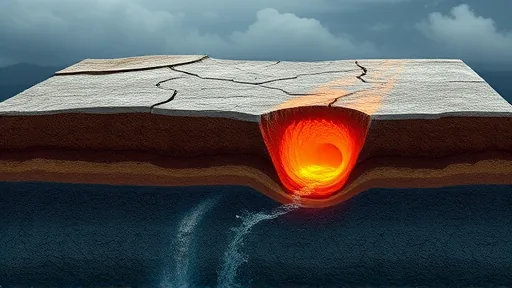
The counterargument here is that human intervention in deep geology carries inherent risk. An investigation commissioned by the South Korean government concluded that a nearby EGS project triggered a magnitude-5.5 earthquake in the city of Pohang in 2017. More than 80 people were injured. The earthquake caused an estimated 300 billion Korean won (148 million pounds) of damage, making it the most destructive in the country’s history. Bill Ellsworth, a geophysicist at Stanford University in California, was part of the team that helped establish the geothermal plant’s role in the disaster “In Pohang, they drilled a couple of wells that were a long way apart,” he says. The hope was that pumping water into one would fracture the rock enough to connect with the other, creating a route for water to pass between them and gather heat. But trying to force that kind of connection through the subsurface is risky, particularly if drilling intersects faults already primed to slip.
The question of scalability now includes seismic safety. Newer projects are trying to be more deliberate, says Ellsworth. In Iceland, engineers create EGS reservoirs more gently. They pump cold water slowly and at relatively low pressure, avoiding sudden blasting. Over months, the cooling rock contracts and cracks, says Lilja Magnusdottir, executive vice president of resources at Icelandic energy company HS Orka. Iceland also has an advantage born of necessity: it is a seismically restless place, so the country has already invested heavily in monitoring. At HS Orka, that now includes using geothermal wells themselves as early-warning sensors. When magma begins to move, it compresses the surrounding rock, creating a telltale signal in the well. “It’s a really cool design,” says Magnusdottir. But even where EGS projects have learned to manage seismic risk, hard rock still makes an unreliable basis for a plumbing system. Fluid can leak away and contaminate groundwater. The same fractures that make the system useful can also make it dangerous.
Building a Radiator Inside the Earth
One way around the fracture problem is to stop asking the rock to carry water at all. Where natural fractures and reservoirs do not exist, an alternative to EGS is to drill a sealed loop through hot rock. Engineers drill down, then sideways, until the boreholes connect underground. They line and seal the loop with steel and cement. This creates something like a buried radiator. Fluid circulates inside the sealed system but never comes into direct contact with the rock itself. This closed-loop system is known as an advanced geothermal system (AGS). It has been tested successfully in Germany, where Canadian energy company Eavor developed a geothermal power plant at Geretsried. Construction began in 2022, and the plant started producing electricity in 2025.
The counterargument here is that closed-loop systems avoid the seismic risks of EGS but face different challenges. They must drill deeper and more precisely, connecting boreholes underground with millimeter accuracy from the surface. The steel and cement must survive punishing temperatures and pressures for decades. The fluid inside the loop must transfer heat efficiently without degrading the materials. And the economics must work: drilling deep, horizontal wells and sealing them costs significantly more than conventional geothermal wells. The Eavor plant at Geretsried represents a proof of concept, but whether the economics scale to commercial viability remains unclear.
The question of scalability now includes cost and depth. “Ultimately, the whole world is the goal,” says Quaise Energy’s Matt Houde. His company pursues an even more ambitious approach: using millimeter-wave drilling technology, originally developed for nuclear fusion research, to vaporize rock and drill deeper than conventional methods allow. The idea is to reach temperatures of 400 degrees Celsius or more at depths of 10 to 20 kilometers, where heat is abundant almost everywhere on Earth. The vaporized rock cools and solidifies behind the drill, creating a glass-lined borehole that requires no steel casing. This approach could theoretically make geothermal power viable anywhere, not just in geologically privileged regions. But the technology remains experimental. No full-scale plant has been built. The question of whether closed-loop systems, enhanced fracture systems, or deep drilling will ultimately prove scalable — economically, safely, and reliably — remains open. The Earth’s heat is inexhaustible, but whether closed-loop systems, enhanced fracture systems, or deep drilling will prove scalable — economically, safely, and reliably — remains an open question for engineers worldwide.
Sources
3. International Energy Agency
6. HS Orka
7. Eavor