A Test Pit That Refused to Stay Empty
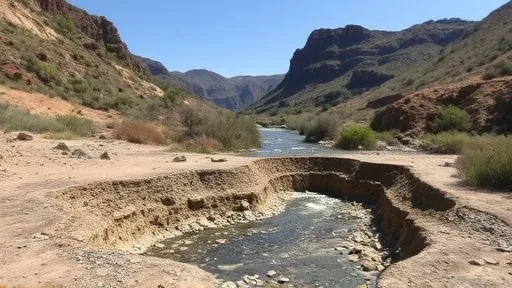
The Côa valley in Portugal is a dry, schist-walled corridor that runs some 17 kilometres along a river, and it holds the largest open-air collection of Palaeolithic rock art in the world. The engravings were first found in 1991. For three decades after that, one question hung over the site like the pre-dawn dark at Penascosa: did the people who carved these animals actually live here, or did they travel in, mark the stone, and leave? The doubt was practical. An open-air site beside a river should have had its occupation layers scoured away by floods. That was the consensus in 1995, and it held for a generation.
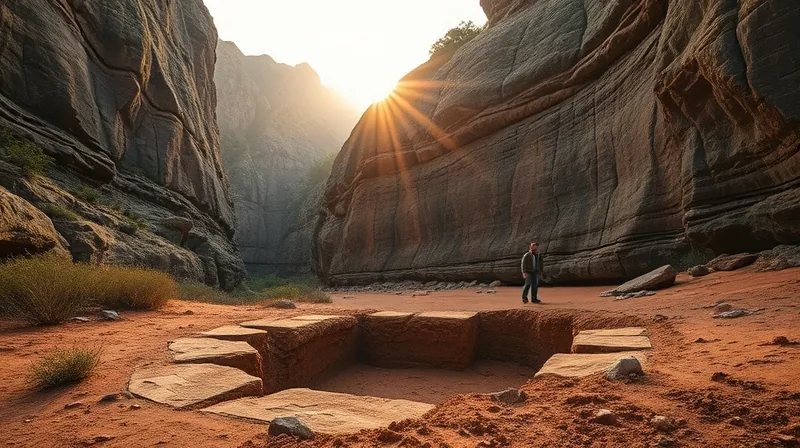
The breakthrough came sideways. In 2025, a test pit dug directly in front of Penascosa’s Rock 3 — a panel carrying a series of overlapping animal motifs — turned up fire-damaged rocks and flaked stone tools matching the late Gravettian and early Solutrean styles. [1] Nobody had set out that season to solve the riddle of the artists’ address. The pit was a probe, and it struck the thing everyone had stopped expecting. Thierry Aubry of the Côa Park Foundation puts the logic plainly: if you don’t look, you don’t find.
Returning to Penascosa last month to open the ground properly, Aubry’s team uncovered buried slabs of schist that had once formed a natural overhang, beneath which ancient hunter-gatherers had taken shelter until the heat from their campfires caused it to collapse.
The artefacts came up in sequence, tracing occupation from the Palaeolithic through to Roman times, a span of human history layered one age upon the next. This is where Côa separates itself from the painted caves of western Europe. Lascaux and its kin were sealed off, time capsules. The Côa valley stayed open, and generation after generation kept using the same stage. On the final day of the dig, the team reached the Gravettian layer, roughly 27,000 years old, and found thumbnail-sized slivers of razor-sharp stone — bladelets made as hunting weapons. “This technology is typical from 26,000 years ago,” Aubry says. [1] It is the first time material this old has been found beside the art.
A Shared Code Written on the Rocks
The bladelets carry a second story in their raw material. One piece of flint came from central Spain, at least 150 kilometres away; another came from central Portugal, 200 kilometres the other way. Two stones from opposite horizons, resting together in one 27,000-year-old layer: the valley sat at the heart of a vast exchange network spanning half of Iberia.
The stylistic parallels follow the same map. The engravings at Côa resemble work in northern Spain and as far off as the Rhône valley in France, and similar open-air engravings have since been found as far away as the Nile valley. João Zilhão of the University of Lisbon, who set up the Côa Valley Archaeological Park in 1996, reads this as “a shared code of representation” — the property of a network that moved information, personnel and objects across a wide zone of cultural homogeneity. Luís Luís of the Côa Park Foundation adds the geography: the valley is a natural border between the Atlantic coast and the Iberian interior, which makes it a meeting place by default.
What did people do when they met? At Fariseu, another decorated site in the valley, Aubry points to a repeating composition: four female aurochs, each with a calf, apparently walking toward the river. The calves all appear to be around six months old. Aubry reads that as a specific moment in the year — and possibly a hunting moment. The images, in his account, carried mythology and practical information at once: a way to show outsiders which group you belonged to, and a record of when and how the great herds could be hunted. “I don’t think it was meant for the people from here,” he says of the panel. [1] “It was for people coming from other regions.” The social reading extends outward. Zilhão compares the Côa hunter-gatherers to certain Aboriginal Australian communities who still use rock art in a comparable way: they decorated the territory they lived in. Luís draws the conclusion the stone tools support — these populations were not isolated bands but participants in a recurring gathering at a natural border between the Atlantic coast and the Iberian interior. “The art was used in moments when distant groups came together,” he says.