Mangrove forests face carbon loss under rising seas
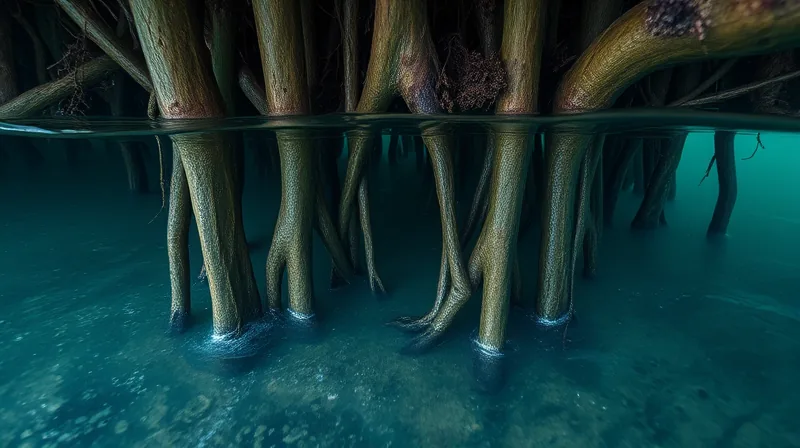
I am a mangrove root. Not the part you see—the arched knee that breaks the water’s surface, the breathing spike that punctures the mud like a snorkel. I am the hidden part. The underground tangle. The net of fibers that holds the soil together grain by grain, century by century. My grip is what keeps the carbon where it belongs.
I have been holding for three hundred years.
Every tide brings me a gift. Silt from the river. Dead leaves from my own branches. Microscopic shells from creatures I will never see. I weave these offerings into the mud beneath me. Layer upon layer. The carbon stays trapped in this dark cathedral of soil, sealed away from the air that would turn it into carbon dioxide.
But something is changing.
The water stays longer now. It does not retreat the way it used to. My breathing roots—the pneumatophores that rise above the mud like thin fingers—they are underwater for hours that stretch into days. I cannot breathe like this forever. I cannot hold.
Track One: The Human Story
In a laboratory at the University of Exeter, Dr. Arya Iwantoro sat staring at a screen that showed a mangrove forest that did not exist. [2] Not yet. The forest on his monitor was a simulation—a digital twin made of equations and probabilities. But what it revealed was real enough to make him pause.
Iwantoro had spent years walking through actual mangrove forests. He knew the smell of the mud at low tide, the sound of crabs scuttling through the roots, the way the light filters through leaves that are slick with salt. But the forests he studied in person could only show him the present. They could not show him what happens next.
So he built a model that could.
The model was not simple. It was three models woven into one: a water flow and sediment transport model, a mangrove growth and dieback model, and a carbon storage model that tracked the changing composition of muddy beds. Iwantoro and his colleagues—Luisa Fernanda Gómez Vargas, Dr. Barend van Maanen (Iwantoro’s supervisor), and an international team from Colombia and the United States—wanted to see the whole picture. Not just one tree. Not just one patch of soil. The entire forest, connected to the sea that feeds it and the sea that might drown it.
What they found changed what we thought we knew about mangroves.
Track Two: The Scientific Story
Mangroves occupy less than 1% of Earth’s surface. That is a sliver. A fringe. A thin green line along tropical and subtropical coastlines where land meets saltwater. Yet within that narrow strip, they hold roughly 15% of all carbon stored in ocean ecosystems. Most of that carbon is not in the leaves or trunks you can see. It is in the soil beneath—a dense, dark archive of organic matter that has been accumulating for thousands of years.
This is why scientists call mangroves a “blue carbon” ecosystem. The carbon is blue because it is stored in coastal and marine environments. And mangroves are among the most efficient blue carbon stores on Earth.
But efficiency does not mean invulnerability.
The new model, published in the journal Earth’s Future in a paper titled “The importance of scale in the future of mangrove blue carbon under sea-level rise,” examined how rising seas would affect carbon storage across entire mangrove forests—not just isolated patches. [1] The researchers modeled a simplified tidal embayment, a kind of generic coastal inlet, and tested how different rates of sea-level rise and different amounts of sediment supply would affect the mangroves.
The results revealed a paradox.
At specific locations within the forest, carbon accumulation could increase as waters rise. More water can sometimes mean more mangrove growth. This matches what field studies have found—and it is true, as far as it goes. But the model showed that this local gain masks a larger loss. When you zoom out to the landscape scale—the whole forest, the whole embayment—sea-level rise generally reduces total carbon sequestration. The gains in one spot are outweighed by losses everywhere else.
Mangroves die. Their carbon-rich soils erode. The carbon that was locked away for centuries is released back into the environment.
I am a mangrove root, and I am losing my grip.
The water does not just stay longer. It brings less sediment now. The rivers upstream have been dammed, the coasts armored with concrete. The mud that used to build me up, tide by tide, is no longer arriving. I cannot keep pace.
When the water rises faster than I can build soil, I drown. It is not a quick death. It is slow. Each tide that covers my breathing roots is a little longer than the last. Each week, I inhale a little less oxygen. My leaves yellow. My branches thin. The crabs that lived in my shade move elsewhere.
And when I die, the soil I held for three hundred years begins to move.
Track One: The Human Story (continued)
Luisa Fernanda Gómez Vargas, also from the University of Exeter, understands what drowning means for a mangrove. “Mangrove plants are highly specialized,” she said. [2] “They require a certain duration of flooding with each tide. If this period is exceeded, a location will no longer be suitable. The plants will ‘drown’ and mangroves will die back.”
She did not use the word “drown” casually. It is the precise term. Mangroves have adapted to live in saltwater, but they are not aquatic plants. Their roots need access to air. The pneumatophores—those finger-like protrusions that rise from the mud—are literally breathing tubes. When they are submerged too long, the tree suffocates.
The team evaluated several sea-level rise scenarios developed by the Intergovernmental Panel on Climate Change (IPCC) . These scenarios range from optimistic to severe. Across all of them, the pattern was consistent: higher levels of sea-level rise produced increasingly negative effects on mangrove carbon storage.
Dr. Barend van Maanen, who leads the mangrove and carbon project at Exeter, put it plainly: “Mangroves face an uncertain future due to climate change and other human impacts on rivers aThe study was funded by the Natural Environment Research Council, the UK’s main agency for funding environmental science]nmental science.
Track Two: The Scientific Story (continued)
The model that Iwantoro and his colleagues built was not the first to examine mangroves and sea-level rise. But it was the first to link three processes together in a single framework: water flow and sediment transport, mangrove growth and dieback, and carbon storage while tracking changes in the composition of muddy beds.
“In effect, we created three models in one,” Iwantoro said.
This is important because mangroves do not exist in isolation. They are shaped by the water that flows through them, the sediment that arrives from upstream, the organic matter they produce themselves, and the composition of the mud beneath them. Change one factor—sea level, for instance—and all the others shift in response.
Previous studies based on field observations had found that carbon storage can increase as sea levels rise. This is not wrong. It is incomplete. Field studies look at specific locations within a forest. They measure what is happening in one plot, one transect, one patch of mud. They cannot see the whole.
The new model revealed that local trends in carbon sequestration may not be representative of larger-scale outcomes. What looks like a gain at the plot level can be a loss at the forest level. The scale of observation matters.
This is the key insight: understanding the coastal landscape as an interconnected system is crucial to understanding how mangroves respond to climate change and human-induced pressures. You cannot manage a mangrove forest by looking at one tree.
I am a mangrove root, and I am being asked a question I cannot answer. The carbon I have held for three hundred years—where will it go when I am gone?
The carbon I have held for three hundred years—where will it go when I am gone? Will it rise into the atmosphere as carbon dioxide, accelerating the very warming that is drowning me? Will it wash out to sea, settling on the ocean floor where no one will measure it? Will it be eaten by microbes and turned into methane, a greenhouse gas twenty-eight times more potent than carbon dioxide?
I do not know. The scientists do not know either. The model shows that mangroves can turn from carbon sinks into carbon sources, but it does not yet show how much carbon will be released, or how fast, or in what form.
That is the next question.
Track One: The Human Story (continued)
The researchers are not alarmists. They are not saying mangroves are doomed. They are saying that the story is more complicated than we thought.
“Mangrove forests are efficient carbon sinks and are therefore crucial for slowing climate change,” Iwantoro said. But he added a warning: research based on field observations may not reveal the wider picture of what is happening across the forest as a whole.
This matters because mangroves do more than store carbon. They protect coasts from storms. They provide livelihoods to coastal communities. They serve as nurseries for fish and habitat for countless species. If mangroves decline, all of these benefits decline with them.
Dr. van Maanen emphasized this point: “As well as being vital carbon stores, mangroves protect coasts from storms, provide livelihoods to coastal communities and habitats for a wide range of species.”
The study’s findings highlight the importance of considering entire coastal systems when planning for climate change. Protecting mangroves is not just about carbon. It is about the whole web of life that depends on these forests—including the humans who live along the shore.
Track Two: The Scientific Story (continued)
The model’s results showed that sea-level rise can alter mangroves from carbon storage sinks to carbon emitters. This is the transformation that keeps scientists awake at night. A sink absorbs carbon. A source releases it. Turning a sink into a source is the worst possible outcome for climate mitigation.
But the researchers caution that new assessments and approaches are needed to better understand future mangrove vulnerabilities. The model is a tool, not a prophecy. It shows what is possible, not what is certain.
The paper, published in Earth’s Future (DOI: 10.1029/2025EF006984), lists ten authors: A. P. Iwantoro, D. H. Urrego, D. Xie, A. P. Nicholas, K. A. Hapsari, J. A. Rodríguez-Rodríguez, J. C. Restrepo, J. Polanía, R. E. Aalto, L. F. Gómez Vargas, and B. van Maanen. [1] They represent institutions in the UK, Colombia, and the United States—a collaboration across borders to understand a problem that knows no borders.
The study was published in June 2025, a time when sea levels are already rising and mangrove forests are already responding. The question is not whether mangroves will change. They are already changing. The question is how much, how fast, and what we can do about it.
I am a mangrove root, and I am still holding.
The tide is rising. The sediment is not coming. My breathing roots are underwater more hours than they are above. But I am still holding. Every grain of carbon that passes through my tangle, I grip. Every leaf that falls, I weave into the soil. Every tide that recedes, I rebuild what I can.
I do not know if it will be enough. I do not know if any of us will be enough.
But I am still holding.
The Open Question
The model has given us a new lens to see what was invisible before. But every answer it provides raises a new question. The most urgent one is this: How much carbon will mangroves release, and how quickly?
The study shows that mangroves can become carbon sources. But the rate of release depends on factors the model has not yet fully explored: the temperature of the water, the activity of microbes in the soil, the composition of the eroding sediment, the fate of the carbon once it leaves the forest. Does it become carbon dioxide immediately? Does it dissolve in the ocean? Does it settle somewhere else and get buried again?
These are not small questions. If mangrove carbon is released as carbon dioxide, it contributes directly to global warming. If it is released as methane, the warming effect is even stronger. If it is dissolved in the ocean, it contributes to ocean acidification. If it is buried elsewhere, it is neutral.
We do not know.
The researchers say that new assessments and approaches are needed. The model is a beginning, not an end. It opens a door to a new way of thinking about mangroves—not as isolated carbon banks, but as dynamic systems that respond to changes across the entire coastal landscape.
What would it mean to manage mangroves at the landscape scale? What would it take to protect not just the trees, but the sediment supply that builds their soil? What would it mean to plan for a future in which some mangroves are lost, while others migrate inland?
These are the questions the research raises. Not what we have solved. But what we can now ask.
The mangrove root is still holding. The question is whether we will help it hold, or whether we will let it let go.