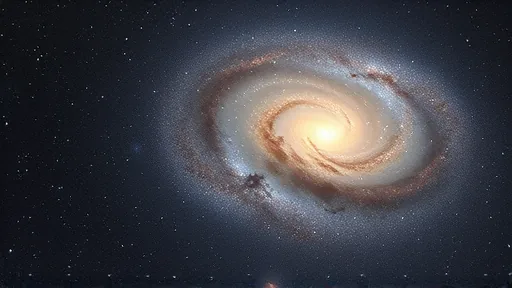
When the Foreground Fools the Eye
IC 342 sits behind a curtain. To see it, an observer must look straight through the flat disk of our own Milky Way — through every cloud of gas, every grain of dust, every star that the galaxy throws in the line of sight. The image released today does exactly that, and what emerges on the far side is a spiral galaxy, one of the brightest members of the IC 342/Maffei group. [1] The group lies roughly 10 million light years away, a neighbor to the Local Group that holds our Milky Way. [1] That proximity is the whole problem. A galaxy this close, viewed through this much clutter, is a portrait painted over an older painting.
The dust does not just dim the light. It miscounts it. Inaccurate accounting of the crowded, dusty Milky Way foreground has produced misunderstandings in IC 342’s history — among them the theory that the galaxy was ejected from the Local Group. A foreground error, in other words, became a story about the galaxy’s past. The data were fine; the ledger was wrong. The theory of an ejected galaxy grew out of a foreground miscount, not out of the galaxy’s own motion.
IC 342 carries dust of its own, and that dust intermittently blocks the glow of hydrogen gas. The blocking is the clue: where the hydrogen dims, bright young stars are at work. The galaxy hides part of itself from us and, in doing so, hands over a diagnostic. What looks like an obstacle is a measurement.

What the Magnetic Maps Add
Magnetic field maps of IC 342 point to a force that may contribute substantially to one of the biggest galactic puzzles: how spiral arms form. [2] That is the societal dimension in miniature — not a policy question but a question of what we owe the evidence. A galaxy’s shape is the most visible thing about it, and we still cannot fully say why the arms exist. The maps suggest magnetism is not a footnote to that answer but possibly a main clause.
A spiral pattern is not decoration; it is the architecture within which stars are born, and how that architecture arises remains one of the biggest open puzzles in galactic astronomy. Magnetic fields entering the explanation means the puzzle has more moving parts than gravity and rotation alone. Every new map either narrows the gap or widens it, and either outcome is progress.
The foreground problem and the arm problem are two different puzzles wearing similar coats. One is dust between us and the galaxy; the other is physics inside the galaxy. Both punish the observer who trusts a single channel of light. IC 342 rewards the one who stacks channels — optical, hydrogen, magnetic — until the hidden thing shows its edges.