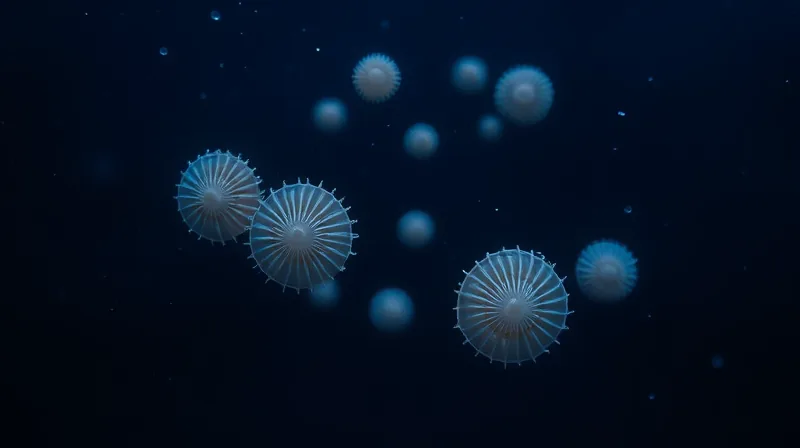
Global Flip in Foraminifera Shell Coiling Explained
A Global Switch No Local Cause Can Explain
Foraminifera are single-celled organisms that build tiny spiral shells, and they are everywhere in the ocean. From the tropics to the coldest high latitudes, these protists drift with currents or crawl along the seafloor. They are among the most abundant eukaryotic organisms on Earth. When they die, their hard shells rain down and blanket the ocean floor. Layer upon layer, these shells form a natural archive of Earth’s history stretching back some 560 million years. Scientists read that archive by measuring isotopes, trace elements, and the mix of species present. In doing so, they noticed something strange:. Among the planktonic forams with snail-like coiled shells, many species strongly prefer one spiral direction over the other. In some species, as many as 97% of individuals coil the same way. [1] Then, at certain moments in the fossil record, a new direction takes over seemingly everywhere at once. The shift happens across the Atlantic, the Indian, and the Pacific oceans. It happens in the tropics and in higher latitudes. No gradual, local process can produce a change like that. The only way to explain a worldwide flip in quadrillions of microorganisms is to abandon the assumption that shell direction is a local adaptation to local conditions.
What makes the pattern so hard to dismiss is its speed. . A local environmental change would leave a local signature. A gradual evolutionary trend would leave a gradient. Neither is what the cores show. Instead, the record shows a trait appearing and then sweeping across vast ocean basins in a geological eyeblink. That is the signature of a population process, not a climate response. It is the kind of pattern seen when a new variant with a broad advantage spreads through a global population. The shells are not adapting. They are recording an invasion.
The numbers behind the mystery are stark:. Paragloborotalia siakensis changed from mixed to left-handed coiling 15 million years ago. Globorotalia scitula flipped twice: from mixed to left-handed 15 million years ago, and then to right-handed 10 million years ago. Pulleniatina obliquiloculata has coiled almost exclusively to the right for the past 860,000 years, but before that it went through a sequence of rapid global flips every few thousand years. These are not slow drifts. They are reversals. And they demand a mechanism that can operate everywhere at once.
Seventy Years of a Question Without an Answer
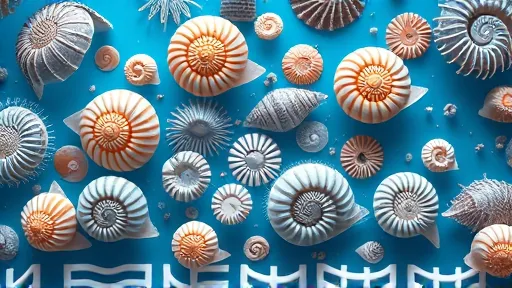
The puzzle is not new:. It was first described in the early 1950s, when advances in seafloor coring let researchers pull up accumulated layers of shells and read them in order. The Swiss micropaleontologist Hans Bolli noticed that among forams with coiled shells, several species had a clear directional preference, and that this preference sometimes changed through time. Others saw the same thing. The question of what drives the flip has been open ever since.
A seminal attempt at an answer came in 1959. [2] The marine geologist David Ericson, a core specialist at Columbia University’s Lamont Geological Observatory — now the Lamont-Doherty Earth Observatory — sifted through hundreds of coiled shells of the species Neogloboquadrina pachyderma from the North Atlantic. He observed that during cold ice ages the shells tended to coil left, and during warmer periods they turned right. He was not sure why coiling direction would track climate, but he proposed temperature as the determining factor. For decades, that explanation stood.
Then the temperature hypothesis fell apart, and it fell apart in two distinct ways. In 2006, Kate Darling, now an honorary professor at the University of Stirling, published genetic work showing that the variants of N. pachyderma are in fact two separate species, each with its own coiling direction. [1] The climate signal was really a species signal. Then, in 2013, the evolutionary paleobiologist Yurika Ujiié, now a professor at Kochi University in Japan, found that shell chirality in different foram species, collected from multiple oceans, did not correspond to temperature at all. [2] Each study undercut Ericson’s idea from a different angle. And there was a deeper problem. It was hard for many researchers to imagine what advantage a spiral direction could give a single-celled organism with no obvious handedness. Half a century after Ericson’s observation, the driving force behind the flips was once again a mystery.
That mystery drew in Bridget Wade, a micropaleontologist at University College London. She had been studying sediment cores for decades when her team noticed that several foram species seemed to flip their shell direction around the same time at different latitudes in the Atlantic, Indian, and Pacific oceans. . The phenomenon clearly extended far beyond a single ocean basin. . To pursue it, Wade’s team synthesized data from five decades of studies and analyzed changes in coiling patterns in several planktonic foraminifera species spanning the past 56 million years. For each species, they found evidence of flipping across multiple ocean basins and climate belts. A species can coil one way for millions of years, then reverse — and the fossil record preserves no local trigger for the change.
The Cryptic Species Already Under Study
What could make a single coiling direction sweep the world? Wade knew that oceans hide many distinct habitats, differing in temperature, currents, ultraviolet light, chemistry, and oxygen. She also knew that an apparently global population of a foram species can hide cryptic species. Genetic studies have repeatedly shown that what looks like one species, based on shell shape including coiling direction, is often more than one. So her team proposed a hypothesis. Suppose one of these cryptic species developed some broad adaptive advantage. Carried by ocean currents and its own success, it could spread across the globe in a gigantic population sweep, bringing a single coiling direction to dominance along the way. The event would then be preserved in the fossil record as a worldwide flip. As Darling, who was not involved in Wade’s study, put it: flipping, in her opinion, means they have speciated. Whether the flipped forams are a new species or a genetic variant, they would need a significant advantage over other forams to sweep all around the world.
. . Julie Meilland, a researcher at the Cerege, a research institute in France, who was not involved in the study, noted that it is probably one of the first times that people who usually do biostratigraphy, basically deep-time research on foraminifera, are approaching such a question. [3] She added that it was very refreshing to see these worlds connect, because very often people doing more modern research do not necessarily connect to people doing deep-time research. .
The next stage of the work is already taking shape. The hypothesis Wade’s team reached — a cryptic species sweeping the globe — is now the frame the field is testing. The tools to test it are the same ones that broke the old temperature explanation: genetics and the fossil record, read side by side. The question that began with Hans Bolli in the early 1950s and passed through David Ericson, Kate Darling, and Yurika Ujiié now sits with Wade’s group at University College London, where the global flip is read not as a climate signal but as the fingerprint of a species on the move.
Sources
3. Cerege