Healthy diets could shrink global farmland by 6 percent
A Planetary View of Agriculture’s Future
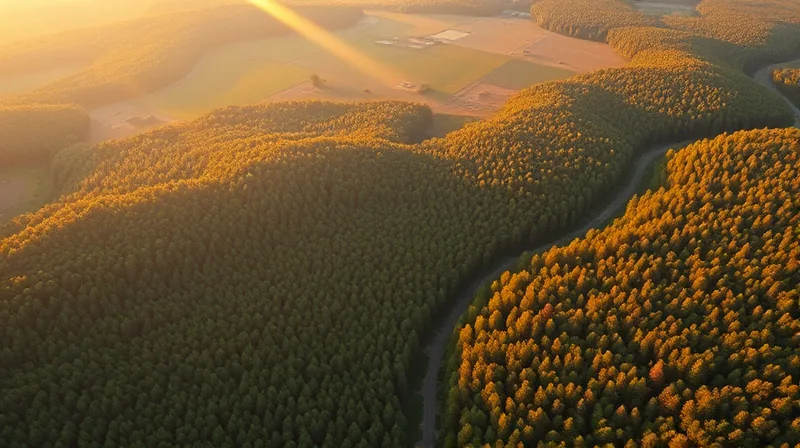
From a satellite looking down at Earth, the most visible human mark on the planet is farmland. For decades, that mark has grown. Population rose. Incomes rose. Appetite for meat and processed food rose. The land under plow and pasture spread, pushing into forests and grasslands. Now, a study published in Nature on July 15, 2026, shows that this historical trajectory can be bent. [2] The study, led by researchers at the Potsdam Institute for Climate Impact Research, uses ten global economic models to simulate what happens if the world shifts to healthy diets, cuts food waste in half, and farms more productively [1] The result is a fundamental restructuring of global agriculture — a break with the past.
The numbers are stark. By 2050, agricultural land would shrink by a median of 6 percent compared to 2020 levels. The range spans from a 1 percent increase to a 26 percent decrease. That 6 percent is the median across all ten models. It means that even the most conservative model predicts almost no net expansion of farmland. The most optimistic model sees a quarter of current farmland returning to nature. This is not a marginal adjustment. It is a reversal of a centuries-old trend of agricultural expansion.
The economic impact is equally dramatic. Agricultural production by 2050 would be 17 percent lower than business-as-usual projections. The range across models runs from 2 percent lower to 32 percent lower. The value of that production falls by 1.6 trillion US dollars — a 26 percent drop. The range here is wide: from 8 percent lower to 58 percent lower. The study’s authors do not call this a loss. They call it a restructuring. Money and land move from one kind of farming to another.
Livestock Declines While Vegetables Surge
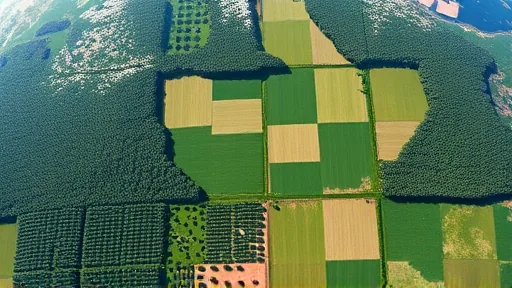
The restructuring is not uniform across all types of food. Livestock takes the biggest hit. The value of livestock production by 2050 would be 49 to 83 percent lower than current projections for that year. That is a collapse, not a decline. The reason is the shift to the EAT-Lancet reference diet, which recommends far less meat and dairy than current consumption patterns in wealthy countries. The models assume that people actually adopt this diet. If they do, the demand for animal products plummets.
Meanwhile, the value of vegetable, fruit, nut, and legume production rises. The median increase is 23 percent. But the range is enormous: from a 33 percent drop to a 106 percent increase. This wide spread reflects uncertainty about how quickly consumers and farmers adapt. Some models assume rapid shifts in planting and purchasing. Others assume slower change. The study reports the full range of outcomes without selecting a preferred scenario.
The study’s authors identify the policy assumption as the key driver of these outcomes. The transformation scenario depends on specific policies to achieve healthy diets, improved productivity, and halved food waste. Different policies produce different results. The study highlights that food policy must take a more active role in managing the transition It must consider both the benefits — improved population health and reduced environmental pressures — and the political economy of the impacts. Farmers who raise livestock will lose income. Farmers who grow vegetables will gain. Governments must navigate this transition.
What the Models Cannot Predict
The study uses a multimodel ensemble of ten global economic models, which is a methodological strength. No single model can capture all the complexity of global agriculture. Combining ten models gives a range of plausible futures. But it also reveals a constraint. The models cannot predict exactly how fast consumers will change their diets. They cannot predict exactly how quickly farmers will switch crops. They can only show what happens under a given set of assumptions.
The study’s authors explicitly name the next step They call for a more active role for food policy. This is not a vague recommendation. It is a direct implication of their findings. The models show that the transformation is possible. They also show that the distribution of impacts is uneven. Some regions and some farmers will lose. Others will gain. Policy must manage this transition. The study does not prescribe specific policies but concludes that policy intervention is necessary.
The models rely on historical data to project future behavior, but the transformation scenario is unprecedented. No historical period has seen a coordinated global shift toward healthy diets and waste reduction. The models can simulate it but cannot validate it. Further research is needed to track real-world adoption of the EAT-Lancet diet and measure actual waste reduction. The study provides a baseline for future research but cannot guarantee outcomes. The data used in the study is publicly available on Zenodo, under dataset v2 published July 15, 2026, and an earlier version from November 10, 2025, allowing other researchers to test the assumptions and run their own scenarios.
Sources
1. DOI: 10.1038/s41586-026-10775-2
2. Nature
3. EAT-Lancet