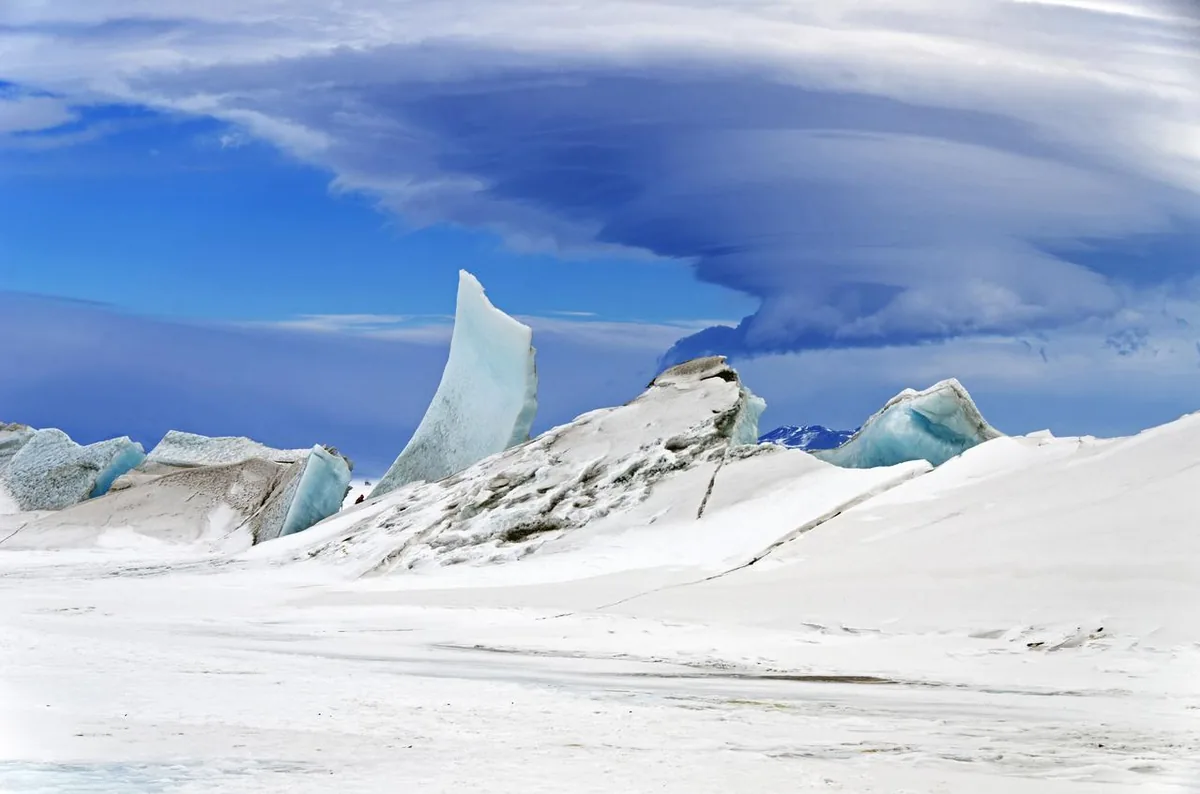
A Salt Signal Visible From Orbit
Satellites looking down on the Southern Ocean have watched a white ring around Antarctica shrink with unusual speed. From 2014, when the sea ice reached its highest extent in the satellite record, to 2016, when it collapsed to a record low, the frozen fringe of the continent changed state in barely two years. [1] By 2023 the ice sat roughly one million square miles below the 1981 to 2010 average — an area about four times the size of Texas, gone. [1] That loss is not only a change at the surface. It has pushed salt into a layer of ocean that begins roughly 2,300 feet down and reaches to about 4,000 feet, a band that wraps around Antarctica like a belt. A paper published Wednesday documents a sharp salinity increase inside that band, and the increase reverses decades in which the same water had been getting fresher.
The reversal is the striking part. Oceanographers usually associate swings of this kind with major climate shifts spread over thousands of years. Here the swing has unfolded in a handful of years, which puts it in a different category from the slow background drift of the sea.
How Less Meltwater Makes Denser Water
The mechanism begins with the melt season. When Antarctic sea ice expanded across several decades up to 2015, summertime melt delivered extra freshwater to the upper polar ocean. That freshwater made the top layer lighter and more stratified, and it freshened the water mass known as Antarctic Intermediate Water.
After 2016 the supply line thinned. With less ice left to melt each summer, the freshwater input fell. The study estimates a net decline in sea-ice meltwater input of nearly 36 millisverdrup per decade, measured against a pre-2016 increase of 14 millisverdrup per decade — a swing in both direction and scale. [1] The unit is small, but the volumes it describes are hemispheric.
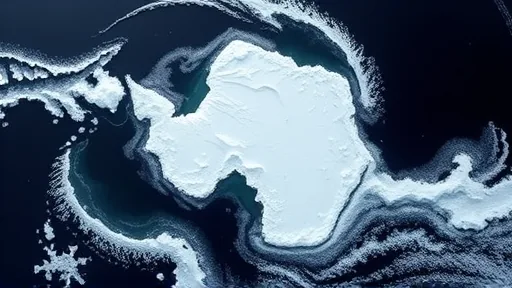
Saltier water is denser water, and the core of Antarctic Intermediate Water has salinified at 4.8 × 10⁻³ ± 1.7 × 10⁻³ grams per kilogram per decade. The team reached that number by combining six independent datasets covering 2004 to 2024. Much of the data came from Argo floats, instruments that drift with currents, sink periodically to measure density and salinity at depth, then rise to transmit their readings. A 2025 study also detected rising surface salinity tied to shrinking sea ice, Gayen added.
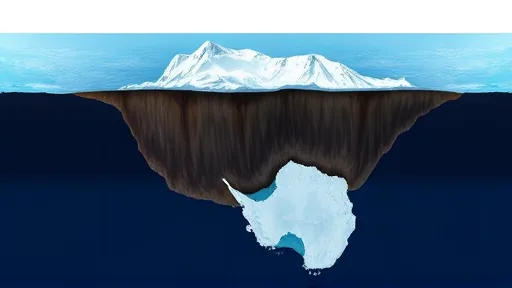
Bishakhdatta Gayen, a researcher and professor at the University of Melbourne and at the Centre for Atmospheric and Oceanic Sciences in Bengaluru, India, and a co-author of the paper, described the reach of the layer. Antarctic Intermediate Water spreads northward into the Indian, Pacific and Atlantic oceans, carrying heat, carbon, oxygen and nutrients toward the tropics and across the equator. A change in its density or thickness therefore alters how heat moves between the ocean surface and the deep, and could affect how the ocean stores and redistributes heat.
The wider consequences are already being traced. Gayen pointed to a 2024 study that identified increased storm frequency and ocean heat loss as possible outcomes. A far-reaching scientific review published this year concluded that changes in Antarctic sea ice cover influence the global distribution of atmospheric heat and moisture as well as atmospheric variability. The speed and persistence of the decline, that review found, suggest the ocean around Antarctica may be entering a new state that would touch not only Antarctic ecosystems but the entire global climate system.
What the Next Decade of Floats Must Show
Michael Meredith, an oceanographer with the British Antarctic Survey who led the BAS Polar Ocean program for years, placed the finding in the architecture of the world’s oceans. “The Southern Ocean is the key juncture for all the world’s oceans,” he said. [2] “It’s the major site where old waters are reprocessed into new, so this could have global consequences.” [2] He also noted the region’s massive role in drawing down human carbon dioxide emissions, which moderates the pace of climate change where people live.
Meredith drew a distinction between two parts of the circulation. Earlier work found that deep circulation in the Southern Ocean has slowed, reducing the rate at which new waters flood and cool the deepest areas. The new study shows the upper part changing rapidly in response to sea ice. “That matters,” he said, “because the upper circulation can affect our climate within years to decades, not centuries.” The caution is built into the record itself. Meredith said it is not yet clear whether the shift is permanent, because it rests on a relatively short observational record. Global climate models used to guide policy still struggle to reproduce the recent sea ice losses — “Our climate models need to catch up,” he said. [2] The measurement that would settle the question is continued monitoring of the layer, and Gayen argued for it urgently, warning that impacts are potentially “knocking on your door” within five years. If the low sea-ice state persists, Meredith said, the changes will keep spreading through the world’s oceans and the effects will ripple out across climate and ecosystems.
Sources
- DOI: 10.1038/s41558-026-02758-y
- Ars Technica — Quote source (original article) — Original: Inside Climate News (https