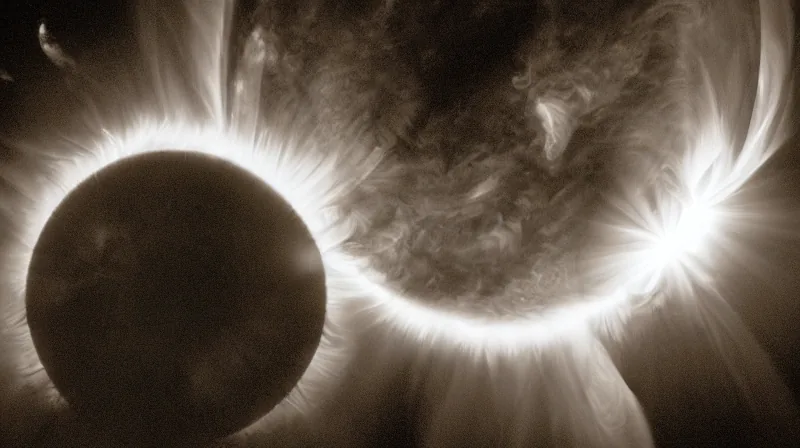
Cannibal CMEs to Trigger Strong Geomagnetic Storm Watch
The sun is a volatile nuclear furnace that occasionally ejects billion-ton clouds of magnetized plasma into space. When these clouds reach Earth, they can trigger significant geomagnetic disturbances. This week, multiple such ejections are heading our way.
The Big Picture: A Storm Brewing in the Void
The National Oceanic and Atmospheric Administration’s Space Weather Prediction Center has issued a G3 geomagnetic storm watch for June 4. A G3 storm is classified as “strong” on NOAA’s five-point scale. It can cause voltage irregularities in power grids, trigger false alarms on security systems, and push the aurora borealis deep into mid-latitudes.
Under G3 conditions, the northern lights could become visible as far south as Illinois and Oregon. That is a show for Chicago. For Portland. For anyone willing to look up after dark.
What makes this event particularly unusual is not just the strength of the storm, but the way it is arriving. Over a 24-hour period, an active sunspot region fired off an M5.7 flare and an X1.1-class flare. Each of these eruptions launched a coronal mass ejection, or CME, into space. And all of them are heading our way.
The Micro Detail: What Is a Cannibal CME?
A coronal mass ejection is not a solid object. It is a cloud of plasma—superheated gas stripped of its electrons—mixed with magnetic fields. When the sun erupts, it hurls this cloud outward like a cannonball. But in space, that cloud expands, stretches, and interacts with everything in its path.
When two CMEs are launched in quick succession, the faster one can overtake the slower one. The leading CME gets swallowed. The magnetic fields merge. The plasma piles up. The result is a single, denser, more magnetically complex structure. Scientists call this a cannibal CME.
The name is descriptive. The faster CME literally consumes the slower one. The combined magnetic field can be stronger. The plasma density can be higher. When this cannibal cloud slams into Earth’s magnetosphere, the resulting geomagnetic storm can be significantly more intense than either CME would have caused alone.
That is what forecasters are worried about. The CMEs from the active region were launched within hours of each other. They are traveling along a similar path. Some are expected to merge before they reach Earth. If they do, the storm could punch harder than initial predictions suggest.
The Chain Reaction: From Sun to Ground
It starts at the sun’s surface. The active region is a dark patch where the magnetic field is twisted and concentrated. When that field snaps, it releases energy in the form of a flare. The flare is light—X-rays and ultraviolet radiation that travel at the speed of light and reach Earth in about eight minutes.
But the CME is slower. It takes one to three days to cross the gap between the sun and Earth. During that time, it is tracked by spacecraft like the Solar and Heliospheric Observatory and the Deep Space Climate Observatory. These satellites measure its speed, density, and magnetic orientation. That data feeds into models run at the University of Colorado Boulder and the U.K. Met Office.
When the CME arrives, it hits Earth’s magnetosphere. If the magnetic field inside the CME is oriented southward, it connects with Earth’s northward-pointing field. That connection opens a door. Charged particles from the CME pour into the atmosphere along magnetic field lines near the poles.
Those particles collide with oxygen and nitrogen atoms. The collisions excite the atoms. When the atoms relax, they release energy as light. Oxygen produces green and red. Nitrogen produces blue and purple. That light is the aurora.
The stronger the storm, the deeper the particles penetrate. During a G3 storm, the aurora can dip down to latitudes around 50 degrees magnetic latitude—roughly the line running through the northern United States.
The Parallels: Who Else Is Watching?
This is not just a show for skywatchers. The North American Electric Reliability Corporation monitors geomagnetic storms because they can induce currents in long-distance power lines. During a G3 storm, those currents can cause transformers to overheat. In 1989, a G5 storm knocked out the Hydro-Québec grid for nine hours, leaving six million people in the dark.
The Federal Aviation Administration also pays attention. High-frequency radio communications used by aircraft over polar routes can be disrupted during strong storms. Airlines may reroute flights to avoid blackout zones.
The U.S. Space Force monitors satellite drag. When the atmosphere heats up from a storm, it expands. Satellites in low Earth orbit—like those in the Starlink constellation—experience increased drag. In 2022, a geomagnetic storm caused 38 Starlink satellites to re-enter the atmosphere prematurely.
Researchers at the University of Alaska Fairbanks run the Geophysical Institute’s aurora forecast. The University of Oulu in Finland operates a network of magnetometers that measure ground-level currents. The Max Planck Institute for Solar System Research in Germany studies the physics of CME propagation.
The Timing: When to Look Up
According to NOAA, the strongest geomagnetic activity is expected during the evening and overnight hours of June 4 into June 5. The peak windows are between 2 p.m. and 5 p.m. EDT and again between 8 p.m. and 11 p.m. EDT. That second window is the prime time for aurora viewing in North America.
But space weather forecasts are uncertain. The arrival of multiple CMEs in quick succession, combined with the possibility of a cannibal merger, means the timing could shift by several hours. The best strategy is to be patient. Check real-time data from apps like My Aurora Forecast & Alerts or Space Weather Live. Look for the Kp index—a measure of geomagnetic activity. A Kp of 7 or higher during the local evening hours means you have a good chance of seeing aurora at mid-latitudes.
Find a dark location away from city lights. Face north. Wait.
The Historical Context
In May 2024, a series of CMEs triggered the strongest geomagnetic storm in over 20 years. It reached G5—extreme. Auroras were seen in Florida, Mexico, and even parts of India. Power grids in Scandinavia reported fluctuations. Satellite operators scrambled to adjust orbits.
The sun operates on an 11-year cycle of activity. We are currently near the peak of Solar Cycle 25, which began in December 2019. The peak was originally predicted for 2025, but activity has been running higher than expected. This means more flares, more CMEs, and more opportunities for aurora—but also more risk.
The Concrete Anchor: A Number for the Future
The CMEs are expected to arrive between mid-to-late June 4 and June 5. The strongest conditions are predicted for the night of June 4 into the early hours of June 5. But here is the number that matters: G3.
That is the storm level. That is the threshold at which aurora become visible at 50 degrees magnetic latitude. That is the line through Illinois and Oregon.
Set an alarm for 8 p.m. EDT on June 4. Check the Kp index. Step outside. Look north.
If the sky is clear and the storm arrives, you may witness a vivid aurora display—a direct result of the sun’s activity interacting with Earth’s magnetic field.