When the Sun Throws Light at Earth
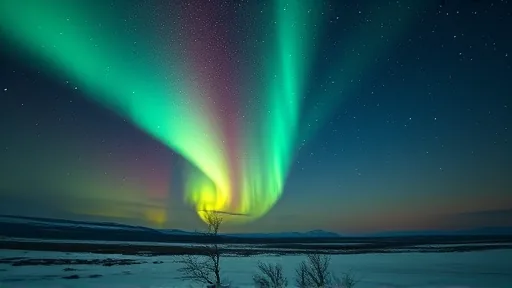
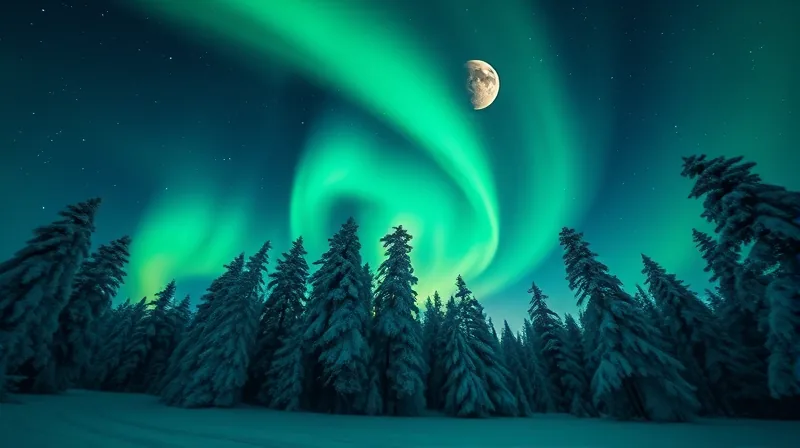
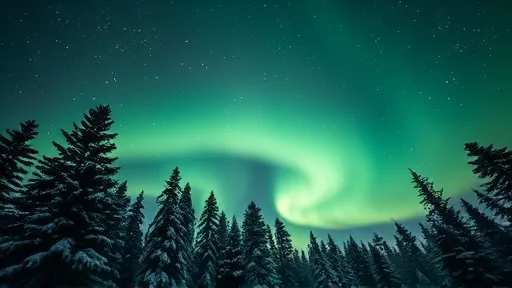
On October 10, 2026, an eruption off the Sun reached Earth and caused strong disturbances in the planet’s magnetic field. [1] That solar outburst did not stay invisible. Energetic particles from the eruption collided with molecules in Earth’s atmosphere and energized them, and those molecules released the extra energy as the colorful aurora captured in today’s image. The aurora hangs in the sky above a horizon of happy little trees near Lansjärv, Sweden — a place where the northern lights are not a rare spectacle but a recurring visitor.
Mars appears in the image together with the Beehive cluster, also known as M44 or Praesepe, and the red planet happened to sit closest to the center of that cluster at the moment the photograph was taken. Two entirely unrelated objects — one a planet, the other a swarm of stars — lined up in the same small patch of sky above the same auroral curtain.
The aurora itself carries a name that predates any telescope. In North Sámi it is called guovssahasat, and the Sámi people indigenous to Sweden and other Arctic regions have traditionally viewed it with respect.
A Planet and a
Swarm in the Same Patch of Sky
The Beehive cluster is not a hive at all, though the name invites the mistake. It is a swarm of young stars, and the analogy runs deeper than language. Bees have been to space — but the Beehive is a collection of stars, and its usefulness to science comes from how those stars move. Their rotation periods have helped humanity learn how stars spin slower over time as they lose mass through their stellar winds.
Mars, by contrast, is close enough to be a neighbor in the frame, a bright point that wandered into the cluster’s heart. The photograph freezes a geometry that will not repeat on demand — the planet’s position relative to the cluster center at that instant is a product of orbital timing, not design.
The image is credited to Petr Horálek of the Institute of Physics in Opava, together with Josef Kujal and Vojan Höfer.