NOAA Plan Weakens Fisheries Science and Habitat Protection
A Roadmap That Redefines Protection
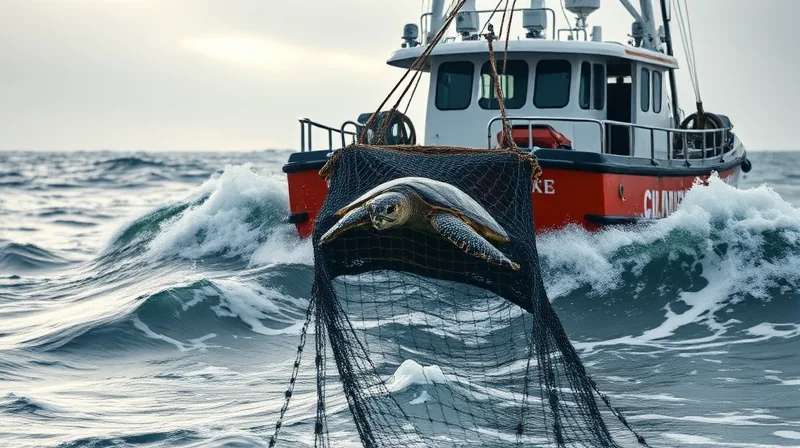
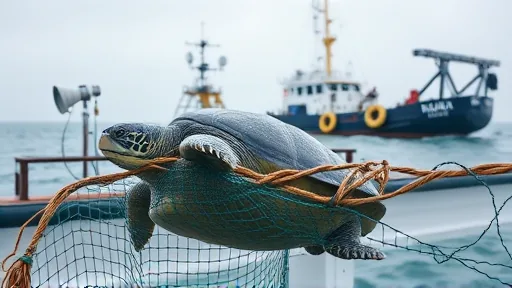
In 2025, the National Oceanic and Atmospheric Administration announced new agency priorities it described as a commitment to “cutting bureaucracy, modernizing our science, and putting our fishing communities first.” [1]. The scale of what is being reclassified is the story. The same agency that is legally required to protect endangered leatherback turtles, sea lions, and whales is now moving to treat those animals as collateral damage in a race to profit from the oceans. . In July 2025, the Trump administration had already relegated those species to that status. By the following announcement, fisheries science itself — the tool used to determine whether a stock can survive being fished — was in the government’s crosshairs.
The agency-level reforms serve as a self-proclaimed “operational roadmap” to fulfilling President Donald Trump’s “Restoring American Seafood Competitiveness” executive order, signed in April 2025. . The roadmap places three things on the table: opening marine national monuments to commercial fishing operations, scaling back critical habitat designations to focus more on the downstream economics of conservation, and weakening decades of peer-reviewed science. . Each of those three items is measurable. Each one changes what a fish stock, a habitat, or a species can expect from the federal government that is supposed to safeguard it.
The announcement did not arrive in isolation. Earlier in the summer, letters were sent to regional fisheries councils directing them to dismantle restrictions in favor of more permissive, economically advantageous fishing procedures. The sequence matters: first the councils were told to loosen the rules, then the agency published a roadmap that redefined the purpose of the science behind those rules. The direction of travel was set before the public framing arrived.
The Rationale and Its Unanswered Question
The administration’s stated rationale is that cutting bureaucracy and modernizing science will put fishing communities first. No one has shown that less bureaucracy produces more fish, or that weaker habitat protection produces stronger coastal economies. “If you asked AI to come up with a plan to hollow out marine ecosystems and impoverish coastal communities, it would look a lot like the one NOAA just put out,” said Andrea Treece, the senior attorney in the Oceans Program at Earthjustice, in an email to Inside Climate News. [1] “The agency is taking a sharp turn away from science.”
Treece’s second statement is the one that has not been answered. . “It’s inexcusable for the administration to make it easier to destroy marine habitats and commit endangered species to extinction in the name of short-term profits,” she said. [1] “You can’t just eliminate parts of the ecosystem you find inconvenient and expect that system to continue to sustain us.” That is a claim about system behavior, not about ideology. If parts of an ecosystem are removed, the system that produces the fish does not keep producing them. No agency document has yet demonstrated otherwise.
The practical meaning of “modernizing science” is now visible in specific rule changes. . NOAA is eyeing a change to gear rules for some fisheries that would allow spearguns and small nets. Gear rules are not abstract. They determine what a fishing operation can put in the water and, therefore, what it can remove from it. Allowing spearguns and small nets in fisheries where they were previously restricted is a concrete expansion of extraction capacity. It is also a test case: if the science behind the old gear restrictions was sound, the new permissiveness has to explain why the old limits were wrong. That explanation has not been produced. .
From Document to Enforcement
The distance between the roadmap and the water is where the real story sits. A roadmap is a document, a gear rule is a regulation, and a regional council decision is an enforcement reality. The letters to the councils were the first step — they directed the dismantling of restrictions. The roadmap was the second — it redefined the science that justifies restrictions. The gear rule change, still under consideration, is the third. Each step moves the same direction: from protection toward permissiveness, from peer-reviewed limits toward economic advantage.
What remains unbuilt is the full application. Marine national monuments have not yet been opened to commercial fishing operations. Critical habitat designations have not yet been scaled back. The decades of peer-reviewed science have not yet been weakened in every fishery. The plan is a roadmap, not a completed demolition. But the sequence is already in motion, and the three items on the table are not hypothetical — they are the stated priorities of the agency that manages them. The gear rule change is still being eyed, not finalized. That is the gap between intent and effect, and the window in which the administration’s rationale could still be tested against evidence rather than asserted against it.
Sources
1. Earthjustice