Butterfly Wings Use Optical Illusions to Evade Capture
Why a Hand Cannot Catch a Butterfly
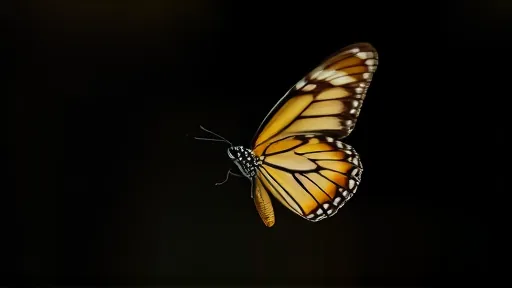
Butterflies in flight create confusing motion cues that baffle the birds that hunt them. High-speed footage of takeoffs shows that butterfly wing patterns in flight create powerful illusory motion cues. The finding rests on a simple fact of biology — butterflies flap their wings far faster than a bird’s eye can resolve. A bird striking at a resting butterfly gets an image of the wings in one position; by the time the beak arrives, the wings have moved through several positions the eye never registered. The camera exposes what the eye cannot.
The bird visual system is not a camera. It is a prediction machine. When a butterfly launches, the bird’s brain receives a blurred smear of wing motion and tries to fill in the gaps. The bird’s eye is drawn to a pattern that appears to be in one place, while the insect’s body is already somewhere else. This is not camouflage in the ordinary sense. Camouflage hides. These markings misdirect.
The bird follows the illusion; the butterfly follows physics. The work was presented in the Nature Podcast on 30 September 2026, based on a research article by Hancock and colleagues. [1]
A Method That Freezes the Unseeable
The measurement is possible because high-speed cameras can record at frame rates far beyond what any bird’s eye can follow. At normal recording speeds, each frame would capture only a blur — the equivalent of trying to read a book while someone flips the pages. High-speed imaging freezes each instant, so the sequence of positions becomes visible. What was a smear to the eye becomes a legible chain of events to the camera. The method does not improve a bird’s vision. It bypasses it entirely, substituting a mechanical sensor for a biological one.
The approach connects to a broader principle in visual science — that motion perception is constructed, not received. The bird’s brain does not passively register a moving image. It builds an estimate of where things are and where they are going, and that estimate can be fooled by patterns designed to fool it. Butterfly wing markings appear to be such patterns. The high-speed footage provides the ground truth against which the illusion can be measured. Without the camera, there is no way to know what the bird’s eye got wrong, because the bird’s version is all the bird has.
The butterfly study is a case study in a larger problem: how to study signals that are designed to be misread by the very sensory systems that would study them.