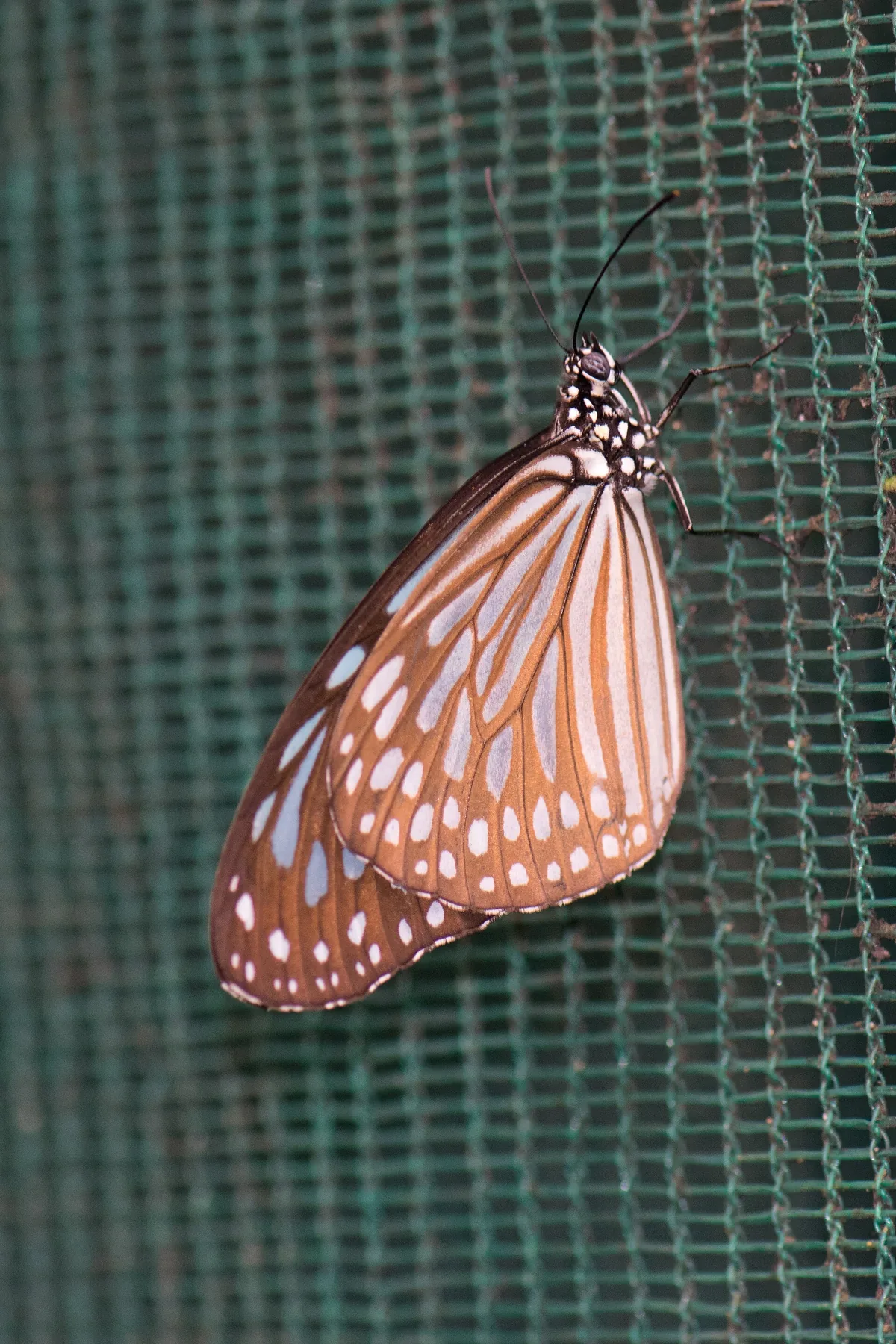
Butterfly Stripes Create Motion Illusion to Evade Predators
The Illusion That Turns Flight Into Misdirection
A striped barber’s pole rotates around its own axis, yet the eye swears the stripes climb upward. Nothing is moving up. The pole only spins. This is one of the oldest tricks the human visual system plays on itself, and it happens because the brain does not measure motion directly — it guesses, then commits to the guess. A butterfly in flight, it turns out, exploits the same guesswork, and does so at the exact moment a bird has already decided where to strike. The stripes and spots on many butterfly wings interfere with the way visual systems try to guess the direction and speed of moving things, boosting false motion cues while hiding the butterfly’s true heading. George Hancock of the University of Exeter in Cornwall puts the consequence plainly: the illusions interfere with the predator’s most basic visual targeting system and disrupt the final ballistic attack — the final moment when the bird commits to grabbing its prey, with no time to change course. [1] The bird does not misjudge the butterfly by a little. It misses. The barbershop pole is not a loose analogy here. It is the mechanism. Butterfly wings deform as they flap, coming together on the upstroke and separating on the downstroke. That deformation causes the stripes to shift angles and point in different directions from one wingbeat to the next. A predator tracking a single heading gets a signal that keeps rewriting itself. Add flight paths that are themselves unpredictable, and the targeting problem stops being hard and becomes unsolvable within the time the attacker has left. The evidence for this began with a coding suspicion. Jolyon Troscianko, also of the University of Exeter, put the first slow-motion video of a butterfly through a computer model built to see the world as a bird sees it. [1] The butterfly was moving upward. The model reported downward motion, glowing with it. Troscianko checked whether he had swapped up and down somewhere in the code. He had not. The wing pattern itself was manufacturing motion that was not there — and in the wrong direction. What reads as a bug in a simulation is, from the butterfly’s side of the encounter, a feature.
What Nearly Four Hundred Species and Fifty Thousand Simulated Wings Agree On

The obvious counterargument is that these patterns might serve something else entirely. Butterfly coloration has been attributed to sexual signaling, to thermoregulation, to camouflage, and the debate over which function dominates is old. That is the test the work set. The team took high-speed video of multiple real butterfly species at takeoff and analyzed the footage through the perspective of predatory birds. They then built simulations of nearly 400 European butterfly species to ask whether the motion illusion patterns were widespread. They were. This is the first empirical evidence for motion dazzle effects produced by butterfly wings — not a hypothesis about a few showy species, but a property distributed across the group. A third phase put human volunteers in front of virtual butterflies on a touchscreen and asked them to catch them. The volunteers are stand-ins, not the real predator, but they test whether a motion illusion actually degrades a catching attempt rather than merely looking strange. Then came the part that closes the loop: genetic algorithms simulating the evolution of over 50,000 wing patterns, programmed to select for the strongest motion dazzle effects. The algorithms, given no information about real butterflies, arrived at patterns strikingly similar to those found in nature. When a blind optimization process rediscovers what evolution already built, the simplest explanation is that evolution was optimizing for the same thing. The dazzle effect is not one trick but several routes to the same end: contrasting vertical forewing stripes, a single vertical band, or internally contrasting wing margin patterns. That redundancy matters. A defense that can be assembled from different starting points is a defense that can evolve repeatedly and independently — which is exactly what a widespread, ancient group of insects would need.
The Next Question the Study Puts on the Table
The pattern of who gets caught is the part that reframes the picture. Butterflies carry visually striking colors that ought to advertise them to predators, yet the pattern of who gets caught does not follow from color alone. Something about the butterfly’s combination of pattern and motion is doing work that color alone cannot explain, and the answer is not that butterflies are faster or more agile in any simple sense. It is that they are harder to aim at. The explanation also extends beyond butterflies, and the authors say so directly. The dazzling stripes on zebras and snakes have long been suspected of confusing predators’ motion perception, but firm evidence has been hard to come by. The same suspicion has followed striped fish and other banded animals, where the case for motion dazzle has been argued but rarely proven. The butterfly study gives this scattered collection of cases a shared mechanism and a method for testing it.
Troscianko frames the larger implication: the study gives a genuinely new way to analyze motion vision, and motion confusion is likely to be far more widespread in nature than previously realized — from the flapping wings of birds to the flicking tails of lizards and fish. [1] That is the research avenue the paper opens, and it is deliberately broad. The next concrete step the authors name is narrower: improving the simulations to account for ventral wing patterning as well as more sophisticated flight dynamics. They do not expect this to change their overall conclusions. They expect it to add nuance. A defense that survives being modeled more carefully is, by itself, a finding.