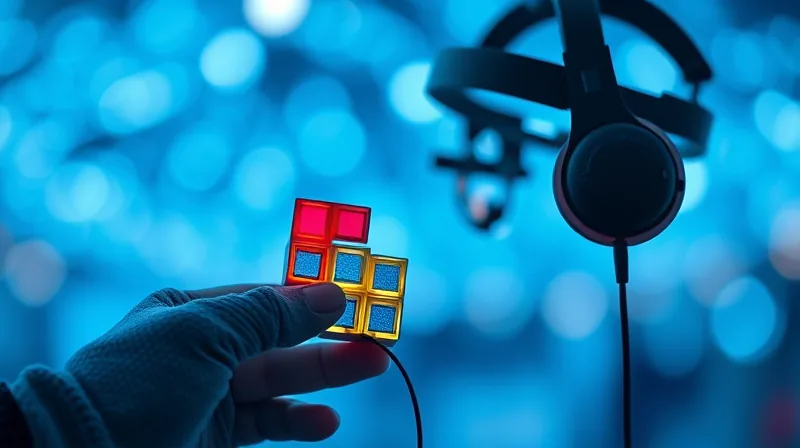
Tetris Reveals How Brains Plan Future Moves
For decades, scientists who wanted to understand how humans make decisions had two basic options. They could bring people into sterile laboratories and have them press buttons in response to simple cues, or they could ask participants to recall past choices from memory. Both approaches share a common weakness: they capture snapshots of decision-making, not the fluid, multi-step planning that defines real-life choices. A new study at the Minnesota State Fair takes a different route. It invites visitors to play a classic video game while wearing a cap that records their brain’s electrical activity, turning a beloved pastime into a scientific instrument.
The game is Tetris, the block-stacking puzzle that has challenged players for decades. Jean-Paul Noel, a neuroscience professor at the University of Minnesota, designed the study to capture something most laboratory experiments miss: the way brains construct plans that extend several moves into the future. When a player sees a falling piece, they must decide not only where to place it now, but how that placement affects the options available for the next piece, and the one after that. This cascading chain of choices mirrors how people navigate daily life, from planning a grocery trip to charting a career path.
From Lab Cues to Real-World Play
Traditional neuroscience experiments often reduce decision-making to simple stimulus-response tasks. A participant sees a light flash, then presses a lever, and researchers measure the time between perception and action. These experiments have produced valuable knowledge about basic brain function, but they miss the layered complexity of genuine planning. The Tetris study bridges this gap by observing players in a task that demands continuous, forward-looking strategy rather than isolated reactions.
The research setup measures three streams of data simultaneously. An eye-tracking system follows where participants look on the Tetris board, capturing how they scan the available space. The keyboard records their placement choices, revealing whether they position pieces on the left or right side of the playing field. Meanwhile, the brain-monitoring cap detects electroencephalography, or EEG, signals — tiny fluctuations of voltage on the scalp that occur naturally as neurons fire. Noel describes these signals as small electrical whispers from the brain, recorded without any invasive procedure.
“What we are looking at is how your eye movements predict the future plans that you make,” Noel explains. The connection between where someone looks and what they subsequently do offers a rare glimpse into the planning process. A player who glances at the far corner of the board before rotating a piece may be preparing a strategy that unfolds several moves later. By synchronizing the eye-tracking data with keyboard responses and brain waves, the research team can observe how these three elements interact in real time.
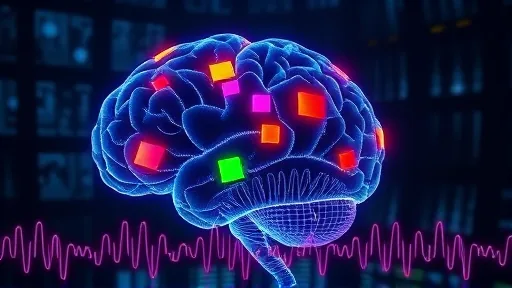
The study also examines how people interrogate the state of the world around them. Players must constantly assess the landscape of the Tetris border — the stacks of blocks already placed — to understand what options exist for the current piece. This ability to survey a situation and identify possibilities is fundamental to planning, whether in a video game or in everyday life. The research asks how this capacity changes over time, both within a single game session and across a person’s lifespan.
A Fairground Laboratory for Diverse Minds
Most neuroscience research draws its participants from a narrow pool: college students who volunteer for course credit. This creates a significant limitation, because young adults in university settings represent only a small slice of the broader population. Their brains, habits, and life experiences differ substantially from those of older adults, people without higher education, or individuals from varied economic backgrounds. The Minnesota State Fair offers a solution to this sampling problem.
The fair attracts hundreds of thousands of visitors each year, representing a cross-section of the state’s population. By setting up a research station in the State Fair Research Building, Noel’s team gains access to participants aged 14 to 80, spanning multiple generations and life stages. This diversity makes the resulting data far more representative of how planning abilities actually vary across the population. A 16-year-old’s approach to Tetris likely differs from a 70-year-old’s, and those differences may reveal important truths about how planning skills develop and change with age.
This is the research group’s first appearance at the fair, and Noel describes this year’s effort as establishing a baseline. The goal is to collect data from approximately 240 participants, with a particular interest in recruiting people at both ends of the age spectrum. Those closer to 14 and those closer to 80 are especially valuable, because their inclusion helps map the full range of planning abilities across the human lifespan. The study takes about 30 minutes to complete, and anyone without a history of epilepsy is welcome to participate.
The fairground setting also addresses another limitation of traditional research: the artificiality of laboratory environments. When people sit in a quiet room with electrodes attached to their heads, they behave differently than they would in natural settings. The bustling, noisy, social atmosphere of the State Fair provides a more realistic context for observing human behavior. Noel hopes this approach enables what he calls “more naturalistic science,” both in the questions asked and the environment where the research occurs.
A Fairground Full of Science

The Tetris study represents just one component of a much larger scientific enterprise unfolding at the fairgrounds. Ellen Demerath, co-director of the State Fair Research Program, describes this year as the program’s biggest yet. More than 60 research projects are running across the 12 days of the fair, spanning topics that range from child development to aging. Organizers hope to attract as many as 20,000 volunteers to participate in these various studies.
The research program deliberately includes studies for every age group, allowing entire families to participate together. Grandparents, parents, and children can all find projects suited to their demographic. This intergenerational approach to data collection produces a rich dataset that single-age studies cannot match. When a family completes studies together, researchers gain insights into how traits and abilities cluster within family units, adding another dimension to the scientific picture.
The diversity of projects also reflects a broader trend in neuroscience toward more inclusive and representative research practices. The field has long recognized that relying exclusively on college students introduces biases that may distort findings. By bringing research directly to the public, programs like this one help democratize science, making participation accessible to people who would never visit a university laboratory. Visitors to the fair can contribute to scientific knowledge simply by playing a video game or answering a few questions.
For the research team, this year’s fair marks the beginning of what they hope will be an ongoing relationship with the community. The baseline data collected in 2026 could eventually support longitudinal studies that track how brain planning changes as people age. If participants return in future years, researchers could observe how the same individuals’ planning abilities evolve over time, providing unprecedented insight into cognitive aging. For now, the immediate goal is simpler: collect solid baseline data and introduce fairgoers to the excitement of participating in real scientific research.