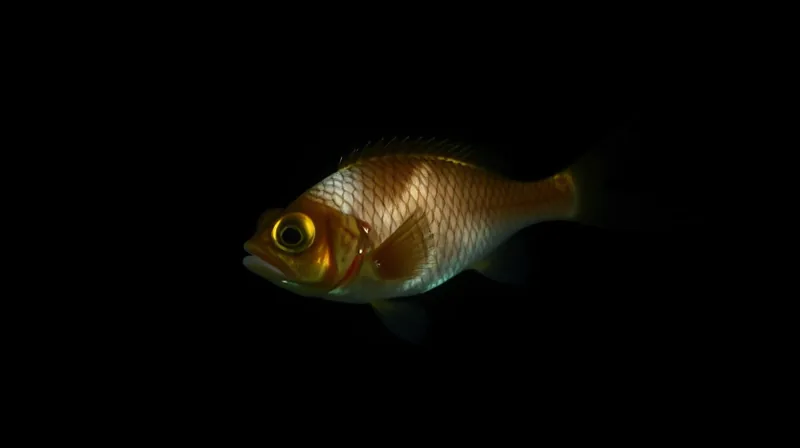
Blind fish recognize themselves without sight
The paradox of self-awareness without self-sight
Most fish have eyes positioned on the sides of their heads. This means they cannot see their own body. Andrew MacColl, a researcher at the University of Nottingham, explains that some fish like eels might see parts of themselves [1] But for the vast majority, the body remains invisible. How then does a fish know what a fish of its own kind looks like?
The problem runs deeper than vision. Many fish never meet their parents. In mammals and birds, young animals imprint on a parent. They learn what their own species looks like by watching the adult. Fish hatch from eggs and swim away alone. They have no parent to study. MacColl states that instinctual recognition is the most likely answer. This inherited knowledge must come from somewhere. But the exact mechanism remains unclear. It likely varies between habitats and between species.
Different environments demand different solutions. Fish that live in clear, sunlit waters can use sight. They recognize shape, movement, or color patterns. But fish in dark or murky waters cannot rely on vision. MacColl points to smell as the alternative. This opens a fascinating possibility. Recognition could be self-referential. A fish might smell itself and use that scent as a template. It would then recognize other fish that smell similar. This bypasses the need for visual self-knowledge entirely.
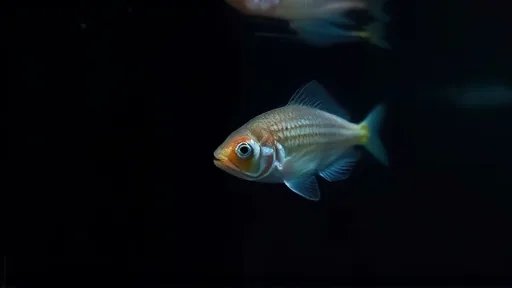
How imprinting works in fish
Mike Webster, a researcher at the University of St Andrews, describes a learning process called imprinting [2] Some fish, including zebrafish, learn to recognize their own species this way. Imprinting is a type of long-lasting learning. It happens early in life during a sensitive period. The young fish learns recognition cues from nearby animals. Those animals tend to be members of its own species. This creates a template for later recognition. Crucially, the fish does not need to see its own appearance to form this template.
For zebrafish, both visual and chemical cues matter for imprinting. Webster explains that many fish species use multisensory integration. They combine information from different senses. These include vision, chemical signals, touch, sound, and even electrical cues. Together, these senses build an accurate picture of the surroundings. The fish recognizes other animals it interacts with by combining all these inputs.
The importance of vision varies dramatically between species. It depends on the habitat the fish is adapted to. In shallow coastal waters and clear rivers and lakes, sunlight penetrates easily. Vision can be the primary sense for many fish living there. But in silty estuaries, the water is full of suspended sediment. In algae-rich eutrophic lakes, phytoplankton scatters the light. In the deep ocean, sunlight does not penetrate at all. Webster notes that fish in these environments might still use vision for shadows or bioluminescent flashes. But without sunlight, they rely more heavily on other senses. Smell, touch, and electrical sensing take over.
When species recognition fails
Species recognition in fish is not always accurate. Many fish live in mixed-species shoals. Webster suggests that at least some of this mixing might come from misidentification. The fish simply mistakes another species for its own. This error has consequences. Hybridization — breeding between different species — is widespread in some fish families. It is more common in fish than in any other vertebrate group. The system has built-in error tolerance.
MacColl raises a deeper mystery. How does species recognition keep pace with divergence during speciation? The many closely related cichlids in East African lakes present a particular problem. These fish have split into hundreds of species in a relatively short time. Each new species must somehow recognize its own kind. But if the recognition mechanism is inherited, how does it change fast enough? MacColl states that any single mechanism is error-prone. The overall error rate is reduced by spatial and temporal context. Fish that live in different parts of the lake or breed at different times are less likely to make mistakes. The system works, but only because multiple factors align. The question of how recognition evolves alongside the species itself remains unanswered.