From Mail-Order Novelty to Laboratory Instrument
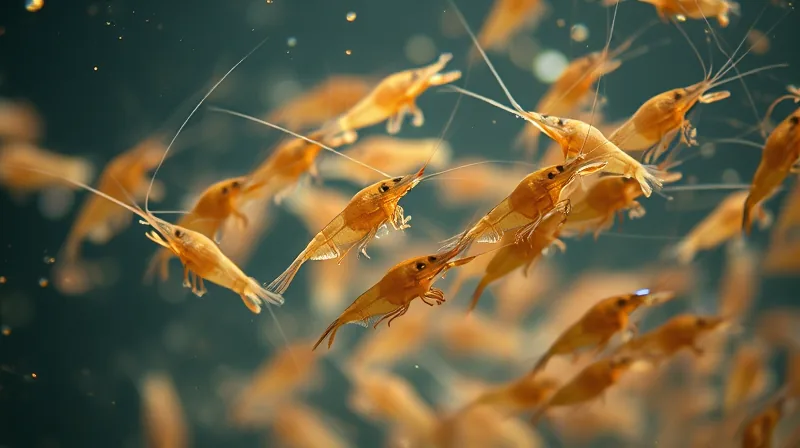
Brine shrimp are about a centimeter long, swim upside down, and beat their legs in a frantic rhythm while trailing their elongated abdomens behind them like tails. Anyone who ever sent cash, a check, or a money order to a New York City outfit called the Transcience Corporation in the 1960s and ’70s received a paper envelope of freeze-dried eggs advertised as a “bowlfull of happiness.” Dropped into salt water, those eggs hatched into what the ads called sea monkeys. For decades they were a novelty, a mail-order joke. In 2021, a student named Xinyu Si in Lei Fang’s laboratory at the University of Pittsburgh began treating them as instruments. [1] The Pittsburgh lab studies what physicists call active matter — a label broad enough to cover bacteria, tiny robots, and anything else that moves by itself and injects energy into its surroundings. Si and Fang wanted to know how biological swimmers mix fluids where turbulence appears. The hypothesis driving the work: in the mixing of fluids in large natural systems, turbulence generated by minuscule organisms plays an underappreciated role. Billions of such creatures agitate the waterways of the world, and the Pittsburgh team suspected the effect had been underestimated.
The apparatus Si built was almost defiantly simple. He poured a thin film of salt water over a glass surface in a tank and positioned magnets underneath. Applying an electric current to the conductive fluid made it interact with the magnets and set the water in motion, flowing one way along one side of a channel and the opposite way along the other. That created a gradient of velocities across the center. Into this controlled flow he released brine shrimp. When he and Fang calculated how the animals’ flailing bodies disrupted the moving water, they saw what Fang called “something very, very strange.” [1] The shrimp were not merely adding to the chaos. They appeared to be changing the direction in which energy moved.
That is the pivot. A system built to study mixing had become a device for flipping a rule physicists had treated as settled for more than half a century.
The Direction of Energy Was Never Fixed
Turbulence is not hard to find. It stirs the foam at the base of a waterfall, shapes the crest of a breaking wave, produces the bumpiness of a flight, the swirls of milk in coffee, and the roil of plasma on the sun’s surface. Francesca De Serio, a civil engineer and hydrodynamics expert at the Polytechnic University of Bari in Italy, put it plainly: turbulence is observed generally everywhere in life, at the beach or washing one’s hands. [1] A turbulent system is complicated, defined by complex forces and inner turmoil, but it can begin simply — a flowing fluid meets an obstacle, part of the flow changes velocity, and the mismatch spawns vortices.
The English mathematician and physicist Lewis Fry Richardson, founder of modern weather forecasting, found that in such systems the kinetic energy of a large eddy feeds into smaller and smaller eddies until it reaches the scale where viscosity, which resists motion, takes over and the energy dissipates as heat. In 1922 he compressed the idea into verse: “Big whorls have little whorls / Which feed on their velocity, / And little whorls have lesser whorls / And so on to viscosity.” Beginning in the early 1940s, the Soviet mathematician Andrey Kolmogorov gave that picture a rigorous mathematical foundation — but his work, like Richardson’s, mainly concerned three-dimensional systems in which energy flows from large features down to small ones.
In the late 1960s, the physicists Robert Kraichnan and George Batchelor extended the investigation to two-dimensional systems. Phenomena like Jupiter’s Great Red Spot belong to that class — a maelstrom so violent it overwhelms any motion farther down in the atmosphere. Here the cascade runs the other way: energy moves from small eddies up to large ones, and smaller vortices near the perimeter of the Great Red Spot feed the giant storm at its center. In the decades that followed, physicists did not deeply interrogate whether those flows were fixed. The question sat there, a locked door nobody pushed on.
Si and Fang pushed. Running the brine shrimp experiment repeatedly, they found that when a solo shrimp swam at an angle of less than 45 degrees to the direction of maximum stretching, energy flowed from smaller scales to larger ones, feeding the flow itself, exactly as predicted for a two-dimensional system. When the shrimp swam at an angle of more than 45 degrees to that same direction, the energy went into reverse, pulling from the larger scale of the flow to energize smaller perturbations. Every experiment pointed to the same conclusion: the orientation of a brine shrimp’s body seemed to determine the direction of the turbulent system’s energy flux. That is the reversal. The geometry of a single centimeter-long animal, not the dimensions of the system, decided which way the river of energy ran.
Rods, Tornadoes, and a Boundary Worth Breaking
To make sense of what they were seeing, Fang and Si turned to tensor geometry, a branch of mathematics long used by turbulence researchers to model quantities that change in several ways at once. A tensor measures something that changes in multiple ways at once — press down on a sponge and its sides bulge outward, and a tensor can describe how the stress of your hand produces that strain. In the Pittsburgh experiments, one tensor represented how shear, the large-scale movement of the water, affected energy flux; the other represented how the flux was shaped by small-scale movements from the swimmers. The swimmer’s orientation set the alignment of the two tensors, and that alignment set the flow of energy. The team reported the result in 2024.
Then they removed the animals. Si and Fang replaced the brine shrimp with an array of centimeter-long rods, which proved easier to measure, and found that by altering the rods’ orientation relative to the flow they could control whether energy transferred to higher or lower scales. The effect survived outside scrutiny: Filippo De Lillo and Guido Boffetta of the University of Turin, whom Fang met at a conference, reproduced it in numerical simulations, a result the Pittsburgh team later published alongside its own rod-array experiments. “That made me much more comfortable,” Fang said, “because it’s a very weird thing to manipulate energy flux.” The findings appeared in 2025 in Science Advances. The demonstration showed that with minimal manipulation, the energy flux in a two-dimensional system can be steered to act more like — though not exactly like — the flux in a three-dimensional one, which suggests insights from one dimensional domain might transfer to the other.
Gregory Falkovich, a physicist at the Weizmann Institute of Science and a pioneer in the study of turbulent two-dimensional systems, called the work “a beautiful and skillful experimental work,” noting that it capitalized on a fundamental and often unrecognized mathematical description of how forces interact to push energy through a system. De Serio found the implication striking: small, specific interventions in the flow can produce a transfer of energy between scales.
The next steps are already underway. Si and Fang are testing whether the observations extend to three-dimensional scenarios, experimenting with tabletop tornadoes. They are also exploring how to influence the “transport barrier,” the threshold between two fluids as they mix. According to Fang’s theory, disrupting that boundary — potentially useful for controlling pollution or mixing fluids in drug development — would require less than 1% of the energy needed to keep the boundary intact. Other groups have entered the same territory. De Serio, at the Polytechnic University of Bari, has been firing strong jets into large tanks of turbulent, rotating, high-viscosity fluid, drawn by the idea that these manipulations could be applied in a real context. In March 2026 she reported results from experiments on a large rotating vortex manipulated with small horizontal jets fired into the middle; she observed patches of inverse energy flux that began as intermittent bursts and grew steady as rotation increased. Si, now a postdoc at the University of Rochester, said the current work introduces a new hypothesis.
Confounding issues remain. The Pittsburgh experiments used a shallow pool of fluid whose friction made turbulence hard to initiate, and large differences separate a weakly turbulent two-dimensional system in a lab from the strongly turbulent three-dimensional ones found in nature. Mathematically there is no reason the observations should not extend to such scenarios — but “no reason it shouldn’t” is not the same as “it does.” A rule of turbulence has been shown to bend in a shallow tank of salt water and sea monkeys. Whether it bends in the ocean, in the atmosphere, or in the plasma of a star is precisely the question the experiment leaves open, and it is a larger question than the one it answered.