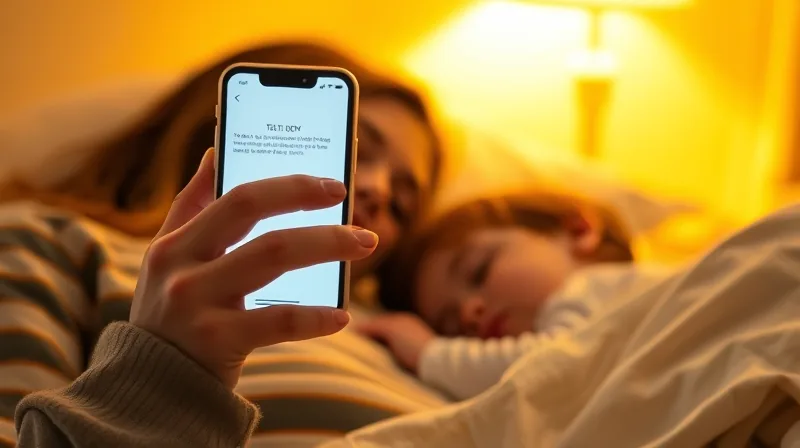
AI becomes the coparent mothers needed
The border was invisible, but Lilian Schmidt crossed it one desperate night in Zurich. Her three-year-old daughter was screaming, the clock read 10 PM, and every sleep expert, every pediatrician, every well-meaning relative had failed. She opened ChatGPT not as a tool, but as a last resort. The advice it gave was the opposite of everything she had heard: more stimulation, not less. A trampoline before bed. Chewing gum. Within five minutes, her daughter was asleep. Schmidt had crossed a line that most parents don’t even know exists—the line where a machine becomes a better parent than the humans who raised us.
Looking back from 2025, this moment seems both inevitable and strange. Inevitable because the math was always there: mothers in the United States spend an extra 13.5 hours per week on chores compared to employed fathers, and an average of 12.5 hours per week on childcare—a 40 percent increase from 1975, according to data from the Bureau of Labor Statistics and Pew Research Center. [1] Strange because the solution came not from a partner, not from a village, not from policy change, but from a large language model trained on the entire internet. The machine became the co-parent that flesh-and-blood partners often failed to be.
Schmidt’s TikTok video from June 2025, captioned “I Turned ChatGPT into my coparent,” exploded to 27,000 followers in three weeks. She began selling access to her custom GPT, Coparent, for $37 on her website. The response was not curiosity but recognition. Thousands of mothers saw themselves in her story. They had been drowning in what sociologists call the “mental load"—the invisible labor of remembering birthday parties, doctor’s appointments, sunscreen, and the thousand other details that keep a household running. The machine offered to carry that load without complaint, without needing to be asked, without expecting gratitude.
The Invisible Labor That Technology Reveals
The history of household technology is a history of promises broken and burdens shifted. When the vacuum cleaner arrived in the early 20th century, it was marketed as liberation from drudgery. When the washing machine became common in the 1950s, it promised to free women for higher pursuits. Yet the data tells a different story: the time mothers spend on housework has remained stubbornly high, even as appliances multiplied. The problem was never the tools; it was the expectation that women would use them to maintain ever-higher standards of cleanliness and care.
Generative AI enters this landscape as the latest in a long line of labor-saving devices that somehow never save enough labor. But there is something different this time. Unlike a vacuum cleaner that can only clean floors, or a washing machine that can only clean clothes, AI can think. It can plan. It can remember. It can generate bedtime stories, create meal plans, write notes to babysitters, and compose toothbrushing songs. It takes on the cognitive labor that has always been the most exhausting part of motherhood—the constant, unrelenting mental load that never sleeps.
Sarah Dooley, a former tech consultant for Visa, started using generative AI in 2023 to write toothbrushing songs for her three daughters. [1] She began hosting small groups for mothers to teach them how to delegate household tasks to AI. Within months, she quit her job and started her brand, the AI-Empowered Mom. Her book, The AI-Empowered Family, is scheduled for release next year. Dooley’s story mirrors Schmidt’s: a woman who found in AI the support she could not find from her partner, her community, or her society.
But the question that haunts this narrative is simple: why is it women who must learn to use AI, while men use it for stock market research and architectural effiThe AI gender gap is real and documented—women are more than 20 percent less likely than men to use generative AI in their everyday lives, according to a 2025 study by the Pew Research Center. [2] 2025 study. [2] But the gap is not about access; it is about application. Men use AI to advance their careers and hobbies. Women use AI to survive the domestic grind.
The Mother Technologist’s Critique
Stephanie Leblanc-Godfrey, founder of Mother AI and self-described “maternal technologist,” has a name for the problem: the “PMS” problem—AI tools are “pale, male, and stale.” [2] The people building these systems do not reflect the society that uses them, and they certainly do not reflect the needs of mothers, who tend to be the heads of households. When your training data is scraped from a male-dominated internet, and your engineering teams are overwhelmingly male, the resulting tools will naturally serve male priorities.
This is not a conspiracy; it is a structural reality. The same forces that created the gender pay gap, the caregiving penalty, and the motherhood wage gap have now created an AI that serves men better than women. Men use AI to get ahead; women use AI to keep their heads above water. The machine does not judge this inequality; it simply reflects it.
Erin Grau, cofounder of the research and corporate training company Charter, offers another explanation for the gender gap: “mom guilt.” [3] Mothers view dependence on AI as a form of cheating, as if using a machine to remember things somehow diminishes their maternal worth. This guilt is itself a product of the same cultural forces that tell mothers they should do everything themselves, that asking for help is weakness, that using a tool is failure. The machine exposes this guilt for what it is: a trap designed to keep women exhaustedThe backlash against AI momfluencers is fierce and predictable. Critics accuse them of promoting a technology with deleterious environmental impacts—training a single large language model can emit as much carbon as five cars over their lifetimes, according to a 2019 University of Massachusetts Amherst studyover tThey warn that generative AI is positioned to put nearly 15 percent of the workforce at risk of unemployment, based on a 2023 Goldman Sachs reportrisk of unemployment. They raise concerns about children’s development and mental health when exposed to AI-generated content. These are real risks, not hypothetical fears.

But the mothers I spoke with have heard these arguments before. They heard them about microwaves, about television, about smartphones. Every new technology brings warnings, and every generation of mothers has been told they are failing their children by using it. The difference this time is that the stakes are not convenience; they are survival. When you are drowning, you do not ask about the carbon footprint of the lifeboat.
The Productivity Trap
Mel Robbins, the podcaster who recently announced a partnership with Microsoft Copilot, frames AI as a tool of women’s empowerment. “I don’t want women in particular to get left behind,” she intones dramatically. Reese Witherspoon went viral for an Instagram post chirping about how AI would “make our everyday lives easier and better.” The Cut responded by bemoaning “the girlbossification of AI,” a term that captures the unease many feel about turning domestic labor into a tech problem. [4]
Leblanc-Godfrey rejects this framing outright. “The way Reese Witherspoon, Mel Robbins, and others are kind of positioning AI as radical feminism—I feel like if you use women’s insecurity or AI being feminist as the entry point, you’ve kind of lost the plot,” she says. She adds, “I reject that sort of productivity porn, toxic efficiency piece of the conversation.” Her critique is sharp: turning motherhood into a productivity problem to be solved by technology is not liberation; it is a more sophisticated form of the same trap.
When I tried using AI for my own parenting tasks, the experience was not liberating but crushing. Entering lines of text into the prompt field to spell out the mundanity of my everyday mom tasks filled me with existential dread. Seeing the sheer volume of my quotidian household responsibilities in aggregate was overwhelming. It felt like AI, much like the vacuum cleaner and the washing machine, did not make my life more efficient so much as it was a slightly flashier means of continuing to tether me to the home.
My husband uses Claude to research the stock market and boost his efficiency at work as an architect. [5] It would never occur to him to use it to keep track of birthday parties and doctor’s appointments. This is not because he is malicious; it is because the mental load is invisible to him. He does not see the thousands of small decisions that keep a household running because he has never been expected to make them. The machine sees them because the machine has been trained to see everything.
The Historical Precedent
The pattern is not new. When the typewriter was introduced in the late 19th century, it was marketed as a tool that would liberate women from domestic drudgery by giving them office jobs. Instead, it created a new form of gendered labor: women became typists, men became managers. The technology did not free women; it simply moved their labor from the home to the office, where it was still controlled by men.
When the telephone arrived, it was initially a male-dominated technology. But women quickly adopted it for social purposes, creating networks of support and information sharing that were invisible to men. The telephone became a tool of female community, even as it was marketed as a business tool. The pattern repeats with AI: women are using it for purposes that the male developers never imagined, repurposing the technology to meet needs that the market does not serve.
The washing machine is the most instructive example. When it became widely available in the 1950s, it was celebrated as a labor-saving device that would free women from hours of backbreaking work. And it did reduce the physical labor of laundry. But it also raised the standards of cleanliness. Clothes that had been washed once a week were now washed daily. Sheets that had been changed monthly were now changed weekly. The technology did not reduce women’s work; it changed its nature and increased its volume.
AI risks the same dynamic. It promises to reduce the mental load, but it may simply raise the expectations. If a machine can remember every birthday, plan every meal, and write every note, then the mother who fails to use it is failing her family. The tool becomes a new obligation, a new standard to meet, a new source of guilt.
The Co-Parent That Isn’t There
The most striking absence in Schmidt’s content is her partner. In her videos, she is doing all the parenting labor: meal prep, grocery shopping, kiddie arts and crafts. The partner is nowhere to be seen. When I asked her about this, she acknowledged that her partner helps, but the invisible labor remains hers. “For women and moms, there is so much invisible labor that you carry and everything is in your hands, and it actually takes time with your kids away from you,” she says.
This is the core contradiction of the AI momfluencer movement. They are using technology to solve a problem that should be solved by society, by policy, by partners. The machine becomes the co-parent because the human co-parent is absent, either literally or figuratively. The AI fills a gap that should not exist.

Schmidt says that while 95 percent of her audience is female, she does receive emails from dads hoping to use AI to ease their partners’ workloads. [1] But these messages are fewer and tend to be in private DMs rather than public comments. When I asked why, she only semi-jokingly said, “the patriarchy.” She added, “Unfortunately, mental load is still considered a female problem. A lot of men don’t even know what mental load even is.”
The research paper “Gendered Divisions of Labor in the Age of AI” (arXiv:2208.03492v1) provides a framework for understanding this dynamic. The authors argue that technology does not automatically liberate women; it can just as easily reinforce existing gender hierarchies. When AI is used to automate domestic tasks, it can free women for paid work, but it can also increase the expectations placed on them. The outcome depends not on the technology itself, but on the social structures in which it is embedded.
The Future of Motherhood
Looking ahead, the trajectory is uncertain. The AI momfluencers are growing in influence, their followers swelling with each viral video. The technology is improving, becoming more intuitive, more personalized, more capable. The cultural conversation is shifting, with more women openly discussing the mental load and the role of AI in alleviating it.
But the fundamental question remains: is this liberation or adaptation? Are women using AI to free themselves from domestic drudgery, or are they using it to survive a system that refuses to change? The answer is probably both, and the tension between the two will define the next decade of motherhood.
Schmidt continues to sell her Coparent GPT, helping thousands of mothers delegate tasks that should never have been theirs alone. Dooley continues to consult for companies, teaching them how to support working mothers with AI tools. Leblanc-Godfrey continues to critique the “toxic efficiency” framing, pushing for a more nuanced understanding of what technology can and cannot do.
The border that Schmidt crossed that night in Zurich was not a line between human and machine, but a line between acceptance and resistance. She accepted that the system would not change, so she changed her tools. She accepted that her partner would not share the mental load, so she gave it to a machine. She accepted that society would not support her, so she built her own support.
The word we thought we understood was “mother.” It meant the person who carries the invisible load, who remembers everything, who sacrifices everything, who asks for nothing. The machine does not ask for anything either. It does not need gratitude, does not need recognition, does not need rest. It is the perfect mother—because it is not human at all.
Sources
1. Visa
2. Mother AI
3. Charter
4. The Cut
5. Claude