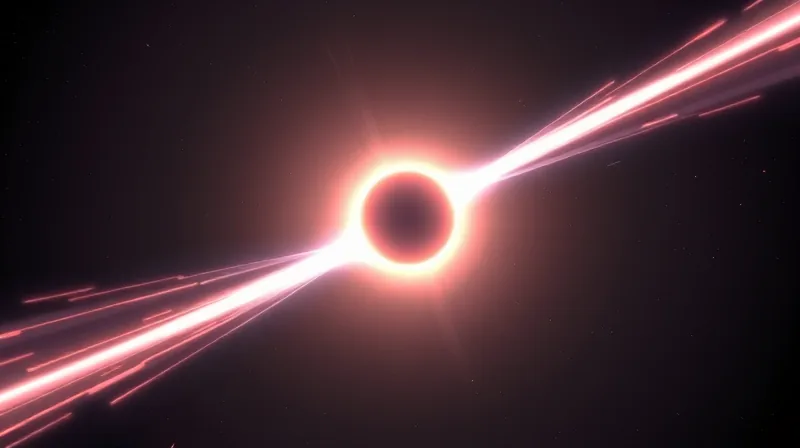
Black hole plasma jets revealed in AI video
A black hole is, by definition, the one thing in the universe that cannot shine. It swallows everything, even light itself. Yet the space immediately around it can blaze with a brightness that outshines entire galaxies. This paradox — darkness at the core, blinding radiance at the edge — has puzzled astronomers for decades. The secret lies in the plasma jets these cosmic giants blast outward. That glowing material moves at more than 98% of the speed of light. For years, studying these jets felt like trying to reconstruct a movie’s plot from a handful of still photographs.
The problem was always the same. Astronomers had only 116 images of the active galaxy 3C 345, captured over many years. Each image was a single snapshot in time. The jets themselves move and twist and pulse with energy. Between those snapshots, entire dramas unfolded unseen. Researchers could guess what happened in the gaps, but they could not see it. The dynamics of the jets remained frustratingly out of reach.
Now a new tool has changed that. Writing in the journal Nature, a team led by researcher A. Foschi reports an artificial-intelligence-driven algorithm called kine. [1] This algorithm does something remarkable. It takes those sparse, separate images and fills in the motion between them. The result is a highly detailed video of plasma jets blasting from the center of 3C 345. Where astronomers once saw isolated frames, they can now watch the full, continuous story unfold.
From Still Photographs to a Moving Picture
The breakthrough builds on decades of slow, painstaking progress. In 1974, astronomer J. A. Hogbom published a foundational paper on a technique called CLEAN, which helped sharpen radio images of the sky. [1] Three years later, in 1977, M. H. Cohen and colleagues used that technique to capture early views of extragalactic jets. These were pioneering efforts, but they had a hard limit. Each observation was a single moment, frozen in time. The jets themselves were anything but frozen.
By 1985, researchers A. P. Marscher and W. K. Gear had developed models to explain how these jets evolve. They could predict patterns and suggest what might happen between observations. But prediction is not the same as seeing. The models were educated guesses, built on physics and inference. The actual motion of the plasma remained invisible. Astronomers knew the jets were dynamic, but they could only imagine the details.
The kine algorithm changes this fundamental limitation. Instead of asking astronomers to guess what happened between frames, it calculates the most likely motion based on the physics of the jets themselves. It watches how brightness shifts, how structures warp, how material accelerates. Then it constructs a continuous video that matches every single observed image. The result is not speculation. It is a reconstruction grounded in the data, filling the gaps with mathematically sound inference.
A Researcher Ready to Apply the New Tool
The scientist poised to apply this tool is Yosuke Mizuno, who works at the Tsung-Dao Lee Institute at Shanghai Jiao Tong University in Shanghai, China. [2] Mizuno has spent years studying relativistic jets and the extreme physics that drive them. For him, the kine algorithm is not just an interesting tool. It is the answer to a problem that has limited his entire field. Every jet researcher has faced the same wall: too few images, too much motion.
With kine, Mizuno and his colleagues can now do something unprecedented. They can watch a jet accelerate, bend, and brighten in real time, at least as reconstructed by the algorithm. They can test their theoretical models against actual observed motion. When Marscher and Gear predicted how a jet should evolve, they could only check their work against a handful of snapshots. Now researchers can compare those predictions against a full, detailed video.
The implications reach far beyond a single galaxy. Every active galaxy with jets produces the same challenge. Sparse observations, rapid motion, hidden dynamics. The kine algorithm offers a path forward for all of them. Astronomers who study these extreme objects no longer have to work from still images alone. They can watch the cosmic film, scene by scene, with the gaps filled in by artificial intelligence.
Replication Will Decide Kine’s Future
The work published in Nature represents a first step, not a final answer The algorithm has proven itself on one galaxy, 3C 345. But science demands replication. The same methods must be tested on other objects to confirm that kine works as well as it appears to. The research community will be watching closely to see whether this success is a one-time triumph or a genuinely general solution.
The history of astronomy offers a cautionary tale. New techniques often work brilliantly on the first object they are applied to. The real test comes when they face different conditions, different data quality, different challenges. A jet with different brightness patterns might confuse the algorithm. A galaxy with fewer observations might not provide enough information. These are the questions that will determine whether kine becomes a standard tool or a specialized curiosity. The team behind the algorithm has not yet announced which target they will test next.
For now, the achievement stands on its own. An artificial intelligence has turned 116 still images into a detailed, continuous video of plasma jets moving at nearly the speed of light. It is a technical marvel and a scientific breakthrough. If replication succeeds, the field of jet dynamics will never be the same. The still photographs will become a thing of the past, replaced by moving pictures of the universe’s most violent engines.
Sources
1. DOI: 10.1038/d41586-026-02522-4
4. Shanghai Jiao Tong University
5. Nature