The Moon Swallows Venus and Planets Align
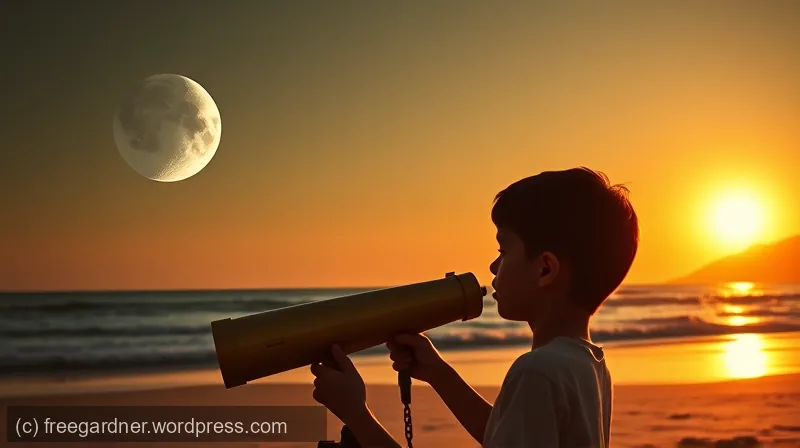
He stood on a beach in Brazil, a child’s toy telescope balanced on a rickety tripod. The year was 1962, and the sky was still bright. His father had told him to look west, just after sunset, and wait. The boy saw the Moon, a thin crescent, and next to it, a point of light so brilliant it seemed to pulse. Venus. Then, slowly, the Moon’s dark edge crept across the planet, eating it whole. For seven minutes, Venus vanished. Then it reappeared, like a star being reborn. The boy did not know the word occultation. But he never forgot the feeling: that the sky could hide something, then give it back.
This June, that same trick repeats. On June 17th, from parts of the United States, Canada, Brazil, and Venezuela, the Moon will pass directly in front of Venus during daylight hours. For those in the exact viewing path, Venus will disappear behind the Moon’s dark limb and reappear on the other side. For everyone else, the Moon and Venus will simply appear close together, a tight pairing in the afternoon sky. But there is a catch: this happens when the Sun is still up. The old rule holds: never point binoculars, a telescope, or a camera near the Sun without proper solar filters. One glance through a lens at the wrong angle can burn a hole in your retina forever.
The Great Sky Meeting
The boy from 1962 grew up to become an astronomer at the University of São Paulo[1]. He studied how planets move, how their orbits trace paths across the ecliptic—the same imaginary line the Sun follows through our sky. This line is why planets appear to gather. They do not crowd together in space; they remain millions of miles apart. But from Earth, their orbits line up like cars on a highway, and sometimes, they pass close to one another from our point of view.
That is exactly what happens on June 9th. Venus and Jupiter, two of the brightest objects in the night sky, will meet in a planetary conjunction. They will appear so close that you can cover both with your thumb at arm’s length. Venus shines with a steady white light; Jupiter glows a softer, creamier yellow. The pairing is a reminder that these worlds are not stars. They are neighbors, orbiting the same Sun, and for a few evenings, they share the same patch of sky.
Then, from June 11th to June 15th, a third planet joins the conversation. Mercury, the smallest and fastest of the inner worlds, will rise low in the western twilight. You will need a clear horizon and a sky free of haze. Mercury is shy; it never strays far from the Sun. But for five nights, it will sit beneath Venus and Jupiter, forming a mini parade of planets. This is not a rare event—planets gather every few years—but it is a beautiful one. It is like watching three old friends meet at a street corner, each arriving at a different hour.
The Longest Day, the Shortest Night
While planets gather in the west, the Earth tilts. On June 21st, at 1:24 a.m. Pacific Time, the Northern Hemisphere experiences the summer solstice. This is the moment when the Sun reaches its highest point in the sky, and the day is at its longest. In Los Angeles, the Sun will rise before 5:30 a.m. and set after 8:00 p.m. In Seattle, daylight stretches past 16 hours. In Fairbanks, Alaska, the Sun barely dips below the horizon at all—a phenomenon called the midnight sun.
But here is a detail that surprises most people: the longest day does not match the earliest sunrise or the latest sunset. In Los Angeles, the earliest sunrise happens around June 12th, more than a week before the solstice. The latest sunset comes after the solstice, around June 28th. This lag happens because Earth’s orbit is not a perfect circle. It is an ellipse, and the planet moves faster when it is closer to the Sun. The result is a slow wobble in the timing of dawn and dusk. The solstice is the peak of daylight, but the edges of the day shift like a tide.
The concept of a solstice has been known for thousands of years. The ancient Greeks, particularly Hipparchus of Nicaea around 150 BCE, used the solstices to calculate the tilt of Earth’s axis. He found it to be about 23.5 degrees—a number that still holds today. That tilt is why we have seasons. Without it, every day would be the same length, and the planets would never gather in the same part of the sky. The tilt is the reason June brings both long days and planetary parades.
Deep-Sky Treasures and the Summer Triangle
Once the sky darkens, after the last glow of twilight fades, the real show begins. High overhead, three bright stars form a giant triangle: Vega, Altair, and Deneb. This is the Summer Triangle, an asterism that dominates the northern sky from June through September. Vega, the brightest of the three, is a blue-white star only 25 light-years away. Altair is closer, at 17 light-years. Deneb is far more distant—about 2,600 light-years—but it shines so brightly that it appears as a steady point of light.
Inside and around this triangle lie some of the most famous objects in the deep sky. The Dumbbell Nebula, also known as Messier 27, was the first planetary nebula ever discovered. It was found by the French astronomer Charles Messier in 1764. Messier was hunting comets, but he kept finding fuzzy patches that were not comets. He cataloged them so other astronomers would not confuse them with real comets. The Dumbbell Nebula is the ghost of a dying star, a cloud of gas expanding outward at 20 miles per second. Through a telescope, it looks like a glowing apple core.
Nearby, the Ring Nebula (Messier 57) floats in the constellation Lyra. It is a doughnut of gas, the remnant of a star that shed its outer layers about 4,000 years ago. The North America Nebula (NGC 7000) is a vast cloud of hydrogen gas that glows red in long-exposure photographs. It is called the North America Nebula because its shape resembles the continent, with the Gulf of Mexico clearly visible. The Veil Nebula is the wreckage of a supernova that exploded 10,000 to 20,000 years ago. It is so faint that it was not discovered until 1784 by the German-born astronomer William Herschel.
These objects are not bright like planets. They are dim, ghostly, and require patience. But they are also stellar nurseries and graveyards of stars. They are where gas collapses into new suns, and where old suns scatter their atoms back into space. The iron in your blood, the calcium in your bones, the oxygen you breathe—all of it was forged inside stars that exploded long before Earth existed. When you look at the Veil Nebula, you are looking at the remains of a star that once made the atoms that now make you.
The Science of Seeing
Why do these events matter? The conjunction of Venus and Jupiter is not a scientific breakthrough. It is a reminder that the solar system is a clockwork. Every planet moves according to laws written by Johannes Kepler in 1609 and refined by Isaac Newton in 1687. Kepler’s first law states that planets orbit the Sun in ellipses, not perfect circles. His second law says that planets move faster when they are closer to the Sun. These laws predict every conjunction, every occultation, every solstice, centuries in advance.
The occultation of Venus by the Moon on June 17th is a perfect example. Astronomers at NASA’s Jet Propulsion Laboratory can calculate the exact moment the Moon will cover Venus, down to the second, for any location on Earth[2]. This is not magic. It is mathematics. The Moon’s orbit is tilted about 5 degrees relative to the ecliptic, so it does not always cross in front of Venus. But when it does, the alignment is precise. The same calculations that put a rover on Mars also predict when a planet will vanish behind the Moon.
There is also a practical side. The lunar occultation helps astronomers refine the Moon’s orbit. By measuring exactly when Venus disappears and reappears, scientists can detect tiny wobbles in the Moon’s path. These wobbles are caused by the gravitational pull of the Sun, Earth, and other planets. Over time, they help improve our understanding of the Moon’s motion, which is essential for future lunar missions. The Artemis program, which aims to return humans to the Moon by 2025, relies on these precise orbital models[3].
The Boy Who Looked Up
The boy from the beach in Brazil is now 78 years old. He still watches the sky every clear night. He has seen dozens of occultations, hundreds of conjunctions, and thousands of sunsets. But he remembers that first one most clearly. He remembers the way the Moon swallowed Venus, held it, and then let it go. He remembers the feeling that the universe was speaking, and that he was listening.
This June, you can listen too. On June 9th, step outside after sunset and look west. Venus and Jupiter will be there, side by side. On June 17th, if you are in the right place, watch the Moon cover Venus. On June 21st, feel the longest day of the year. And when the sky is fully dark, look up at the Summer Triangle. Find the Dumbbell Nebula. Find the Ring Nebula. Find the ghost of a star that died before humans existed.
These events are not rare. They happen every year. But they are never the same twice. The Moon’s orbit shifts. The planets drift. The solstice arrives at a slightly different moment each time. And you, the observer, are also different. You are older, wiser, more aware. The sky does not change quickly. But you do.
On June 21st, at 1:24 a.m. Pacific Time, the Earth will tilt exactly 23.44 degrees toward the Sun. That is the number. That is the anchor. That is the moment when summer begins, and the planets gather, and the Moon hides Venus, and the deep sky opens its doors.
Go outside. Look up. The universe is waiting.