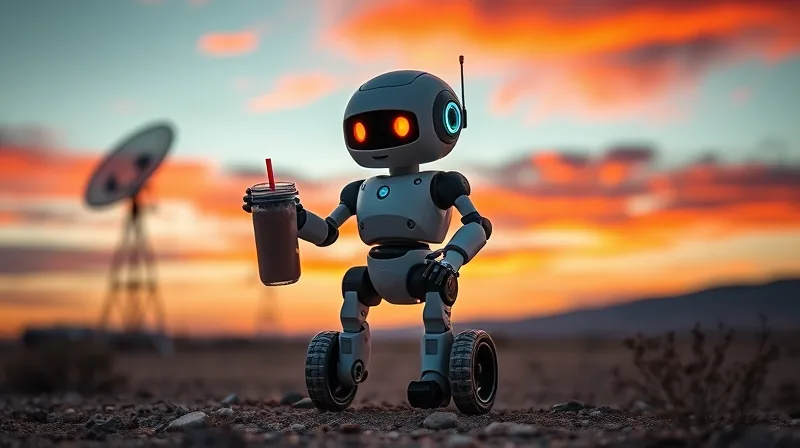
The Robot That Doesn’t Promise the World, But Pours a Protein Shake
In Martinez, California, a small city on the northeastern edge of the San Francisco Bay Area, a startup called Hello Robot is doing something unusual: it’s putting robots in real homes, with real people, right now. Not in five years. Not behind glass in a lab. Today.
The robot is called Stretch. It’s not a humanoid that walks on two legs or mimics the grace of a person. It’s a wheeled base with a telescoping arm, pinchers, and a head full of sensors. When its battery runs low, the lights around its “eyes” glow red, making it look angry—a joke the engineers make, but one that hints at the humility of the project.
Hello Robot isn’t building a foundation model. It isn’t promising to replace every worker or take over every chore. It’s doing something more grounded: showing where AI actually lifts us, not where it dazzles us.
Where AI Lifts: Independence, Not Replacement
Keith Platt became quadriplegic in 2021. [4] He can control parts of his shoulders, his neck, and his head. Before Stretch, simple tasks like drinking a protein shake in the morning required another person to be present. That dependency is exhausting—physically and emotionally. Platt says anything he can do to regain independence, like putting on reading glasses or brushing his own teeth, “is huge.” [4] Not just for him, but for the people who care about him.
Stretch is controlled by a voice-operated iPhone app. Platt can tell it to move to a spot in his house, then take over direct control to manipulate objects. The first time he tried to get Stretch to serve him a protein shake, it took nearly two hours. Alone. No one else in the room. He stuck with it. Now, it takes a few minutes.
That’s where AI lifts. Not in grand promises of a robot butler that does everything, but in the patient, incremental work of giving someone back a piece of their day. The robot doesn’t replace human care; it reduces the burden of constant assistance. It allows family members to leave the house without hiring a professional caregiver. That’s not a sci-fi vision. It’s happening now.
Where AI Deceives: The Hardware Gap
Meanwhile, a few miles south in Silicon Valley, the narrative is different. Humanoid robots are being unveiled with fanfare. One company, 1X, announced its Neo robot last year, claiming to have sold out of 10,000 units, but independent verification of deliveries is lacking. Another startup, The Bot Company, faces a lawsuit from a San Francisco Airbnb owner alleging property damage from its robot, though details remain unconfirmed
The deception isn’t malice. It’s the gap between what AI brains promise and what robot bodies can deliver. A robotic hand and arm weigh far more than a human’s, and physics doesn’t care about your marketing deck. When robots make mistakes, they damage things. That’s not a bug—it’s the current state of hardware. As one researcher at UC Berkeley put it, “The state of hardware today is actually abysmal from the perspective of, ‘I want to have robots in my parents’ place.’” [4]
The data problem is even bigger. AI algorithms may be advancing, but they need real-world training data. Simulation helps, but it’s not the same as a robot bumping into a coffee table, learning to navigate a cluttered kitchen, or dealing with a rug that shifts under its wheels. As one investment firm noted, “The moat isn’t just IP, but accumulated operating hours under real-world liability.”
Hello Robot is collecting that data now, in real homes, with real people. That’s the lift. The deception is believing you can skip that step.
Where AI Makes Us Superfluous: Not Yet
The fear that robots will make humans superfluous is real, but it’s not the story here. Stretch doesn’t replace Platt’s caregiver. It reduces the frequency of need. It gives him back small moments of agency. That’s not superfluousness—it’s the opposite.
The real risk of superfluousness lies elsewhere: in the hype that convinces investors to pour money into robots that can’t safely enter a home, while ignoring the ones that already can. In the promise of a humanoid that will do everything, which delays the deployment of a robot that can do one thing well.
Hello Robot’s Stretch 4 costs $30,000—affordable by robot standards, but still expensive. The company states it ships in a cardboard box via UPS, emphasizing accessibility No wooden crates, no installation teams. That’s intentional. Accessibility matters.
The company isn’t promising to remake the world. It’s making a robot that can pour a protein shake. And for Keith Platt, that’s enough to change a life.
Sources
1. World
2. Protein
3. Shake
4. California