The Skin That Should Have Said No
For hundreds of millions of years, the ocean has been a club with a strict door policy. Mammals got in. Reptiles got in, repeatedly. Birds got in. Amphibians, by the logic of their own biology, never did — at least not fully, not permanently, not as adults.
The reason is not mysterious. Amphibian skin is a sieve. It takes in water, gases and whatever else is dissolved around it. In fresh water that is a feature. In salt water it is a slow execution: the sea pulls water out of the animal while salt pushes in, and the animal’s own chemistry collapses. Every living amphibian — all roughly 8,000 species of frogs, salamanders, newts and caecilians alive today — lives with some version of this constraint. None of them is fully adapted to life in the sea.
That is the rule. And then there is a flat, 74-centimetre animal pulled out of Late Triassic rock in Guanling county, in what is now a national geopark in China. [1] Farmers found it. The fossil material, laid down about 237 million years ago, was analysed by a team that named the species Gerrothorax maritimus. [1] It was not a fish. It was not a reptile. Four legs and gills settled the question of what kind of animal it was: an early amphibian, a stem species, a relative of forms that would eventually lead toward the amphibians we know.
This amphibian did not beat the salt problem with a new kidney or a new gland. It beat it with armour.
Armour as a Passport
Gerrothorax carried a complete covering of body armour. In fresh water, that plating was a defence — a shell against predators, a reason not to be swallowed. In the sea, the same structure became something else entirely: a barrier.
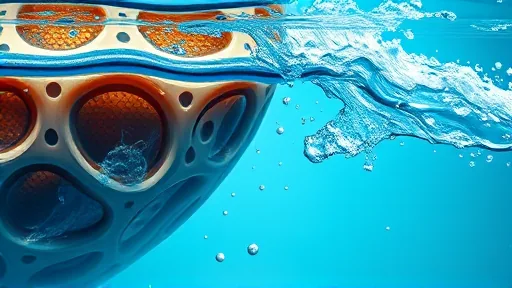
The armour limited the skin-based exchange of water, gas and salt that defines amphibian physiology. The armour that once kept predators out now kept the ocean from getting in.
Ryosuke Motani of the University of California, Davis, who was part of the team that analysed the fossil, describes the animal as flat and bottom-dwelling, a resident of the sea floor. [1] Its wide mouth and the strong hyoid bone in its neck point to suction feeding: the animal opened its jaws and pulled prey in with the water rather than chasing it down. Modern bottom-dwelling ambush predators of comparable size use the same strategy — wobbegong sharks among them. The picture is of a patient animal lying on the sediment, waiting.
The fossil record of the genus supports the accident reading. The closest relative of the new species is Gerrothorax pulcherrimus, an amphibian from freshwater environments, first described nearly a century ago. The marine life of G. maritimus, in Motani’s framing, was not a planned conquest. It was a freshwater amphibian that happened to be carrying the equipment required to colonise the sea.
It is a story about a piece of inherited hardware that turned out to fit a door nobody was trying to open.
Reading Salt From Bone
The team did not rely on the anatomy of the skeleton alone. They measured strontium isotope ratios in the fossil bones. Strontium isotopes carry a signature of the environment in which an animal built its skeleton, and the remains of G. maritimus carried a clear sea-water signature. The animal did not merely die in the ocean. It grew to adulthood there.
The geology agrees. Palaeogeographic reconstructions place the site of the discovery at least 30 kilometres from land in the Late Triassic, roughly 237 million years ago. An animal that lived its adult life 30 kilometres offshore, in fully marine conditions, and left its remains behind, is not a washed-up corpse. It is a resident.
The site also produced a neighbour. The fossil was recovered alongside the remains of Guizhouichthyosaurus, an ichthyosaur reaching lengths of seven metres — a marine reptile sharing the same sea floor.
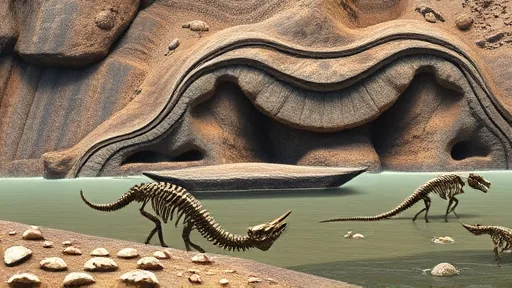
That coexistence is the sharpest part of the finding. John Long of Flinders University in Australia goes further: had the marine invasion by many groups of reptiles at the same time not happened, amphibians might have had a chance at diversifying in that niche. They clearly did not. What the fossil shows, in his words, is that amphibians closely related to modern forms were able to adapt to different environments, like seawater, in ways we never thought possible. “Amphibious” is commonly taken to mean the ability to be on land or in the water. That is a misconception. Many modern newts never leave the water and remain amphibians. His comparison is blunt: it is like calling a snake a tetrapod when it has no limbs. The word describes a lineage, not a lifestyle.
The fossil shows no evidence that the creature underwent metamorphosis, the transformation that turns a tadpole into a frog in many modern amphibians. Motani says so plainly: there is no sign of it. Whatever G. maritimus did with its life cycle, it did not do what the familiar frogs do.
That is settled. It is also why the trick never scaled. One species, one lineage, one accident of armour — and then nothing. The amphibian with the plating stayed a curiosity in the rock, a single branch that reached the sea and went no further.