A Shuttle Standing Upright Rewrites What a Museum Can Do
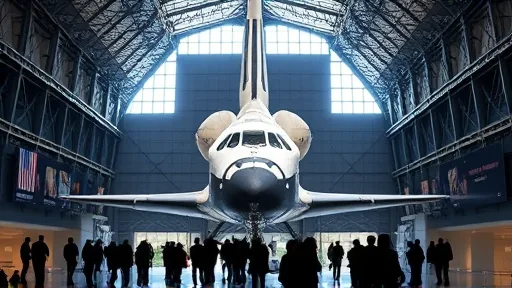
For decades, the museum world has treated the spacecraft as a specimen: horizontal, roped off, lit like a fossil. The new Samuel Oschin Air and Space Center in Exposition Park breaks that assumption by refusing to lay the shuttle down. Endeavour stands upright, mated to its solid rocket boosters and its enormous external tank, in a launch-ready stack roughly 20 stories tall. It is anchored to a concrete pad a floor below ground by just eight bolts. The effect is less display case than geology: a monument that looks as if it is pushing up out of the earth on its way to orbit. The $450-million, 200,000-square-foot expansion opens to the public on Nov. 13, and it arrives as a rebuke to the idea that a retired vehicle should be shown the way you show a car. [1] The old arrangement, a shuttle parked flat in a hangar-like building at the west edge of the Science Center, gave visitors a side view and a ceiling. The new arrangement gives them altitude, and altitude changes the argument. The same object, two entirely different claims about what it was.
The ambition is not new. The idea of standing the shuttle upright emerged from a Science Center master plan more than 30 years ago. What is new is the execution, and the execution required solving a problem that has nothing to do with spaceflight and everything to do with architecture — how to hold a 20-story stack without walls that compete with it.
A Steel Web That Steps Back
The instrument here is the building itself, and its most consequential decision is subtraction. Above three-story concrete lower walls, the shuttle gallery’s structure becomes a lean, self-supporting steel diagrid — a lattice that wraps the orbiter with no interior walls and no interior columns. The architect, ZGF, keeps the dark, cavernous volume in the background so the eye has nowhere to go but the vehicle. The web of steel connectors reads like a constellation, and the cone-shaped surface above it is made of thousands of panels, each one different, each subtly shifting in shape. Each panel is different, and their subtly shifting shapes recall the heat-shield tiles on the shuttle itself. The panels merge support and weather protection, and through steel clips they frame the building’s outer stainless-steel tiles.
A conventional hall would have put a roof over Endeavour and called it shelter. This one puts a skeleton around it and calls it a frame. The visitor’s attention is the scarce resource, and the architecture spends it carefully, keeping the dark, cavernous volume in the background so the eye has nowhere to go but the vehicle.
The paths inside are choreographed the same way. A 16-story-tall re-creation of the launchpad’s gantry — the “Launch Tower” — brings you closer by glass elevator, with viewing decks at multiple levels. Part science exhibit, part thrill ride, the center teaches through the body before it teaches through text.
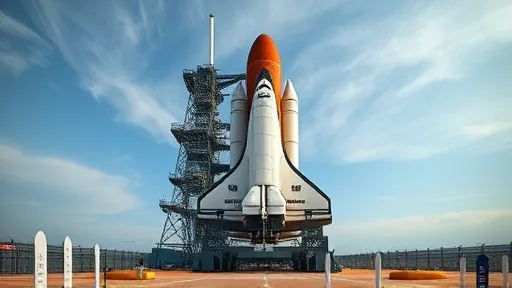
The details reward the second look. Ceramic tiles nearer the front are darker, stained by the heat of reentry. Some of the shielding is white, quilted silica fabric, literally handwoven. The external tank, the last of its kind, was tracked down at NASA’s Michoud Assembly Facility in Louisiana; it is fluted in places like a colossal column and mottled reddish elsewhere, as if made of clay. A replica of the flight deck packs more than 1,000 switches, dials and displays into a space where astronauts slept against walls and ceilings. A line of graphics along one wall lays out all 135 shuttle missions as vertical stripes of information. None of this is decoration. Each item is a measurement of how handmade the heroic thing actually was.
What the Upright Shuttle Leaves Unfinished
The Oschin’s aviation and space galleries — bridging the shuttle hall and the Science Center’s towering lobby — use the same principle of letting extraordinary artifacts lead. The three-story aviation hall suspends almost two dozen aircraft from extra-thick concrete beams, among them a replica Wright Brothers glider, a Grumman F11F-1 Tiger inverted as if a Navy Blue Angel were still steering, and a Joby S4 Air Taxi. Large openings cut through each floor plate so the craft can be seen from every angle, even above. A central bank of bleacher seating called the “Concourse” links the first and second floors. It is excellently executed, and it feels familiar — planes and spacecraft across several levels, oversize graphics, hands-on displays — and it rarely reaches the intensity of the shuttle gallery.
Outside, the addition makes an uneven case. Its irregular, overlapping stainless-steel panels catch unique swathes of sunlight, and where the building wraps the shuttle it reads as a gleaming cone visible from far away. Elsewhere the form feels leftover, like foil stretched around a conventional mass. The scalelike panels inevitably read as a watered-down echo of Frank Gehry’s Bilbao-era work — and the echo is ironic, because Gehry’s own 1984 Science Center Air and Space Gallery sits a few feet away, empty and deteriorating since it closed in 2011. That canted, seven-sided building folded a Lockheed F-104 Starfighter into its sheet metal and stucco. Science Center President and Chief Executive Jeffrey N. Rudolph says there is hope of someday returning it to service, but its small spaces, awkward circulation and constant leaking have made that difficult. [1] The larger missed opportunity is the park. With Oschin, the Lucas Museum of Narrative Art, BMO Stadium, two expansions to the Natural History Museum and the renovation of the California African American Museum, Exposition Park now arguably holds Los Angeles’ most impressive collection of cultural institutions. The buildings are still not connected in a meaningful, humane way. State Drive, an ugly black roadway, separates the Science Center from the Rose Garden. The park’s 2020 master plan called for replacing it with a shaded pedestrian route called Museum Walk — a connector discussed since as far back as the 1984 Olympics. Andrea Ambriz, general manager of the state-run Office of Exposition Park Management, wrote in an email that if there was funding, and significant effort toward its delivery, the office would indeed explore creating a green promenade. [1] \"We’d love to see it developed,\” Rudolph said. The state contributed $80 million to the Oschin Center and is spending another $450 million on the park’s deferred maintenance, accessibility and a new park along its south edge. A few million more to better connect its facilities has not followed.
Meanwhile, inside, the galleries succeed precisely by disengaging from that world. Their darkness narrows attention and turns a familiar experience into a journey. Oschin shows what a city can build when its aerospace workshops, its soundstages and its architects pull in one direction. The ground outside shows how far the wiring between those strengths still has to run.
Sources