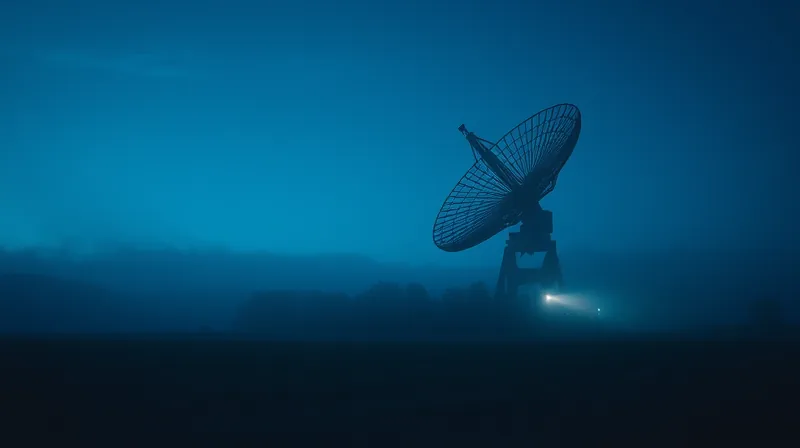
Jodrell Bank Telescope Faces Closure Amid Funding Cuts
The instrument that once tracked Sputnik’s carrier rocket across the night sky now faces an uncertain future. Britain’s largest telescope, the iconic Lovell Telescope at Jodrell Bank, is on the chopping block. Scientists warn that proposed cuts would amount to ‘national self-harm,’ a phrase that captures the gravity of the moment, as reported in a 2026 Nature news article. [1] The decision comes as escalating costs have scuppered plans for a new radio telescope at the same site.
For decades, the Lovell Telescope stood as a monument to British scientific ambition. It was the world’s largest steerable radio telescope when it was completed in 1957. Its white steel bowl became a symbol of humanity’s reach into the cosmos. Now, that same structure may fall silent, a victim of budget pressures rather than technical failure.
The established model of big science — build it, fund it, keep it running — has broken against the hard reality of rising costs. The telescope’s operational expenses have climbed steadily, while funding commitments have not kept pace. The Nature report details how escalating costs scuppered plans for a new radio telescope at the same site, leaving the existing instrument without a clear financial path forward.
The Economics of Giant Dishes
The principle at stake extends far beyond one telescope in the Cheshire countryside. Radio astronomy depends on massive infrastructure that cannot be scaled down without losing capability. The larger the dish, the fainter the signals it can detect from the edge of the universe. This creates an uncomfortable paradox: the most scientifically valuable instruments are also the most expensive to maintain.
The Lovell Telescope’s story mirrors a broader pattern across modern astronomy. Major facilities worldwide face similar pressures, as operational budgets compete with the construction costs of next-generation instruments. The James Webb Space Telescope and other flagship projects demand enormous resources, squeezing the funding available for ground-based facilities, according to the telescope’s official project documentation. [4] This is the scaling problem: what works for a small instrument becomes unsustainable when applied to a giant one.
Jodrell Bank’s situation illustrates how the economics of scale can work against scientific progress. A smaller telescope would cost less, but it would not deliver the same discoveries. A larger one would push boundaries further, but the price tag becomes prohibitive. The sweet spot between capability and cost grows ever narrower, and the Lovell Telescope has found itself on the wrong side of that equation.
What the Cuts Would Destroy
The proposed cuts would not merely retire an old machine. They would dismantle a working research facility that continues to produce valuable data. The telescope remains active in astronomical observation, contributing to studies of pulsars, gravitational waves, and other cosmic phenomena. Its loss would create a gap in the global network of radio observatories that no other British facility could fill.
The phrase “national self-harm” comes from scientists who understand what is at stake. They see the decision as short-sighted, trading long-term scientific leadership for immediate budget relief. The telescope has been a fixture of British science for nearly seventy years, and its decommissioning would send a signal about the country’s commitment to fundamental research. Once dismantled, such infrastructure cannot be easily rebuilt.
The financial arithmetic is unforgiving. Maintenance costs for a structure of this size never decrease; they only grow as the aging telescope requires more repairs. Each year, keeping the Lovell Telescope operational demands a larger share of the available budget. The choice facing funding bodies is stark: support this existing facility or invest in new projects that promise fresh discoveries, a dilemma the Nature report identifies as central to the current crisis.
Seventy Years of Cosmic Discovery
In the history of radio astronomy, the Lovell Telescope represents something irreplaceable. It was the first telescope to detect a radio signal from a distant galaxy. It tracked early space probes and provided critical data during the Space Race. Its contributions to science are documented across decades of research papers and discoveries that changed our understanding of the universe.
The telescope’s name honors Sir Bernard Lovell, who founded the Jodrell Bank Observatory in 1945, as documented by the observatory’s official history. [2] His vision created an institution that became a world leader in radio astronomy. The current crisis tests whether that legacy will continue or become a historical footnote. The decision rests with funding bodies who must weigh the value of past achievements against future priorities.
The broader scientific community watches closely, because this is not merely a local problem. The Nature report notes that the decision reflects a wider tension between maintaining existing facilities and funding next-generation projects, a challenge faced by observatories worldwide. The outcome at Jodrell Bank could set a precedent for how nations approach their own aging research infrastructure.