D-Shaped Magnets Could Transform Fusion Energy
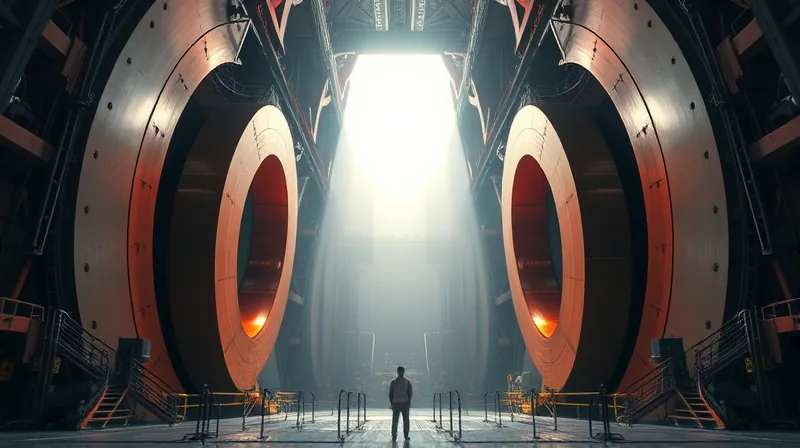
Inside a double-height room in Devens, Massachusetts, about a dozen technicians move with quiet purpose. Hard hats and protective clothing are the uniform of the day. Some workers check pipes rising through the floor into a raised, circular platform. Others tend to instruments mounted inside one of two semicircular chambers. One technician focuses on a pair of D-shaped objects, each big enough for a person to stand inside. They sit upright in a steel frame, looking like something from a steampunk dream.
The visual impression is striking. Hole-studded rectangular plates jut out from the arc of each D. Horizontal grooves decorate the spine of the structure. Together, they resemble a three-dimensional, mechanical version of an illuminated letter from a medieval manuscript. But these objects are not art. Each one is a toroidal field magnet, a piece of engineering developed in collaboration with scientists at the Massachusetts Institute of Technology in Cambridge. The team behind them believes these magnets hold the key to something the world has chased for decades: commercially viable nuclear-fusion energy.
The physics is unforgiving. Fusion power density scales with magnetic strength in a way that rewards ambition. Double the field strength, and the density of the fusion reaction increases by a factor of sixteen. That is not incremental progress. That is a leap. Physicist Alex Creely, chief engineer at Commonwealth Fusion Systems, the company building this machine, puts it plainly: ‘That is a game-changing technology
The dream of fusion has always been about containment. Stars do it naturally, crushing hydrogen under immense gravity until atoms fuse and release energy. On Earth, no such gravity exists. Instead, engineers must create conditions that mimic a star’s core using magnetic fields so powerful they can hold superheated plasma in place. The plasma reaches temperatures of millions of degrees - far hotter than any physical material can withstand. Only invisible magnetic forces can keep it from touching the walls of its container.
For decades, the standard approach has been the tokamak, a doughnut-shaped chamber where plasma is confined by magnetic fields. The problem has always been size. To generate enough magnetic force, traditional designs required enormous, sprawling machines. They were expensive beyond reason and slow to build. The promise of the D-shaped magnet is different. Pack a stronger field into a smaller space, and the whole machine shrinks. Smaller machines cost less. They build faster. They test quicker. That speed could be the difference between fusion remaining a theoretical promise and becoming a practical power source.
Commonwealth Fusion Systems is betting everything on this calculation. The company is not alone in the race, but it has a distinctive edge. Its partnership with MIT brings academic rigor to commercial urgency. The technicians in the room are not just assembling hardware. They are assembling the proof that a compact fusion reactor can work. The D-shaped magnets are the heart of that proof.
The road to this moment has been long. Fusion research has consumed billions of dollars and countless careers over the past seventy years. Every generation has believed it was close. Every generation has discovered new obstacles. The plasma would not stay stable. The magnets would not hold. The materials would not survive. Yet the fundamental appeal never faded. Fusion promises energy that is almost limitless, with no carbon emissions and no long-lived radioactive waste. The fuel is hydrogen, the most abundant element in the universe. A glass of seawater contains enough deuterium for the energy equivalent of a barrel of oil.
What changed now? The answer lies in superconducting materials. The magnets at Commonwealth use high-temperature superconductors, which can carry enormous currents without resistance at temperatures that are cold but achievable. This allows magnetic fields far stronger than older designs could manage. And because field strength compounds so dramatically in fusion physics, a stronger magnet does not just improve the reactor a little. It transforms what is possible.
The technicians in the room understand this. They are not just following blueprints. They are participating in an experiment that will determine whether a compact tokamak can achieve what sprawling predecessors could not. The semicircular chambers around them are part of the same system, housing components that must work in perfect harmony. Every pipe, every instrument, every groove in every magnet matters.
The company’s timeline is aggressive. Commonwealth Fusion Systems has stated its intention to demonstrate net energy gain from a pilot plant, with the SPARC demonstration device slated to come online in the coming years. The D-shaped magnets now being assembled are destined for that machine. If the physics holds, the company could be the first to deliver commercial fusion energy. If it does not, the setback will be public and expensive. Either way, the field will learn something.
The stakes extend beyond one company. A successful compact fusion reactor would reshape the global energy landscape. Nations that currently depend on imported fossil fuels could become energy independent. Industries that cannot be easily electrified - shipping, aviation, heavy manufacturing - could find a new path to decarbonization. The climate crisis has made the search for clean, reliable, baseload power more urgent than ever. Fusion is the only candidate that offers it without intermittency or waste problems.
But the limitations are real, and they are visible even in that Devens room. A magnet that works in a factory is one thing. A magnet that works continuously for years inside a reactor is another. The stresses are immense. The materials must survive neutron bombardment that would degrade conventional structures. The superconducting properties must hold under conditions that push every physical limit. No one knows yet whether the D-shaped design can endure the long haul.
Creely’s confidence is measured. He calls the technology game-changing. That distinction matters. Fusion has broken hearts before. The gap between laboratory success and commercial reality is vast. A reactor that produces more energy than it consumes for a few seconds is a scientific triumph. A reactor that produces electricity reliably for decades, at a cost competitive with other sources, is an engineering miracle.
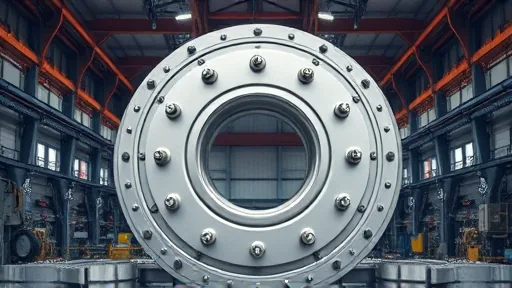
The technicians finish their checks. The magnets stand silent in their frames. Outside, the Massachusetts landscape continues its ordinary rhythm. Inside this building, the future is being assembled piece by piece, D-shape by D-shape. Whether it will work is a question only the experiment can answer. But the effort itself represents something remarkable: a coordinated push by a private company and a top university to do what governments and international collaborations have struggled to achieve for half a century.
The next few years will be decisive. The pilot plant will be built. The magnets will be tested under full load. The plasma will be heated and held. And the world will watch to see whether the promise of fusion finally matches its physics. The D-shaped objects in that room are not just components. They are the physical embodiment of a bet - that human ingenuity can tame the power of the stars, and do it soon enough to matter. Whether that bet pays off will determine not just the fate of one company, but the pace at which clean energy can reshape the global economy.