Two Thermometers, One Room: The Case for Commodities
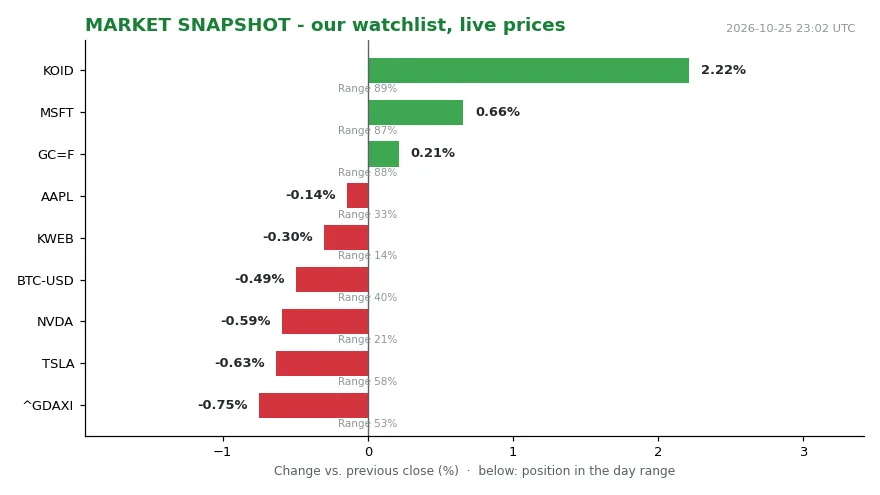
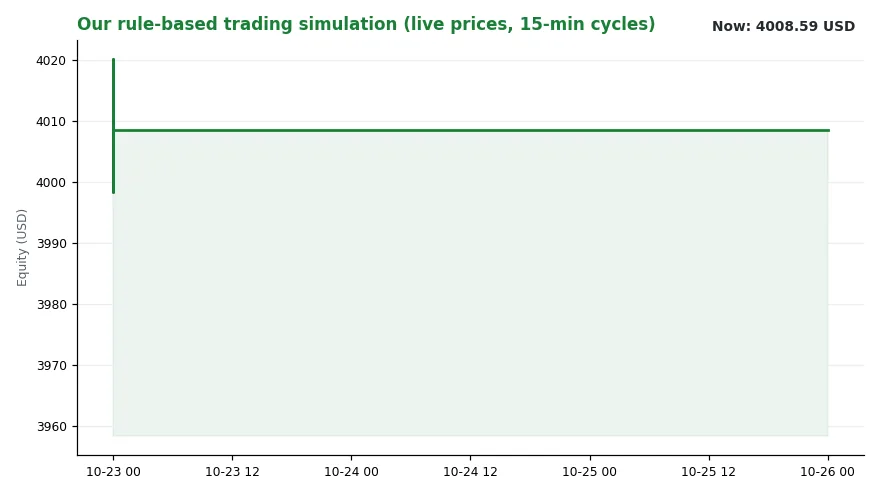
At 22:59 UTC on 25 October our watchlist read less like a market than like a set of instruments disagreeing about the same room. Nvidia printed 210.96 USD, down 0.59 percent and sitting at 21 percent of its daily range (where 0% is the day’s low and 100% the day’s high), close to the lows. Microsoft printed 524.51 USD, up 0.66 percent and at 87 percent of range, close to the highs. Gold futures stood at 4,017.10 USD, up 0.23 percent and pinned at 94 percent of range, while front-month crude (the futures contract closest to expiry, usually the most actively traded) came in at 101.98 USD, down 1.25 percent. Add KWEB at 23.14 USD and 14 percent of range, and KOID at 33.21 USD, up 2.22 percent at 89 percent of range, and the pattern is not one risk signal but a rotation: exposure draining sideways out of the AI complex and out of Chinese internet names, and settling where value is stored when the price of energy is in question. Our regime reading (the desk’s own model label for the market state it measures) says trend=falling, level=3.63, and the busiest signal channel of the day was “central banks”, with three events. The rule-based simulation we document stood at 4,008.59 USD, flat against the previous day, 2,012.65 USD of it in cash, with the latest decision a watch on KWEB at zero (own measurement, 25 October 2026).
In our reading, a copper mine and a data centre have more in common than either has with an index future: both are, at bottom, long-duration bets on electricity.
What the note actually argues
Goldman Sachs recommends a positive commodities allocation, tactically and structurally, as a portfolio hedge against geopolitical escalation — intensified shipping attacks or damage to energy infrastructure — that could push energy prices significantly higher [1]. A number supports the pitch: the BCOM commodities basket (the Bloomberg Commodity Index, a broad basket tracking futures across energy, metals and agriculture) has delivered a 36 percent total return year-to-date [1]. On the day of the note, BCOM was up 0.94 percent while natural gas futures fell 2.56 percent and copper fell 2.13 percent, so the basket’s strength is not a uniform story [1].
The note’s supporting arguments fall into three groups. First, energy: the bank expects crude oil and European natural gas prices to moderate as Middle East supply adapts, but flags that a cold winter could lift European gas prices [1]. Second, agriculture: the Iran and Russia-Ukraine wars, a high likelihood of a weather-disrupting Super El Niño and the potential for food export restrictions pose upside risks to agricultural prices [1]. Third, structural scarcity: rising demand meeting persistent supply constraints, especially in copper, gold and select power markets [1].
The nuance matters. Because many spot energy prices already incorporate a substantial risk premium (the extra return investors demand for holding a riskier asset), the bank favours targeted hedges with more asymmetric upside and attractive valuations, specifically long European summer 2027 gasoline futures and TTF (the Dutch Title Transfer Facility, Europe’s benchmark natural-gas price hub) European natural gas Q1 FY27 call spreads (buying one call option and selling another at a higher strike to cap cost and payoff) [1]. That is a different instrument than “buy oil”. It is a way of paying for protection where the market has not yet priced the tail.
The mechanism: energy has become a discount-rate variable
The channel the note describes is monetary, not merely industrial. Since the Iran war began, equity and particularly bond prices have become unusually sensitive to energy prices, which the bank attributes to resilient global GDP growth and five years of above-target inflation that have led central banks to respond to the inflationary effects of higher energy prices [1].
An oil spike used to be a sector event: it moved airlines and refiners. Now it moves the discount rate (the interest rate used to convert future cash flows into today’s value), because it moves the policy path. A ten-year yield of 4.9880 percent, up 0.0350, and a VIX (the Cboe volatility index, the market’s priced expectation of S&P 500 swings over 30 days) at 19.45, up 2.21 percent, describe a market that, in our reading, is pricing policy risk rather than growth risk (own measurement; yield and VIX levels as quoted in the source header).
The second mechanism is physical. Commodities provide diversification by insuring against supply disruptions at a moment when rising supply concentration, US-China competition in AI and geopolitical fragmentation increase those risks [1]. The channels are concrete: copper faces constrained mine supply against demand from electrification, data centres, energy security, quasi-strategic stockpiling and AI [1]. Gold demand is being boosted by central bank diversification, while annual mine supply remains small relative to the above-ground stock [1]. In select power markets, such as US PJM (the mid-Atlantic/Midwest grid operator and capacity market), geographically highly concentrated data-centre demand is running into power supply constraints [1].
That is the gap the note is pointing at: a hedge priced against a risk the spot curve has not fully absorbed.
Who wins, who pays, who decides
The beneficiaries are legible [1]. Copper producers with constrained mine supply sit on the supply side of an electrification trade [1]. Gold holders benefit from reserve diversification by central banks [1]. Owners of capacity in constrained power markets such as PJM hold an asset whose scarcity is geographic, which in our reading is not cyclical [1].
The payers are equally legible: energy-intensive data-centre builders, bondholders whose duration (a bond’s sensitivity to interest-rate changes, measured in years) has become an energy derivative, and consumers at the receiving end of food and power prices [1].
What to watch, and what remains unknown
The framing matters: this is a hedge recommendation, not a forecast. The same note expects crude oil and European gas to moderate [1], which means the case rests on asymmetry, not on a directional call. What we would watch: European gas into the winter and the Q1 curve that the call spreads reference; copper mine supply discipline; PJM capacity signals as data-centre load concentrates; and any agricultural export restriction [1].