The Empty Bell: The 2026 IPO Class Is Down to One Name
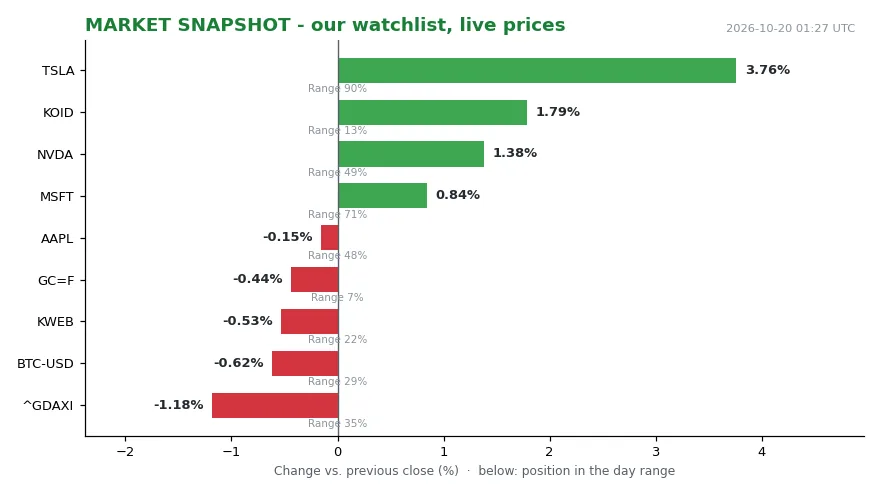
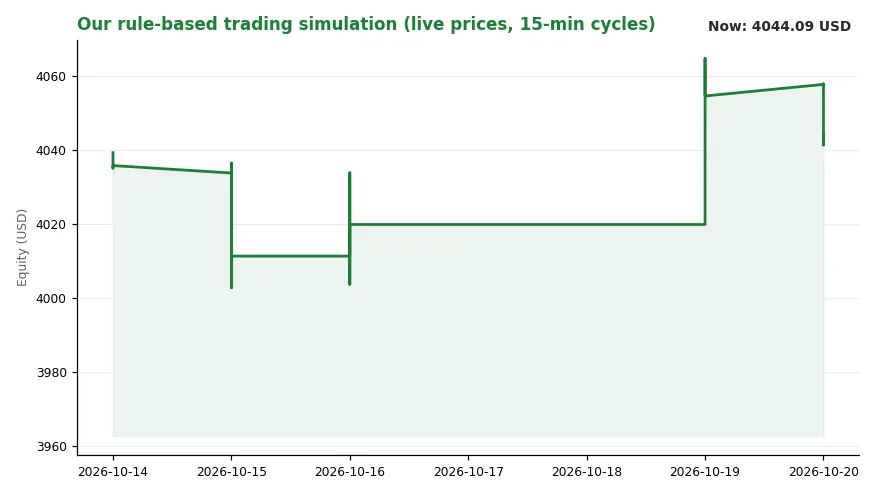
At 01:24 UTC on 20 October, our own measurement of the market described a tape that was rising in some places and slipping in others, and refusing to commit either way. Nvidia printed 217.09, up 1.38 % and sitting at 49 % of its daily range — dead centre. Microsoft traded at 533.52, up 0.84 % and at 71 % of its range, nearer the highs. Tesla stood out at 368.06, up 3.76 % and at 90 % of the day’s range. Elsewhere the picture inverted: gold futures at 4142.00, down 0.44 % and at just 7 % of the range, pressed on the lows; bitcoin at 81,337.01, down 0.62 % and at 29 % of its range; the KWEB China internet ETF at 24.28, down 0.53 % and at 22 %. Our regime reading was trend=falling, level=3.63. The rule-based simulation we document held 2,416.47 USD of its 4,041.36 USD in cash and had logged its latest decision as WATCH on KWEB at 0.00 — no position taken. Read together, that is rotation without conviction: a narrow bid for a few mega-cap technology names, and money leaving almost everything else on the shelf.
That is the tape on which this week’s news lands. And the news is that the party is smaller than the invitation list implied.
The question that hangs over the 2026 calendar is what a public listing is actually for, once the companies everyone most wanted to see list decide they would rather stay home?
The calendar that shrank
Heading into 2026, investors expected a wave of debuts from mega-cap private companies, SpaceX, Anthropic and OpenAI among them. SpaceX did come to market, in June, and total IPO proceeds this year are up sharply on the back of mega-cap debuts like it. The count tells the opposite story: the number of U.S. IPOs priced this year is down 33 % compared with 2025, according to Renaissance Capital. More money, fewer deals.
Several other planned offerings have been postponed this year, and postponements have accelerated across sectors in recent weeks.
Which leaves the prediction market as the cleanest scoreboard available. On Kalshi, the contract asks whether a list of companies will officially announce an IPO in 2026. Of the 23 names still open to trade, exactly one clears even odds: Anthropic, at 75 % as of Monday morning. Everyone else has bled out. Plaid carried 50 % odds in January; traders now put it at 10 %, against a reported $8 billion private valuation. Deel was 50-50 as recently as February; it now sits at 3 %. Databricks has fallen from more than 50 % in January to 1 %. OpenAI is at 3 % for this year, and only 50-50 by June 2027.
The gap between filing and pricing
The Kalshi contract makes explicit something investors usually keep vague. An “official announcement” is not a press report, a founder’s interview or a banker’s leak. It resolves only if the SEC declares a company’s S-1 effective, if an IPO prices, or if an exchange assigns a ticker to the stock. Contracts are settled using various news outlets as sources, which means resolution can lag a filing by days.
That definition matters because it marks the boundary between intent and capital formation. Anthropic confidentially filed a prospectus with the Securities and Exchange Commission in early June — a real step, and not one of the three triggers. A confidential filing can sit, be amended or be withdrawn without the public ever seeing a price. The gap between filing and pricing is precisely where the 2026 calendar has gone to die.
Why should that gap move markets beyond the companies involved? Because a priced IPO converts private claims into a daily-priced public asset. It gives employees a market for locked equity, gives index funds something to buy, gives the issuer a currency for acquisitions and gives public investors a claim on the fastest-growing part of the economy. Every postponement defers that conversion. When proceeds rise while deal counts fall, as they did this year, the public market gets narrower and older at the same time — the newest, largest growth stories stay behind a private wall, and the indices that track them become increasingly a record of the last cycle rather than a claim on the next one.
The revenue problem underneath
Optimism about the AI listings rested on an assumption of near-vertical growth. That assumption took a hit last week, when Anthropic disclosed third-quarter revenue of $16.8 billion — a weaker quarter-over-quarter growth rate than in earlier periods. [1] 22V Research analyst Dauvin Peterson wrote on Sunday:.” [1] Peterson added: “At the end of the day, the revised IPO valuation range starting at $1.5T vs the prior expectation of at least $2T was viewed as disappointing and added fuel to the fire for the AI-related equities that were already under pressure.” [1] Two mechanisms are visible in that note. The first is pricing pressure on large language models, which feeds directly into the revenue-per-unit economics that public investors would underwrite. The second is the valuation anchor: a range starting at $1.5 trillion, against an earlier expectation of at least $2 trillion, changes the reference price not just for one issuer but for every private and public comparable in the sector.
Who wins, who loses, who decides
The losers from a thin 2026 class are not hard to identify. Employees holding illiquid paper in the postponed names have no market for it. Underwriters and exchanges lose the fee and listing revenue. Public-market investors who wanted exposure to the largest AI labs are left with second-order proxies — suppliers, infrastructure, adjacent platforms — which is one plausible reading of the narrow mega-cap bid in our own tape. Existing holders of AI equities absorbed the valuation reset directly.
On the winning side sit the private-market buyers with capital still to deploy, and the venues that price the waiting itself: Kalshi’s contract volume is a direct beneficiary of the uncertainty it measures. SpaceX, having listed in June, captured the window that others missed.
The decision-makers are few. Anthropic’s board and the SEC’s review calendar control the only remaining major trigger; OpenAI’s leadership has already ruled out a 2026 debut; and the pricing environment for AI revenue does the rest. One disclosure deserves weight when reading coverage of this market: CNBC and Kalshi have a commercial relationship that includes customer acquisition and a minority investment. That does not make the odds wrong, but it is a reason to read the framing of those odds with the same care as the numbers.
What we watch next
The next real signal is procedural, not rhetorical: whether Anthropic’s registration goes effective, whether a ticker is assigned, and at what range a deal is finally marketed. The $1.5 trillion floor is the number to hold against the earlier $2 trillion expectation. Second, watch whether any postponed name re-enters — Plaid at 10 % is the cheapest option on the board. Third, watch the deal count rather than the proceeds line in the fourth quarter, because the divergence between the two has been the year’s defining feature. Fourth, watch SpaceX’s post-listing trading as the only live template for how public markets actually price a company of this size and story.
The honest uncertainty is substantial. Twenty-three contracts are a curated list, not a census of the IPO pipeline. Resolution depends on news reporting, which can lag a filing by days. And a 75 % probability is a crowd’s opinion about a decision made by a small group of people behind closed doors — it is not a commitment, and it can move on a single filing.
The coordinates of this story are unglamorous: the SEC’s filing index, where a prospectus can sit in confidence for months; a prediction-market order book, where the odds on 22 of 23 names have collapsed; and our own nightly tape, where trend=falling at level 3.63 and a simulation holding more than half its capital in cash both say the same thing — this is a market waiting for a bell that has not rung. Nothing here is a recommendation; it is a description of where the conversion stalled.
Methodology note: market data reflect our own measurement as of 2026-10-20 01:24 UTC. Company probabilities are Kalshi contract odds as reported by CNBC. This article is educational analysis, not investment advice.
Sources
Mentioned organisations (context, not sources)
- Nvidia — Organisation (homepage)
- Microsoft — Organisation (homepage)
- Tesla — Organisation (homepage)
- Kalshi — Organisation (homepage)
- SpaceX — Organisation (homepage)
- Anthropic — Organisation (homepage)
- OpenAI — Organisation (homepage)
- Plaid — Organisation (homepage)
- Deel — Organisation (homepage)
- Databricks — Organisation (homepage)