
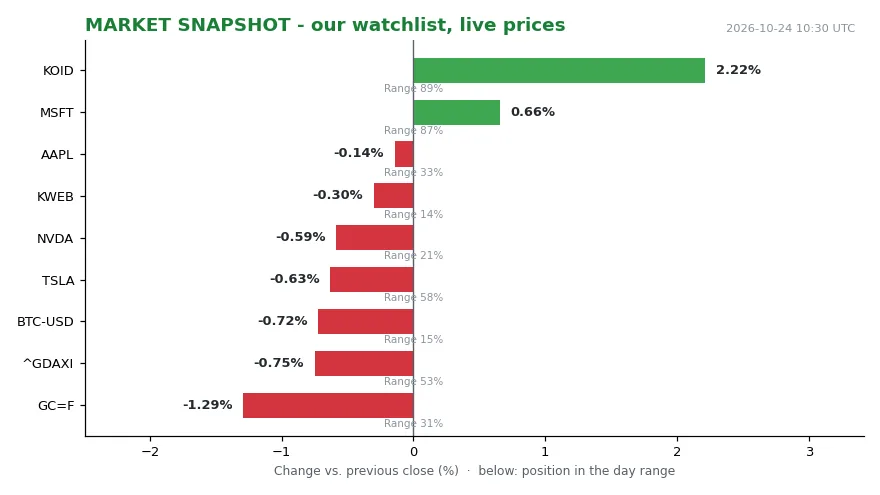
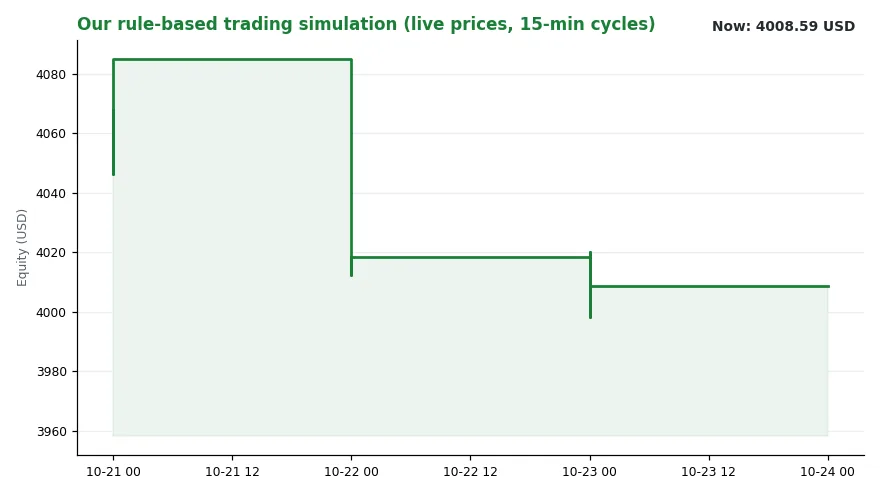
At 10:26 UTC on 24 October 2026 our own quote feed showed NVDA at 210.96, down 0.59 percent and near the day’s lows at 21 percent of its range — range position is where the price sits between the session low at 0 percent and the session high at 100 percent; MSFT at 524.51, up 0.66 percent and close to the day’s highs at 87 percent of range; gold futures at 4,007.90, down 1.29 percent and sitting mid-range at 31 percent. Bitcoin traded at 80,447.27, off 0.78 percent and pinned near its low at 8 percent of range, while KWEB held 23.14, down 0.30 percent and at 14 percent of range. Crude oil for December delivery printed 103.27, up 3.82 percent — the loudest figure on our board — with the VIX — the “fear gauge”, the price of options that pay out when the S&P 500 swings — at 19.45, up 2.21 percent. Our regime reading — our internal gauge of trend direction and strength — is trend falling, level 3.63. Busiest signal channel of the day: central banks, three events. Sim equity 4008.59 USD (+0.00% vs. the same time yesterday); cash: 2012.65; latest sim decision: WATCH KWEB @ 0.00.
On our reading, that is not a flight from risk. It is a sorting. Money is holding large-cap software near its highs while gold, crypto and China exposure sag toward their lows. On our reading, a barrel above 103 dollars is the tell: what moved was an energy and price signal, not a growth signal. That is the correct frame for a piece of news that landed ten days earlier in Washington and that will not reach a single bank account before January.
The number that arrives in January
On 14 October 2026 the Social Security Administration confirmed a 3.6 percent cost-of-living adjustment (COLA) — the yearly inflation adjustment added to Social Security payments — for every beneficiary, effective January 2027 [1]. It is the largest increase since 2023 and a tie for the fifth-largest adjustment in 35 years [2]. The agency estimates the change lifts the average retired worker’s monthly payment by roughly 75 dollars [1]. The reach is broad: about 72 million Social Security beneficiaries receive the higher amount from January, and roughly 7.3 million recipients of Supplemental Security Income (SSI) — a separate needs-based federal payment for low-income aged, blind or disabled people — from 31 December 2026, out of about 76 million people affected [1].
The dollar effect depends on the base, and the base depends on claiming age. Using the SSA’s June 2026 averages, a 62-year-old drawing $1,451.50 moves to $1,503.75 — $52.25 more per month, or $627 across the year. [1] At 67, the full retirement age — the age at which the full calculated benefit starts — for everyone under current rules, $2,037.51 becomes $2,110.86. At 70, $2,264.98 becomes $2,346.52, an increase of $81.54 monthly and $978.48 annually [1]. The gap between the youngest and oldest rows is not a quirk of the table: claiming before 67 carries an early-claiming penalty, waiting past 67 adds delayed retirement credits — bonus percentages added for each month of waiting past full retirement age — until 70, and older beneficiaries have simply banked more COLAs over time [1].
The 2026 maximums show the same gradient in harsher relief. A worker who earned the taxable maximum — the annual cap on earnings subject to Social Security payroll tax — in every year from age 22 could draw $5,181 a month at 70, $4,152 at full retirement age, and $2,969 at 62 [1]. Qualification normally requires 40 credits — work units earned per dollar of covered earnings, with 40 needed to qualify — earned at one credit per $1,890 of covered earnings in 2026, capped at four per year [1].
An index that lags by design
The formula is mechanical. The SSA compares the Consumer Price Index for Urban Wage Earners and Clerical Workers (CPI-W) — the price index built from households whose income comes mostly from wages — for the third quarter of the current year with the same quarter a year earlier, takes the percentage difference, and rounds to the nearest 0.1 percent [1]. The CPI-W is narrower than the headline inflation figure most people read: it covers only households where more than half of income comes from clerical or wage occupations and where at least one earner worked 37 weeks or more in the prior 12 months — roughly 30 percent of the U.S. population [1].
That construction produces two structural gaps, and they are the reason this announcement is contested rather than celebrated. The first is a lag: the index measures prices already paid, and the payment adjusts months later. The second is coverage: a basket weighted for wage-earning households is not a basket weighted for retirees, who spend more on healthcare services [1]. The Senior Citizens League’s executive director, Shannon Benton, framed the timing problem directly: “When inflation spikes due to a geopolitical event like the Iran war, seniors pay the price. Prices go up today, but benefits stay the same for months due to an outdated COLA methodology. Working people can request a raise or seek a higher-paying position, but seniors have to make lifestyle cuts or drain their savings until the next COLA” [1].
What produced this particular number is disputed in emphasis but not in direction. The Motley Fool attributes the outsized figure primarily to two policies — tariffs and the Iran war — citing a Liberty Street Economics report by three New York Fed economists estimating that tariffs added 2.9 percentage points to goods prices by February 2026, and noting that the war caused the largest energy supply disruption in modern history [2]. Our own tape is consistent with the second half of that story: crude at 103.27 with a 3.82 percent gain is exactly the kind of print that feeds an energy-driven CPI.
Who gains, who absorbs the gap
Three groups sit on different sides of a 3.6 percent adjustment. Beneficiaries with high bases and late claiming dates collect the largest nominal increases — the age-70 row is worth more than half again what the age-62 row is worth per month. Beneficiaries who depend on Social Security for most of their income and hold little flexible savings absorb the lag most painfully; Gregory DuPont, an attorney and certified financial planner, describes that group as “relying on Social Security for the majority of their income, with little flexible savings to absorb the gap” [2]. And the decision layer is split: the formula is set in law; the SSA only applies it [1], while the methodology itself — the piece Benton calls outdated — is a policy question, not an actuarial one [1].
There is a fourth actor that rarely appears in the headline: Medicare. Personalized SSA notices due in December will state the exact 2027 benefit and how much is withheld for premiums, which means the gross COLA and the net deposit are not the same number [1].
What to watch, and what we cannot know
The next hard datapoints are administrative: the SSA notices, then the January payment. The next analytical ones are the third-quarter CPI-W path, energy prices, and whether tariff pass-through — the share of a tariff that ends up in consumer prices — continues at the pace the New York Fed authors estimated [2]. DuPont’s preparation advice is deliberately unglamorous — review spending, cut discretionary lines, build income sources that are not tied to the COLA, and stress-test a budget assuming the adjustment underperforms for several years [2]. A smaller future COLA would not mean prices fell; it would mean they rose more slowly, which is a different sentence with a different consequence for a household budget [2].
What we cannot say is whether 3.6 percent covers what retirees actually paid this year; the index measures prices already paid, and the payment adjusts months later [1].
Sources
[1] Keith Speights, “The 2027 Social Security COLA Is Official. Here’s the Average Benefit at Every Age From 62 to 70,” The Motley Fool via Yahoo Finance, 24 October 2026. [2] “Social Security’s Trump bump-driven raise,” The Motley Fool via Yahoo Finance. “Social Security payments up to $5,181 coming this week — who gets paid?”, Newsweek via Yahoo News. “Social Security’s next COLA could be smaller than retirees expect,” Yahoo Finance, citing Gregory DuPont of Advocate Wealth Solutions.
Prices cited are our own feed readings as of 2026-10-24 10:26 UTC. This article is educational and contains no investment recommendation.
—