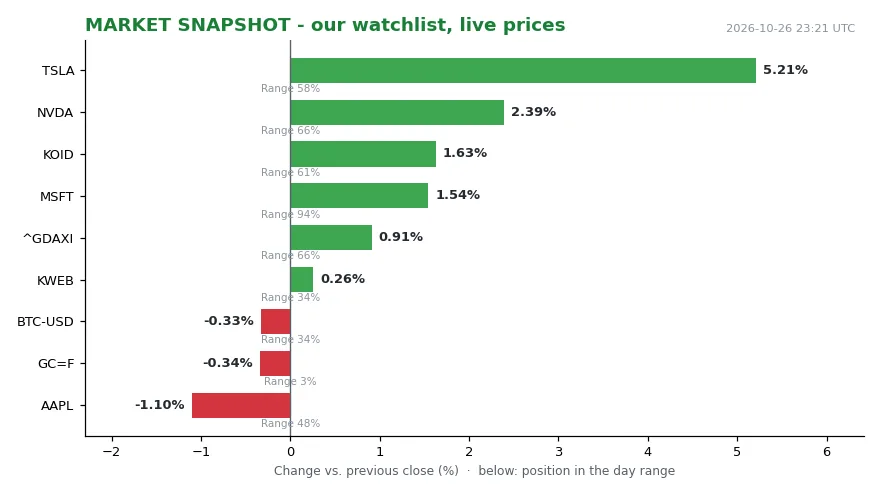
At 23:18 UTC on October 26, our watchlist looked less like a market bracing for a central bank and more like one that had already placed its bet. TSLA printed 391.62, up 5.21% against the previous close and sitting mid-range at 58% of its daily band [M1]. MSFT traded at 532.60, up 1.54% and pressed near its highs at 94% of range [M1]. NVDA stood at 216.00, up 2.39%, mid-range at 66% [M1]. Gold went the other way: GC=F at 4,024.60, down 0.34% and hugging its lows at 5% of range [M1].
That is a rotation rather than a retreat. The bid sits in large-cap growth; the hedge does not participate. Crypto and China tech occupy the lower half of their bands — BTC-USD at 79,772.09, down 0.33% and 34% of range, KWEB at 23.20, up 0.26% and 34% of range [M1]. AAPL is the downside outlier at 343.91, down 1.10% and mid-range at 48% [M1]. In Frankfurt, ^GDAXI ended at 25,410.84, up 0.91% and 66% of range [M1]. KOID, another name we track, added 1.63% to 33.75 and finished at 61% of its band [M1].
Our own book reproduces the ambiguity instead of resolving it. Sim equity stands at 4,004.94 USD, unchanged versus the same time yesterday, with 2,002.32 held in cash [M2]. The latest rule-based decision was WATCH KWEB @ 0.00, a hold with no entry price set [M2]. The busiest signal channel on October 26 was “central banks”, with exactly one event [M2]. The regime reading, meanwhile, says trend=falling at level=3.63 [M2].
Reading the two layers together, the pattern is a disagreement. Price says risk-on; the regime says the trend is down. One measurement reads the tape, the other reads the state of the system. Both are ours, and on this particular day they point in opposite directions. That tension is the right frame for the week, because the Federal Reserve walks into the same split.
Which Clock the Committee Reads
The Fed meets this week to decide whether to raise interest rates for the second time this year in a bid to subdue inflation [S1]. Most economists and Wall Street analysts expect the benchmark rate to be left unchanged at 3.75% to 4% when the policy statement is released on Wednesday [S1]. So the race is not really about October. It is about which clock the committee is reading.
Team Hold points at Wednesday and at the 88% probability traders assign to a pause, according to CME Group’s Fed Watch tool [S1]. Team Hike points at December 8-9, the year’s last scheduled meeting, where the same tool prices a 71% chance of an increase [S1]. There is no November meeting to break the tie [S1]. The two camps are not arguing about the destination: most economists and investors expect one more increase before year-end [S1]. They are arguing about pace.
The data behind that argument is not subtle. Headline consumer prices rose at a 3.7% annual rate in September as energy costs jumped [S1]. Core inflation, which strips out the volatile energy and gas categories, ran at 2.6% from a year earlier [S1]. The Fed’s target is 2% [S1]. Gasoline above $4 a gallon for the last three months accounted for more than half of the September increase in consumer prices, according to the Labor Department [S1].
Add energy back in and the calendar turns political: Americans vote on November 3 [S1]. Voters have expressed frustration with the cost of gas, food and utilities, and that frustration now sits on the calendar next to the FOMC statement [S1]. Three clocks, in effect: the committee’s, the data’s, the electorate’s.
The mechanism: overnight loans and the expectations channel
The transmission is narrow and well documented. The federal funds rate is what banks charge each other for overnight loans [S1]. When it moves, borrowing costs move across the U.S. economy [S1]. September’s quarter-point increase was the first in three years, and it repriced short-term money from a standing start [S1].
The second channel is expectations, and it dominates this week. Traders do not wait for the decision; they price it. Fed Watch converts 30-day Fed funds futures prices into probabilities, and those probabilities are already the market’s answer: 88% hold in October, 71% hike in December [S1].
A third channel normally runs through communication, and this week it is deliberately narrowed. Fed Chairman Kevin Warsh will hold a press conference after the decision [S1]. He has argued against sharing forward guidance on rate decisions, so investors are unlikely to get clues from him beforehand [S1]. That shifts weight onto the statement itself and onto the quarterly projections, which last month signaled that the rate-setting committee expected to raise rates later this year [S1]. Less talk, more text. And the text has to reconcile a 3.7% headline and a 2.6% core with a 2% target and a committee that has already moved once.
The actors: who sets the pace, who absorbs it
The committee sets the pace, and its tone is not uniform. New York Fed President John Williams, speaking at the University at Buffalo after the September hike: “With the policy action we took at our September meeting, there is no need for urgency, and we have time to gather more information” [Q1].
Capital Economics reads the same evidence differently in degree, not direction. In a recent research note, senior North America economist Thomas Ryan wrote: “Although the latest hot inflation readings and rise in inflation expectations will concern Fed officials, they still appear broadly intent on tightening policy at a measured pace” [Q2]. Note what both statements share: neither proposes a stop. Both propose a speed.
Who pays for that speed? Anyone who borrows, because a higher federal funds rate raises borrowing costs across the economy [S1]. Who benefits from waiting? The tape’s answer on October 26 was visible rather than explained — TSLA up 5.21%, MSFT near its highs, gold soft [M1]. Who controls the messaging? Warsh, whose aversion to forward guidance is itself a policy choice with market consequences [S1]. Households are contending with rising prices for gas, food and utilities, eight days before a midterm vote [S1].
What we watch next — and what we cannot resolve
Wednesday, 2 p.m. ET: the statement, and whether the phrase “measured pace” survives contact with a 3.7% headline [S1]. Then the press conference, which we expect to be thin on guidance by design [S1]. Then December 8-9, where futures currently lean toward a move at 71% [S1].
Then the energy line. Gasoline above $4 for three months is the largest single contributor to the September CPI increase, and it is the variable the Fed controls least [S1]. Then core. At 2.6% against a 2% target, it decides whether this is an energy story or a broadening one [S1]. And then our own two readings, which we will keep publishing side by side even when they contradict each other [M1][M2].
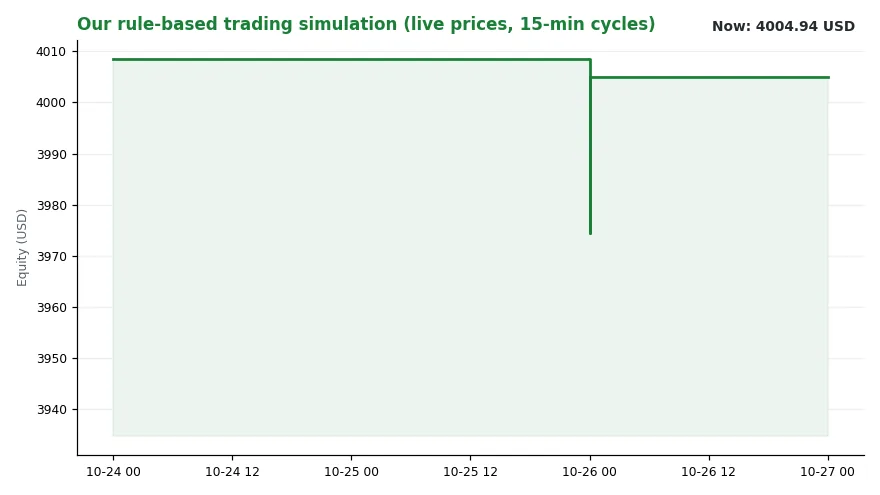
The open question is not Wednesday. It is that our tape and our regime disagree, and we cannot yet say which one is early and which one is simply wrong. The committee’s own communication carries the same unresolved split: projections pointing to another increase later this year, and a regional president saying there is no need for urgency [S1][Q1]. Two clocks, one decision, and no arbiter until the data that arrives after it. Our sim sits half in cash and watches KWEB at zero [M2] — not a view, but an admission that the disagreement has not resolved itself yet.
—
Sources
- Federal Open Market Committee — Quote source (original article)
- Cbsnews — Quote source (original article)