Two Clocks, One Winter: Inside the Unregulated Market Where the Oil Price Arri
ves First
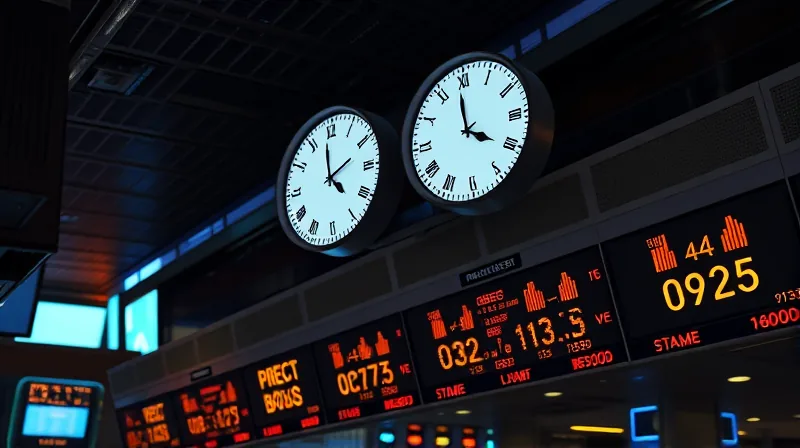
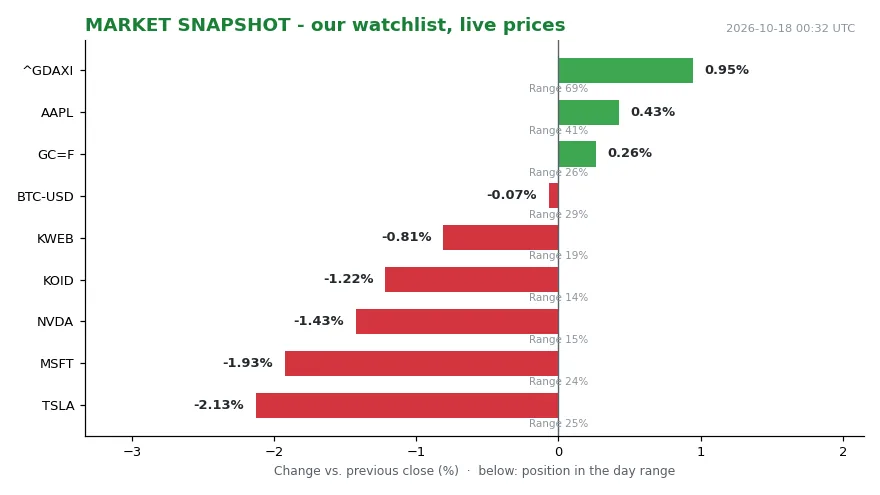
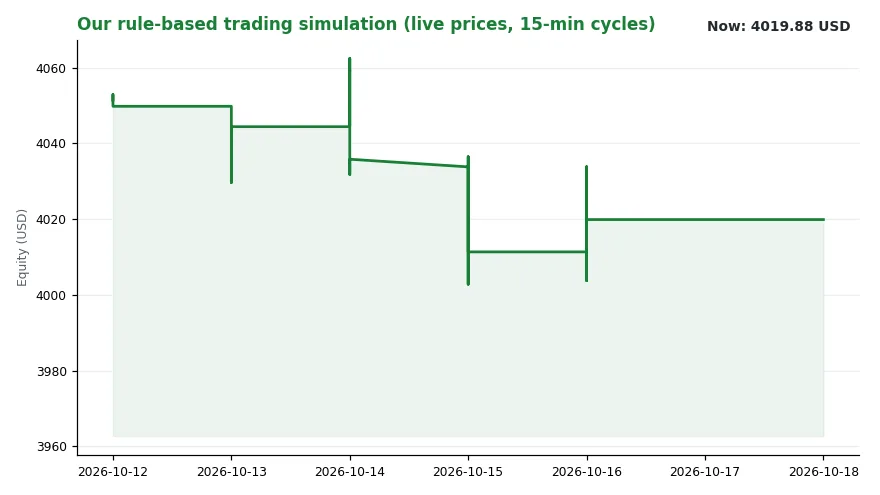
Our tape first: rotation, not panic. On 2026-10-18 at 00:27 UTC our watchlist showed selective risk reduction rather than a broad exit. Nvidia (NVDA) printed 214.13, down 1.43% versus the previous close and at only 15% of its daily range — the distance between the day’s high and low price — near the lows. Microsoft (MSFT) traded at 529.05, 1.93% lower, holding 24% of range. Tesla (TSLA) stood at 354.72, off 2.13%, mid-range at 25%. Gold futures (GC=F) leaned the other way at 4181.10, up 0.26%. The DAX — Germany’s main stock index — was firmer at 25622.61, plus 0.95%, and kept 69% of its range. BTC-USD — bitcoin priced in US dollars — quoted 81,378.00, flat at -0.01% but at 93% of range — near the day’s highs. Our simulated book — a practice portfolio tracked without real money — carried 2014.07 USD in cash against 4019.88 USD of equity, unchanged from the same time yesterday. The regime reading — a summary signal of overall market conditions — was trend=falling, level=3.63. The busiest signal channel — a category of market-moving events tracked by the system — on 2026-10-17 was “central banks”, with 5 events. Money leaned away from the two largest technology names on that list and toward gold, German equities and bitcoin’s upper range.That is one clock, and it ticks in seconds. A second clock is ticking in roughly 1.5 million British people outside the mains gas network. Those homes heat with oil, and the vast majority sit in rural locations. Two timelines are racing toward the same winter: a traded price that reprices by the minute, and a tank that gets filled once. The first clock has already moved; the second decides who pays for it. The gap between them is where the winter’s cost lands.
The setup: a price series, not a forecast
The news is a number line. Until March, UK heating oil held near 60 pence per litre (ppl). When the war in Iran began in March, it jumped to a high of 134ppl. After a dip in recent months it is climbing again and currently stands at 111ppl, according to the price comparison site Boiler Juice. The market is unregulated, unlike gas and electricity. That design feature explains the speed: a change in the global price reaches the customer almost immediately, with no cap and no tariff review in between. A standard tank holds about 500 litres, so a fill now costs around £550 — against roughly £300 a year ago.
For households, this is not a forecast. It is an invoice. Peter Mason, in Minety, north Wiltshire, is near the end of his tank and puts the winter top-up at over £550 [1]. He describes the market as oscillating, “plus or minus £50”, while never having been as high as it is today. Retirement makes the adjustment one-directional: spending gets stretched, and savings get drawn down. Our reading: the expectation embedded in today’s 111ppl quote is geopolitical. Nothing in the retail structure filters that geopolitical premium out before it reaches a tank.
The mechanism: fast pass-through (how quickly wholesale costs show up in retail prices), slow relief
Heating oil is a refined product priced off global wholesale markets. Tensions in the Middle East and the war in Ukraine are both affecting supply. Supply concerns linked to the Middle East are affecting the production and transportation of wholesale oil. Because retail is unregulated, that wholesale signal reaches the delivery almost unmediated — without an intermediary step. Households do not buy a flow of energy; they buy a delivery at the price of the day they order. Timing therefore matters as much as shopping around, and buying early locks in today’s level rather than avoiding it.
There is a second, quieter mechanism, and it comes from the payment counter rather than the oil market. A 2014 study by Tamás Briglevics and Oz Shy in the Review of Industrial Organization asked why most merchants do not use price discounts to steer customers toward cheaper payment methods. Using transaction data, the authors estimated the expected net cost reduction, by merchant type, of offering debit-card and cash discounts. Steering consumers that way does cut most merchants’ card processing costs — the fees merchants pay to accept card payments. But the effect is modest: the reduction “is small and may be insufficient to offset the increase in the cost of administering price menus that vary by payment instrument” — price menus are lists of different prices for different payment methods —.
Small operational savings — a bulk-buying club, a fuel card, a differentiated price menu — are real but bounded, and the payment study puts a rough ceiling on them. They are unlikely to fully offset a supply shock — a sudden change in supply that moves prices — of the size seen between March and now. Dylan Williams, who runs the van business Van & I of Monmouth, has exactly that experience. His fuel card means he pays card prices rather than pump prices, yet it “doesn’t make much a difference these days”. A full tank cost him between £120 and £130 at the start of the year; it now runs to £160. He describes the situation as “ever increasing, ever worrying”.
The players: a chain of cost-bearers
At the household end sits the retiree drawing on savings. One step up sits the small van operator, who has raised his service prices to offset the rise. Further up sits the not-for-profit: Dean Forest Kitchen cooks fresh meals every day and delivers them across a rural area with no public transport. Its volunteer director, Yvette Farrell, sets out the squeeze precisely — a not-for-profit model leaves “not a lot of wiggle room when it comes to increase in any expenses”. The organisation has signalled that a price rise may become unavoidable, because the meals have to reach clients who would otherwise see nobody during the day.
Then there is care. Tristan Holland runs TLC Support Service, a small team of community care workers travelling around Wotton-under-Edge and Dursley. Staff use their own vehicles and the company pays 55p per business mile — a mile driven for work and reimbursed. Fees went up at the start of the year to account for expected extras, and that has not been enough: “Everything has risen - the cost of the fuel, the training, even the uniforms that we purchased”. The stated aim is to keep services affordable, but some margin is needed simply to continue operating.
The collective response is the buying club. Richard Willan runs the Nadder Oil Buying Club in Wiltshire, where more than 1,000 residents buy in bulk for a better price, and he sees rural residents as increasingly vulnerable as the colder months set in. His watch list is political: “We are watching to see what happens with (Donald) Trump in the mid-term elections in America, that might change things again”. The Competition and Markets Authority has taken a similar view of the exposure, describing heating oil customers in remote areas as too vulnerable to price shocks. That is an observation, not a remedy; no cap applies in this market.
What to watch next
The forward list is short and every item on it is uncertain. First, the 111ppl level itself, and whether it keeps climbing into winter. Second, the geopolitical trigger: a US-Iran peace deal is the identified route to lower prices. Third, the political calendar the buying club is already tracking. Fourth, timing behaviour, with many customers buying early in preparation for the colder months. Fifth, the regulatory question the CMA has flagged without resolving.
None of this can be settled from the data in front of us. Our own regime reading — trend=falling, level=3.63 — describes equity risk appetite, not the oil price, and should not be read across. Conflating the two would be the classic error: assuming a calm equity tape implies a calm winter.
The caution is about how a price series like this gets misused. A price series that moves on political statements invites the belief that it can be timed. The evidence points the other way: swings of £50 on a single fill, a jump from 60ppl to 134ppl and back to 111ppl within months, and households with no ability to wait out a bad week. The payment study makes the same point in miniature — savings from clever menu design exist, but they are small and easily eaten by the cost of running the mechanism. Bulk buying and fuel cards are worth having; they are not a hedge against a supply shock. Who is watching matters as well. The CMA has named the vulnerability of remote heating-oil customers. Beyond that, visibility is thin: an unregulated retail market, a price published by comparison sites, and 1.5 million households whose exposure rises as the temperature falls. The two clocks will keep running at different speeds, and the slower one has no cushion: 1.5 million households, an unregulated retail market, and a winter that has not yet arrived.
Quoted sources
[1] Peter Mason: “I’m getting toward the end of the tank and need to top up for winter… it will be over £550” Peter Mason: “it was about £300 to fill up - it is horrendous” Peter Mason (paraphrased): “It means I’ll have to eek out what I spent my money on. I’m retired, its not like I can change jobs.” / “I have to be really careful and pull money out of savings.” Peter Mason: “The price goes up and down. It can vary plus or minus £50 but it has never been as high as it is today.” Dylan Williams: “It’s ever increasing, ever worrying - keeping an eye on the news, keeping an eye on the diesel prices.”
Dylan Williams: “it doesn’t make much a difference these days” Yvette Farrell: “It’s impacted us a lot because we work on a not-for-profit scenario so there is not a lot of wiggle room when it comes to increase in any expenses.” Tristan Holland: “Everything has risen - the cost of the fuel, the training, even the uniforms that we purchased.” Richard Willan: “We are watching to see what happens with (Donald) Trump in the mid-term elections in America, that might change things again.” Briglevics, T. & Shy, O. (2014), Review of Industrial Organization 44: 367-392: “this reduction is small and may be insufficient to offset the increase in the cost of administering price menus that vary by payment instrument.” This article is educational analysis, not investment advice.